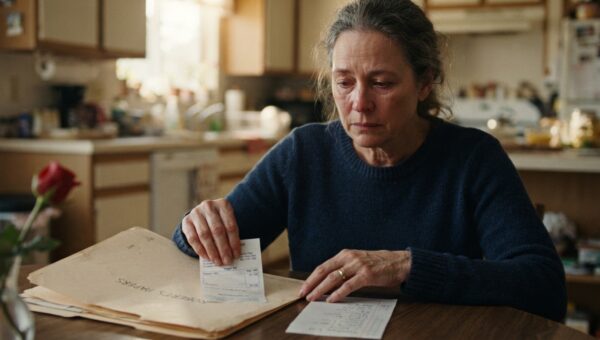
The linoleum in Mom’s mobile home had a long, ragged tear right by the refrigerator where the vinyl had given up years ago, and every time I stepped on it, the floor gave a soft, sickening crunch. I had driven down from up north hoping for a quiet Christmas visit, but the moment I walked through the door into that heavy, stale heat, I knew something was fundamentally wrong.
Mom was sitting in her usual vinyl armchair with a faded floral quilt draped over her knees, looking smaller than she had back in the summer. Her skin had that thin, yellowish cast that comes from not eating real food, and when she tried to stand up to hug me, her knees clicked like dry twigs.
I set my duffel bag down by the narrow hallway and went straight to the small kitchen to put on the kettle. I opened the refrigerator door to grab milk for tea, and the smell hit me first. A sour, heavy wave of spoiled dairy. I pulled out a carton that had expired nearly three weeks ago, shoved right behind an open can of syrupy peaches and nothing else. There were no eggs, no bread, no fresh vegetables, just empty shelves and a jar of generic peanut butter with a knife left sitting in it.
I turned around and looked at Mom, who was watching me with those wide, foggy eyes. She had lost at least eighteen pounds since I had seen her last, and her collarbones pushed against her thin blouse like two dry branches.
“I just haven’t been all that hungry lately, honey,” Mom whispered, her voice rattling in her chest. “Your sister brings me things when she has the time.”
The thing is, I had been sending two hundred dollars of my own hard-earned money every single month specifically for groceries, on top of what Mom’s pension was supposed to cover. My sister, Brenda, was the one designated as Mom’s financial administrator after Dad passed away six years ago. Brenda had promised me, hand on a Bible, that she would handle the twenty-one hundred dollars a month coming in from Dad’s retired union benefits so Mom could live out her days in comfort.
Brenda lived just two hours south in Lake Worth in a nice suburban development with a manicured lawn and a double garage. Every time I called, Brenda told me Mom was fine, just slowing down like old folks do, and that everything was being handled by the book.
“Where is the food, Mom?” I asked, keeping my voice as gentle as I could manage. “What happened to the groceries I sent money for?”
“Brenda says prices are just too high right now,” Mom mumbled, looking down at her frayed slippers. “She says we have to watch every penny.”
That single sentence sat in the small, grease-stained kitchen like a heavy iron weight. I stayed calm for Mom’s sake, boiling water for a cup of instant soup and making her eat a few crackers, but my mind was spinning in circles. Three outfits hanging in her tiny closet. A refrigerator holding only expired milk and canned peaches.
An eighty-four-year-old woman wasting away in a tin box while my sister lived in luxury two hours away. I didn’t sleep a wink that night on the lumpy pull-out couch in the tiny living room, listening to the old wall heater clank and wheeze every time it kicked on.
The next morning, before the sun had fully cleared the horizon, I kissed Mom on her thin cheek, got into my sedan, and drove straight to the local bank branch in town. The teller behind the counter was a tired-looking woman with graying hair pinned up in a clip, and she gave me a polite, professional smile when I stepped up to the window with Mom’s paperwork and my identification. I explained that I was the younger daughter and needed to check on my mother’s monthly deposit status because things looked off at home. The teller took the papers, scanned them into her terminal, and her expression shifted from polite boredom to something guarded and cold.
“Your mother’s pension doesn’t stay in this account,” the teller said quietly, not looking up from her screen. “It goes directly into a linked secondary routing number every single month.”
“Linked to where?” I asked, my palms instantly going cold against the counter.
“To an account in Lake Worth,” she replied, tapping her fingernail against the plastic desk divider. “Under the name of Brenda Vance.”
The math hit me right there in the fluorescent-lit bank lobby like a physical blow. Twenty-one hundred dollars a month, multiplied by twelve months, multiplied by six long years. One hundred and fifty-one thousand, two hundred dollars total. Mom had been getting a meager three hundred dollars a month in cash or cheap gift cards while Brenda systematically vacuumed up the rest to feed her own lifestyle. I walked out of those automatic sliding glass doors, got into my car, and sat in the parking lot with my hands shaking so hard I could barely grip the steering wheel. I dialed Brenda’s cell phone on the third ring, my chest burning with a white-hot fury that had been building all night.
“Well, look who’s calling on Christmas week,” Brenda answered, her voice bright and breezy with that practiced cheer she used whenever she wanted to sound like a pillar of the community. “Is Mom acting up again?”
“I am standing in the bank in town right now, Brenda,” I said, my voice dropping into a flat, deadly whisper. “The teller just showed me where the pension goes. Every single cent of it.”
There was a short pause on the line, just the sound of distant traffic on her end before she let out a light, dismissive sigh. “Oh, is that all? Look, you don’t understand how expensive things are down here. Mom doesn’t need that money anyway. She barely goes anywhere.”
“She barely eats!” I shouted, the restraint finally snapping in my throat as a couple walking by turned to stare at my car. “She has expired milk and a half-empty can of peaches in her fridge, and you bought a three-hundred-and-forty-thousand-dollar house in Lake Worth off her back!”
“Mom doesn’t even know what month it is,” Brenda snapped back, her friendly tone evaporating instantly into pure, venomous ice. “I earned every dime of that handling her care while you were living three states away playing good daughter once a year. Do whatever you want, but you can’t prove a damn thing.”
She hung up the phone with a sharp click. I sat there in the quiet car for a long time, watching the rain start to streak across the windshield, knowing exactly what I had to do next. I didn’t go back to the mobile home to argue; instead, I drove straight to the county office of Adult Protective Services and parked right by the front doors.
The investigator assigned to our case was a sharp-eyed woman named Clara who had silver hair cut into a clean bob and a desk covered in stacks of manila folders. Clara listened to my story without interrupting once, taking steady notes in black ink on a yellow legal pad while I laid out the dates, the bank name, and the terrifying reality of Mom’s living conditions. Three days later, Clara called me back with a stack of subpoenaed bank records that made my stomach turn over. It wasn’t just skimming or unauthorized transfers; it was a complete, calculated hostile takeover of an elderly woman’s life.
“We pulled the original administrative setup from six years ago,” Clara said, sliding a thick packet of certified copies across her desk. “Right at the bottom of the intake file is the Power of Attorney document giving your sister full control.”
I looked down at the signature line on the official state form, expecting to see Mom’s shaky, looping cursive from back when her hands were still steady. Instead, I saw a jagged, rushed imitation of Mom’s name, scrawled by someone who had clearly practiced it a few times in a mirror. Below it was a notary stamp belonging to an office supply store clerk who lived three doors down from Brenda in Lake Worth.
“It’s a forgery,” I whispered, tracing the fake letters with the tip of my finger. “My signature isn’t on it either, even though I was supposed to be co-signer.”
“It’s felony financial exploitation and elder abuse,” Clara said, her voice completely steady as she closed the folder. “And because it involves interstate wire transfers and forged state documents, it’s well past the point where your sister can talk her way out of it.”
The intervention happened on a Tuesday morning when the weather was gray and miserable. Clara and two local deputies went out to Mom’s mobile home while I stayed behind to pack a small bag of her actual clothing, the three worn dresses she lived in, before taking her to a clean, quiet temporary care facility three towns over where she could get proper meals and medical checkups. Mom was confused and scared at first, her small hands clutching my sleeve as the deputies helped her out the door, but when I promised her she would never have to look at another can of peaches again, she let out a long, shuddering breath and leaned against my shoulder.
Meanwhile, official legal notices and frozen asset warrants were being hand-delivered directly to Brenda’s doorstep in Lake Worth. Brenda tried calling my phone three times that afternoon, her voice swinging between hysterical crying and furious threats about ruining our family name, but I didn’t answer a single one of her calls. I blocked her number, deleted her from my life, and handed every single bank statement and text message over to the district attorney’s office.
Mom sits comfortably now in a sunny, warm room at the new facility, her cheeks filling out with healthy color and her eyes bright with life again, eating fresh meals every single day without having to count pennies she never even knew were being stolen. The state is currently moving forward with full asset seizure proceedings against Brenda’s Lake Worth property to recover every single dollar of restitution owed back to Mom’s true account. Last Tuesday, the mail carrier dropped off the final packet of official bank closure notices from the old fraudulent routing number, and I took them straight to the kitchen table. I watched the golden afternoon sunlight hit the wood surface as I tore the papers across the middle, letting the gray fragments drop quietly into the bin below.