I always thought I was the one protecting myself when I walked away in 2022. I believed that setting a hard boundary meant locking the door, turning the deadbolt, and throwing away the key. For three years, I went to work at my desk, balanced corporate ledgers, and earned my steady fifty-four thousand dollars a year without ever looking back over my shoulder.
I told myself that peace of mind had a price, and silence was simply the cost of doing business with a stubborn old man who refused to respect my independence.
My father was a retired machinist named Arthur Ellis. He spent forty years turning steel on a lathe, which meant he viewed human problems with the exact same blunt geometry. If something was bent, you hammered it straight. If a joint failed, you tore it apart and welded it over. When my marriage fell apart after five difficult years, I didn’t want his heavy-handed repairs or his lectures on financial prudence. I wanted to bleed in private. I wanted to rebuild my life as an accountant without hearing him talk about rainy day funds or the folly of trusting men who didn’t know a torque wrench from a hammer.
One afternoon in late autumn, after a particularly sharp argument over the phone where he told me I was managing my divorce like an amateur balancing a checkbook, I hung up.
I didn’t answer his next call. Or the one after that. When he showed up at my apartment building two days later, I stayed on the other side of the heavy oak door and told him through the peephole to go home. He stood there in the hallway for nearly ten minutes before I heard his heavy boots shuffle away down the linoleum stairs.
We didn’t speak again. Not on my birthday, not through the holidays, not when I got my promotion to senior ledger clerk. I built a neat, orderly wall around my life, convinced that distance was the only cure for a father who loved me too loudly and listened too little.
The service for him at Grace Lutheran Church was small, gray, and mercifully brief. The pastor said a few quiet words about endurance, and then we walked out into the damp parking lot where the November wind was biting at our collars.
I was holding the folded paper bulletin in my hand, staring down at my black leather heels against the gravel, when someone cleared their throat behind me.
It was Ray. Ray worked the day shift at the office park where I spent forty hours a week staring at spreadsheets. He wore his high-visibility yellow vest even on weekends, and I always nodded to him when I swiped my keycard at eight in the morning.
He touched the brim of his cap and looked down at his boots before meeting my eyes. “Mrs. Ellis, I need to tell you something about your father.”
I blinked against the cold wind, clutching my purse strap tighter. “Ray. What is it? Did something happen at the lot?”
He shook his gray head slowly. “Not lately. But your dad… he was a fixture there. For three years. Since 2022. When you stopped talking to him.”
My fingers tightened around the church bulletin until the paper tore. “What are you talking about?”
“He parked in the visitor lot every single day at noon,” Ray said, his voice dropping into that quiet, careful register people use when they are delivering bad news in hospital corridors. “Same spot. Third row. Blue Buick LeSabre. He’d pull in right around eleven-fifty-five, cut the engine, and just sit there with the window rolled down an inch. He ate a turkey sandwich on white bread every day. Watched the front glass doors.”
I stared at him, my brain refusing to assemble the pieces. “For how long?”
“Three years,” Ray repeated gently. “I asked him once why he came all the way across town just to sit in a corporate park parking lot. He looked right at me and said, ‘I just need to see her walk through that earning door. That’s how I know she’s okay.'”
The world didn’t shatter or spin. It just stopped dead. My knees felt hollow, like dry reeds, and the gravel beneath my shoes seemed to tilt sideways.
Ray reached out as if to steady me, then pulled his hand back, respecting the distance. “There’s something else, Mrs. Ellis. Every single day, he had a second sandwich on the passenger seat. Wrapped in foil. He never touched it. I asked him about that too, once. He just smiled, kind of sad, and said, ‘Maybe today she forgets her lunch and needs an old man’s help.’ He waited out there through the winter snowstorms, through the July heat waves, right up until two weeks ago when he ended up in the hospital.”
I couldn’t breathe. The wind whistled through the bare elm trees by the church fence, but all I could hear was the hum of an idling engine in a third-row parking space three miles away.
I didn’t go to the post-funeral luncheon at the church basement. I didn’t call my aunt or answer my phone when it buzzed in my coat pocket. I drove straight to my father’s house on Maple Street, my knuckles white against the steering wheel of my sedan.
The house was exactly as he had left it. The mail was piled neatly on the small pine table by the front door, held down by a brass paperweight. The air inside smelled faintly of sawdust, instant coffee, and old wool. It was terribly, painfully quiet.
I walked straight through the living room and into the small galley kitchen. The laminate countertops were spotless, except for one corner where a plastic cutting board still lay beside an open loaf of sandwich bread and a jar of yellow mustard. A roll of heavy-duty aluminum foil sat right next to them.
My throat tightened until it burned. I walked over and touched the edge of the cutting board. It was clean, wiped down with a damp cloth, as if he had finished his morning routine before driving to the hospital for the very last time. He hadn’t stopped preparing for me, even when I had stopped showing up for him.
I walked out through the back door into the detached garage. The overhead bulb was dim, casting long shadows across his workbench where his old lathe sat covered in a green canvas tarp. And parked right beside the workbench was the blue Buick.
The dust on the hood was thick enough to write on. I found the spare key hanging on a rusted nail by the side door, my hand shaking so badly it took three tries to slide it into the padlock. The shackle snapped open with a sharp, echoing metallic crack.
I pulled the driver’s door open. The interior smelled of old peppermint and cedar air freshener that had long since lost its scent. I leaned across the center console and looked over at the passenger seat.
There it was. A small square package wrapped tightly in crinkled aluminum foil, sitting right in the middle of the vinyl bench seat. It had been there for weeks, untouched, gathering a fine layer of gray dust from the garage air.
My breath caught in my chest. I reached out and picked it up. It felt light, ridiculous, and unbearably heavy all at the same time.
I didn’t open it. I couldn’t. Instead, I slid into the driver’s seat, pulled the key from my pocket, and turned it in the ignition. The dashboard lights flickered to life, amber and dim, glowing against the dark interior. The digital clock blinked twelve-and-zero, flashing silently because the battery had been disconnected.
In the glove box, tucked beneath a stack of owner’s manuals and grease-stained maintenance receipts, was a small, spiral-bound pocket notebook. The cover was worn soft at the corners where his thumb had held it.
I opened it. The first few pages were filled with grocery lists and part numbers for his lathe. But further down, dated in his neat, stiff machinist’s handwriting, were short daily entries.
October 14. Clear day. Saw her in the blue jacket. Looked tired. Walked fast.
November 3. Rain. Car wouldn’t turn over at first, but made it by noon. She stopped to talk to the tall fellow from shipping. Looked like she was laughing. That’s good.
January 12. Snow piled high. Watched the doors for an hour. She didn’t come out until twelve-fifteen. Was worried. She’s working too late.
I sat there in the dark garage with the steering wheel pressing against my ribs, reading page after page of silent, anonymous devotion. He hadn’t written a single word of blame. Not once did he complain about my silence, my coldness, or the door I had shut in his face. He had simply recorded the weather, the color of my coats, and the simple fact that I was still walking through those doors.
The anger that had kept me warm for three years dissolved into something cold and sharp. I had spent all that time guarding my independence, believing I was the victim of his stubbornness, while he had spent every noon hour sitting in a third-row parking stall just to make sure the world hadn’t broken me completely.
He didn’t want to fix me. He just wanted to know I was okay.
I turned off the ignition, took the notebook and the foil-wrapped package from the seat, and got out of the car. I locked the garage door behind me, feeling the heavy iron latch click firmly into place.
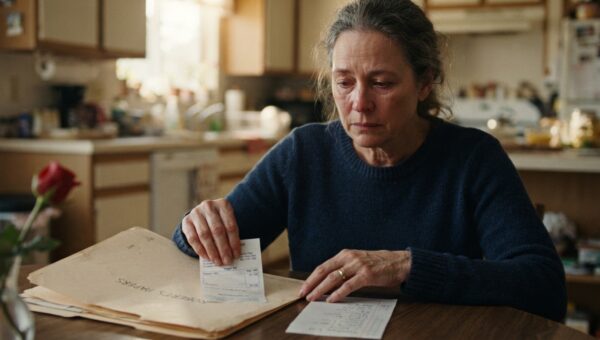
Back in my own kitchen later that evening, the house was just as quiet as my father’s had been. I set my keys on the counter, took off my coat, and sat down at the laminate table.
I picked up the small square of aluminum foil from my father’s car. Slowly, carefully, I peeled back the shiny edges. Inside was a slice of white bread, hardened at the crusts from weeks of sitting in the dark, folded over a thin, dry layer of ham that had long since lost its color. It wasn’t edible. It was just a relic. A daily ritual performed by a man who didn’t know how to say I’m sorry out loud, so he said it with bread and foil instead.
I took the sheet of foil, smoothed it out flat against the wood with the palm of my hand, and folded it neatly into a square. Then I opened the kitchen drawer and placed it right at the back, beneath the spare napkins and the takeout menus, where it would stay.