The ticking of the kitchen clock sounded louder than it had any right to, marking off seconds that suddenly felt heavier than lead. The doctor gave me two choices in that sterile white box of an office on Tuesday morning. Eighteen months with the experimental treatment if my body cooperated, or six without it. The cost was $184,000 out of pocket, and my insurance company hid behind a neat little stamp that called it unproven, meaning they wouldn’t pay a single red cent.
I sat there with my coat buttoned all the way up because the air conditioning was too high, thinking about seventy-eight years of pinching pennies, of washing aluminum foil, of never buying a new car until the old one simply stopped moving. I had exactly $190,000 sitting in the bank, every single cent of it earmarked for Leo and Maya’s college tuition since the day they were born.
My son Judd had squeezed my hand so hard his knuckles turned white while the doctor was still talking about protocols and trial phases. “Mama, you fight,” he had told me, his voice cracking just enough to let me hear the panic underneath. “We’ll find another way for the kids.” Judd always believed there was a loophole in every problem, some clever financial shuffle that would make the math work out if we just wished hard enough. He meant it with every ounce of his warm, impulsive heart.
But my daughter Lucinda sat on the opposite side of the small plastic table, her arms crossed tight over her chest, staring down at the scuffed linoleum floor. She wouldn’t look up when she spoke, her voice flat and hard. “She always said those babies come first.”
They were both right, and that was the truly awful part. Judd was right that a mother should want to stay, should want to grasp at any straw that promised another spring, another Christmas watching Maya unwrap clumsy packages. Lucinda was right that I had spent fifteen years drilling it into their heads that education was the only ladder out of the dirt, that a promise made to a newborn grandchild was a sacred debt that outlived the person who made it. I spent three sleepless nights pacing the narrow hallway of my small house, staring out the front window at the empty streetlights, listening to the old floorboards groan beneath my slippers.
I drank lukewarm chamomile tea that tasted like dry grass and watched the digital numbers on the microwave glow through the dark house, clicking from 2:14 to 2:15, then 2:16, hour after long hour.
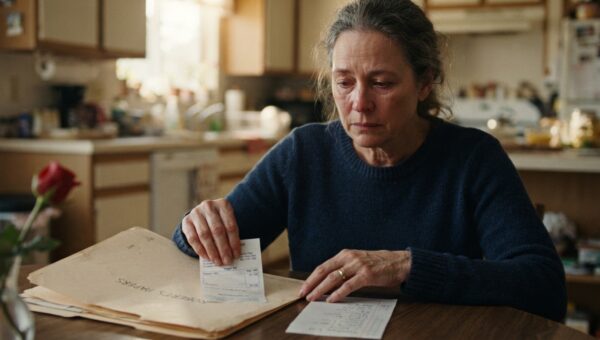
I didn’t tell anyone what I was doing during those nights. I pulled out the green ledger books from the bottom drawer of the mahogany desk, the ones where I had tracked every grocery bill and heating oil delivery since my husband Arthur passed away back in ninety-four. I added up figures that didn’t care about my breath or my heartbeat. If I paid the clinic, the bills would swallow the college fund down to the bone, leaving behind a few thousand dollars and a mountain of medical bureaucracy that Judd would have to untangle while working his second job at the warehouse. And for what? Eighteen months of nausea, of fluorescent lights humming above hospital beds, of becoming a project instead of a person.
I kept picturing the way Leo looked last Thanksgiving when he talked about his engineering classes, his eyes bright with a future I had promised to anchor.
The house always got too quiet around four in the morning, right before the first delivery truck rumbled down the highway past the edge of town. I sat at that kitchen table with my reading glasses slipping down my nose, turning the pages back and forth until the numbers blurred into gray smears. I thought about my mother and how she went out in that cold back room thirty years ago, fading away without a fuss, leaving things neat for the ones coming behind her. There was a strange kind of peace in knowing that dignity wasn’t something you bought from a pharmaceutical company. It was something you decided on yourself when the corners started closing in.
By Friday morning, my mind was as clear as winter glass. I walked over to the wall phone by the pantry, lifted the heavy receiver, and dialed the clinic number with fingers that didn’t shake at all. A young woman with a bright, professional voice answered on the second ring, asking me what I had decided about the trial protocol and the financial clearance forms. I didn’t hesitate. I told her I was declining the treatment and thanked her for her time, and when she started to ask if I wanted to speak to the patient advocate, I simply hung up the receiver and set it back on the cradle. The silence that filled the kitchen after that click felt clean, unburdened by any more arithmetic.
Later that afternoon, I called Judd and Lucinda and told them to come over for supper, mentioning nothing about the phone call, though I knew the news would have to come out before the sun set twice. They arrived separately within ten minutes of each other, bringing that familiar, prickly energy they always carried whenever they were in the same room too long. Judd brought a bag of groceries he didn’t need to buy, and Lucinda brought a casserole dish wrapped in a dish towel, both of them acting like nothing heavier than weather was hanging over our heads. I had set three places at the round oak table, the same table where they used to do their spelling homework with chewed-up wooden pencils while I stood at the stove stirring gravy.
We ate in relative quiet, passing the butter and the green beans around like we were rehearsing for a normal Sunday. But the tension in the air was thick enough to slice with a bread knife, settling into the small spaces between us. When I finally cleared the plates away and set down a pot of black coffee, I didn’t sit back down right away. I stood by the sink, looking out at the backyard where the tomato stakes were leaning sideways in the autumn dirt. I knew I had to lay it out plain before my knees gave out or my courage thinned.
Judd took a sip of his coffee and looked at me, his eyes searching my face for some sign of weakness or wavering. “So, Mama, did you talk to the financial coordinator at the clinic today?” he asked, leaning forward with his elbows on the table, trying to sound encouraging. “Lucinda and I were talking on the phone last night, and we figured out we might be able to take out a second loan on the truck or something to help cover the deposit.” Lucinda didn’t look at either of us, her gaze fixed hard on the rim of her coffee mug as if she were reading tea leaves in the dark dregs.
I turned around and placed the manila folder right in the center of the table, right between their coffee cups. It didn’t make a sound when it landed, just a soft whisper of paper against oak. “I called them this morning,” I said, my voice steady, sounding clearer to my own ears than it had in months. “I told them no. I’m not doing the treatment, Judd.” The words hung in the air, small and final, refusing to bounce back or soften against the walls.
Judd stared at the folder, his mouth open slightly like he had missed a step on the stairs. “No? What do you mean, no? Mama, we talked about this, we said we’d find a way for the kids later, but you have to fight this thing.” He stood up so fast his chair scraped loudly against the linoleum, his face flushing dark with a mixture of fear and sudden anger. “You’re just giving up? You’re just sitting here letting it win?” He walked over to the counter, running a hand through his thinning hair, looking like a little boy who had just been told his favorite dog wasn’t coming back from the vet.
Lucinda finally raised her head, and her eyes were bright with unshed tears that she refused to let fall. She reached across the table and touched the corner of the manila folder with one finger, her touch as light as a moth landing on a screen door. “She didn’t give up, Judd,” she said, her voice shaking just enough to give away the storm she was holding inside. “She did the math. She’s been doing it since Tuesday.” She looked up at me, her gaze piercing right through my defenses. “You’re saving the college money, aren’t you?”
“Every last dollar of it,” I said softly, walking over to pull out my chair and sit down between them. “I’m seventy-eight years old, Judd. I’ve had a good run, a better run than my mother had, and certainly a better run than a lot of folks get. If I spend $184,000 of Leo and Maya’s future on eighteen months of throwing up in a hospital bathroom and lying in a white bed watching the ceiling tiles count down, what kind of mother and grandmother am I leaving behind? A broke one who couldn’t keep her word.”
Judd turned around, his chest heaving as he tried to find words that wouldn’t break in his throat. “We don’t care about the money, Mama. We care about you. We want you here.” He came around the table and dropped down onto his knees beside my chair, burying his face in my lap the way he used to do when he scraped his knee on the gravel driveway forty years ago. His shoulders shook with great, dry sobs that tore at something deep inside my ribs. I laid my hand on his head, feeling the coarse gray in his hair, and let him cry out the terror of losing the roof over his world.
Lucinda got up from her chair, walked over, and placed her hand over mine where it rested on Judd’s shoulder. She didn’t cry, but her lower lip was pressed into a hard, white line. “You’re stubborn to the very end, aren’t you, Ma?” she whispered, though there was no bite in it anymore, only a heavy, aching kind of respect that took years to grow. “Always keeping the books balanced down to the last penny.”
“Somebody has to,” I answered, managing a small, dry smile. “Otherwise the world gets too messy to live in.”
The next few weeks weren’t dramatic like the movies make it out to be. There were no sudden miracles or cinematic epiphanies, just the steady, grounding rhythm of ordinary days returning to their proper order. Judd came by every evening after work, not to argue or lecture, but to help me stack wood on the back porch or sit in silence while the six-o’clock news muttered from the corner. He and Lucinda had an awkward, quiet conversation out by the driveway on a Thursday evening, smoking cigarettes together like they used to do when they were teenagers hiding behind the garage, and when they came back inside, the old friction between them had somehow softened into something durable and shared. They were finally pulling on the same end of the rope.
On a crisp Tuesday morning exactly two weeks after my call to the clinic, the lawyer’s office downtown sent over the final transfer paperwork for the educational trusts. I sat at the kitchen table with a heavy black fountain pen Arthur had left behind in his shaving kit, signing my name across three different legal pages that secured Leo and Maya’s tuition down to the penny. No hospital liens could touch it. No experimental treatment bills could swallow it whole. It was locked down tight, waiting for the day they walked onto their respective campus quads to build something of their own.
When the kids came over that weekend, I didn’t give them a grand speech. I just handed each of them a thick brown envelope with their names written in my slightly shaky cursive, explaining simply that their grandfather’s ledger was closed and their futures were paid for. Maya cried and hugged me so tight I thought my ribs might crack, while Leo stood there looking down at the papers with a stunned, reverent expression, promising me he would keep his grades up every single semester. They stayed for dinner, and we laughed about old family stories, and for a few hours, the impending shadow at the edge of the room simply stepped back and waited.
Now, as the months have worn down and my strength has begun to quietly ebb away like water sinking into dry sand, I find myself sitting out here on the front porch where the air smells of cured hay and approaching frost. The afternoon sun is dipping low behind the neighbor’s cedar fence, casting long, golden shadows across the boards of the porch floor. My breath comes a little shallower than it did in August, but my head is clear, unclouded by heavy narcotics or hospital fog. My granddaughter’s college acceptance letter rests safely on the wooden table beside my tea mug, glowing white in the fading light. The math finally balances out, and the ledger is closed, leaving nothing behind but peace and the quiet hum of the world keeping time without me.