The telephone on the kitchen wall started ringing right at noon, cutting through the quiet hum of the refrigerator while I was wiping down the laminate counter. I didn’t think much of it because Tuesdays are always slow around the house, just me and the ticking clock and the faint smell of bleach from the morning chores. When I picked up the receiver, a crisp, professional voice didn’t even wait to say hello before rattling off a warning.
“The school nurse called my house,” is what I should have told her, but instead she was the one talking.
“Is this Mr. Calhoun?” the woman on the other end asked, sounding rushed and slightly annoyed.
“No, this is his wife,” I said, pausing with the dish towel still folded in my hand.
“Well, Spencer fell off the monkey bars and scraped his knee pretty bad,” she said, her words tumbling together. “His father is the contact listed for emergencies, but nobody’s picking up his cell.”
I stood there in the middle of the kitchen for a solid three seconds, listening to the tiny static hum on the line. We don’t have a son. We don’t have a Spencer. I told her straight out that she had dialed the wrong number and that there must be some mistake with the office records.
“Are you at thirty-four elm street?” she asked, her voice dropping a notch as she flipped a page on her desk.
She read the address back to me, and every single syllable was my own house, right down to the crooked porch step Arthur had never quite fixed.
“Yes,” I whispered, the word barely making it past my teeth.
“Well, that’s the number on file,” she snapped before hanging up without another word.
I didn’t scream or drop the phone. I just walked over to the wooden staircase and sat right down on the bottom stair, staring at the scuff marks on the baseboard.
My husband Arthur drives a delivery route for a regional supply company, and every Tuesday and Thursday he leaves the house before dawn, just like he has for nineteen years now. Sixteen hundred dollars a month is what he always claimed went straight to commercial gas, tolls, and long-haul maintenance on the van. I sat on that step until my knees went cold, trying to force my brain to connect things that didn’t fit together.
By one in the afternoon, I grabbed my keys, locked the front door without even checking the back burners, and drove three towns over to the elementary school the nurse had mentioned. The parking lot was full of compact cars and minivan stragglers, and my little sedan looked entirely out of place sitting near the curb. I walked through the double glass doors under a sign that said visitors must report to the office, ignoring the secretary entirely as I slipped down the hallway toward the nurse’s station.
Through the narrow wired glass of the office window, I saw a little boy sitting on a green vinyl cot holding a blue ice pack to his knee. He had light brown hair that flopped over his forehead in a distinct, stubborn wave that I had kissed a thousand times on a different man’s head. It was Arthur’s cowlick, plain as day, sitting on top of a seven-year-old stranger.
“Can I help you find someone?” a woman behind the counter asked, eyeing my coat.
“I’m just looking,” I said, my voice sounding hollow even to me.
A woman with short dark hair and a canvas tote bag hurried into the office, signing a pink clipboard with a plastic ballpoint pen. She knelt down beside the boy on the cot, rubbing his back and calling him sweetie in a soft, practiced tone that made my stomach turn over. They walked out together hand in hand, heading toward a silver sedan parked by the playground.
The school open house was scheduled for Thursday evening, giving me exactly three days to figure out whether I was losing my mind or losing my entire life.
The drive home took twice as long because my hands kept shaking on the steering wheel every time I had to brake for a light. When I walked back into the kitchen, the silence of the house felt heavy and suffocating, completely different from the peaceful quiet I had enjoyed just hours before. I went straight to the bottom drawer of the oak desk in the den where we keep the household files, pulling out the blue cardboard box filled with old bank statements, tax returns, and spiral notebooks.
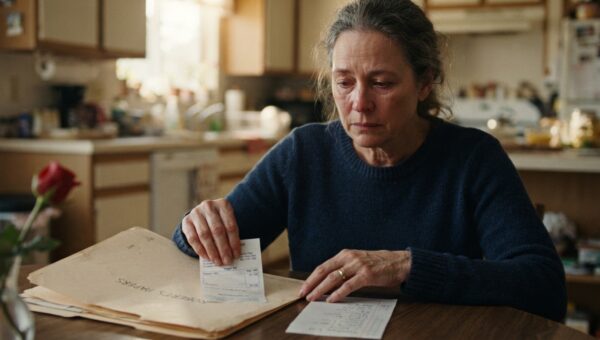
Arthur was always the meticulous one with the ledgers, writing down every single cent of household overhead in his neat, block-letter handwriting. I flipped back through the pages to the entries from seven years ago, tracing my finger down the columns of numbers until I found what I was looking for. Right there, month after month, year after year, were entries marked for regional tolls and supply surcharges totaling sixteen hundred dollars flat.
“It’s just the cost of doing business,” Arthur had told me over coffee back when the van first started needing extra maintenance.
I took out a calculator from the drawer and punched in the numbers, watching the little green screen blink back the total over nineteen years of marriage. Sixteen hundred dollars a month for a second household, masked as highway expenses while he drove off into a morning sky I never questioned. I didn’t cry because I had run out of tears before I even left the school parking lot, leaving only a cold, methodical anger that settled deep in my chest.
Tuesday night rolled in slowly, and when Arthur came home around six o’clock, he smelled faintly of gasoline and stale coffee, just like he always did after a long shift on the road. He took off his muddy work boots by the back door, placed his lunchbox on the counter, and gave me his usual half-smile before washing his hands at the sink.
“Long day on the northern loop,” he said, drying his palms on the kitchen towel without looking me in the eye.
“Traffic bad?” I asked, keeping my voice remarkably steady as I stirred a pot of soup on the stove.
“Terrible down by the river bridge,” he muttered, pulling out a chair at the table. “They’re doing roadwork again.”
I watched the back of his neck as he sat down, noticing for the first time the slight graying at the edges of his hair where it curled just above his collar. He had played this part for nearly two decades, coming home to a hot dinner and a clean house after spending his alternate days playing father in a different town three zip codes away. I didn’t say a word about the school nurse or the boy on the cot because I wanted all my pieces in place before the board dropped.
Wednesday was spent driving out to the modest suburban development near the elementary school during the late morning hours when the streets were quiet and empty. I parked my car three houses down from a split-level home with a blue child’s bicycle leaning against the porch railing and a small basketball hoop planted in the driveway. The mailbox by the curb had two names painted on the side in neat black lettering, and neither one of them was mine.
Arthur’s delivery van was parked right in the driveway behind a compact station wagon, looking as natural and permanent there as it did in our own driveway at home. I sat in my car with the windows rolled up halfway, watching a woman carry a basket of laundry out to the side yard while a small boy kicked a red ball against the garage door. That was the moment the disorientation finally burned away, leaving behind a sharp, protective clarity that felt less like grief and more like survival.
By Thursday evening, the parking lot of the elementary school was packed bumper-to-bumper with cars, forcing parents to park along the grassy shoulders of the road. I walked through the front doors under bright fluorescent lights that hummed against the painted cinderblock walls, surrounded by chatter, laughter, and the unmistakable smell of floor wax and construction paper. The hallways were lined with finger-painted art projects and clumsy handwriting exercises pinned to colored construction paper boards.
I found the fourth-grade classroom listed on the open house flyer near the end of the north wing, where a chalkboard banner welcomed families to a night of sharing. Inside the crowded room, parents were leaning over tiny wooden desks to examine math worksheets and dioramas made from shoeboxes and pipe cleaners.
Arthur was standing near the back corner of the classroom, talking to a teacher while leaning casually against a bookshelf filled with worn paperback books. Standing right beside him, holding a small stack of papers and smiling proudly, was the same dark-haired woman I had seen sign the boy out of the office three days before.
I walked straight down the center aisle between the rows of miniature chairs, my footsteps clicking softly against the linoleum floor until the noise around me seemed to fade into a dull hum. Arthur looked up just as I reached his row, his casual smile freezing halfway across his face as his eyes locked onto mine.
“What are you doing here?” Arthur asked, his voice dropping into a tight, strained whisper as he stepped away from the teacher.
“You missed the phone call from the nurse on Monday,” I said, loud enough that the woman beside him turned her head with a questioning look. “Spencer fell off the monkey bars.”
The woman blinked, her smile faltering as she looked between Arthur’s pale face and my expression. “Who are you?” she asked, her voice trembling slightly.
“I’m his wife,” I said, looking right into her eyes. “Nineteen years this coming November.”
Arthur stepped forward, holding out a hand like he was trying to calm a stray animal in the road. “Wait. Let’s go outside and talk about this,” he stammered, his composure completely dissolving into a stuttering mess of panic.
The woman dropped her stack of papers onto the nearest desk, the pages scattering across the wood like dry leaves. “Arthur, what is she talking about?” she demanded, her voice rising sharply enough to draw the attention of two nearby parents. “Who is she?”
Arthur looked like a man standing on a trapdoor with the lever already pulled, his mouth opening and closing without any sound coming out.
“Tell her about the sixteen hundred dollars a month for gas and tolls,” I said, my voice remaining completely calm and level while the room around us went dead silent. “Tell her about the delivery route that never quite ended on Tuesday afternoons.”
The woman stared at him, her face hardening as the terrifying truth of nineteen years of fabricated corporate trips settled over her all at once. She didn’t scream or cry, but she stepped back as if physical distance could protect her from the wreckage.
“Get out,” she whispered, pointing a finger toward the classroom door. “Get out of my sight right now.”
Arthur looked at her, then back at me, realizing with absolute finality that both of his carefully partitioned worlds had just collapsed into a single pile of ash. He tried to say something, some weak excuse about explaining everything later, but the words died in his throat under the weight of the silence.
I didn’t wait for him to pack or make a scene in front of the neighbors, turning my back on him right there beside the miniature desks and walking out into the cool evening air.
When I got home, the house was dark and empty, holding the exact same quiet it had possessed before the phone call ever interrupted my afternoon. I walked into the kitchen, reached into my coat pocket, and pulled out Arthur’s spare house keys that he must have left in his work jacket. I dropped them into a small ceramic bowl sitting right by the front door where we always tossed our loose change.
I turned off the porch light, pushed the deadbolt home with a solid, definitive click that echoed down the hallway, and walked over to the wooden staircase. I sat down right on the bottom stair, looking out across the clean, empty floor of my own living room, knowing precisely who owned every single room in the house.