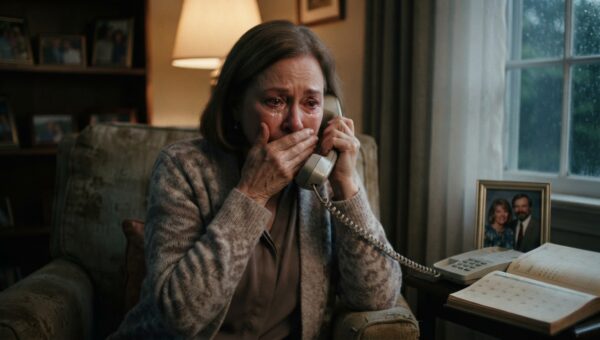
The asphalt of the Marriott parking lot had that gray, baked-in look that never quite washes clean no matter how many times it rains. I sat there in my station wagon with the engine idling, watching the automated glass lobby doors slide open and shut every time a businessman in a blue suit walked out with a rolling bag. My hands were still resting on the steering wheel, and honestly, they wouldn’t stop shaking.
It was a Tuesday afternoon, right around two o’clock. Arthur was supposed to be in Cincinnati for a regional supply meeting, just like he had been every Tuesday for the last five years. Same hotel. Same chain. Same three nights a week away from our kitchen table in Charleston.
I wouldn’t even have called if I hadn’t wanted to surprise him with those tickets to the shore for our anniversary. I thought I was just being a good wife, ringing the front desk to make sure they put us in a corner booth or a nice quiet room. Instead, the girl behind the counter had clicked her keyboard a few times, let out a little puff of air, and asked me a question that stopped my breathing dead in my tracks.
“Which reservation?” she asked, sounding entirely bored. “He has two rooms.”
That was the crack in the glass. Just like that. Two rooms.
Not one room where he slept off the exhaustion of corporate logistics and regional inventory audits. Two rooms booked under the exact same name, week after week, month after month, year after agonizing year. I didn’t scream at the phone. I didn’t cry. I just hung up, grabbed my purse, got into the car, and drove forty-five minutes down the interstate without turning the radio on once.
When I pulled into the lot, I didn’t go inside right away. I just sat there. I watched the revolving doors. I watched the taxis pull up and drop off businessmen who looked just like Arthur from behind, carrying the same heavy black briefcases and wearing the same tired expressions. I waited two full hours for my brain to catch up with my chest.
That was when the side service door propped open with a rubber wedge, and a woman in a gray housekeeping tunic stepped out into the humid afternoon air to take a breath.
She had graying hair pulled back in a messy clip and a lanyard full of plastic hotel keys around her neck. Her name tag said Elena. I didn’t plan it, but before I could talk myself out of it, I shoved my door open, crossed the hot pavement, and asked her straight out.
She looked at me like I was selling something before she saw the look on my face. Then her eyes softened, just a little bit, the way older women look at someone who just dropped a plate they can’t afford to replace.
“Room 314,” she told me, keeping her voice low while she looked around the parking lot. “Every single week. A woman checks in twenty minutes after him. Five years of it. And you want to know the funny part? She tips me a hundred dollars every time to make sure those sheets get swapped out and bagged immediately.”
$26,000 in tips over five years. Just for linen service. My stomach turned completely over, and I felt that cold, heavy drop you get right before you throw up. I thought about all those nights Arthur called me from the room, telling me he was eating a turkey club at his desk, staring at spreadsheets while the city lights flickered outside. I thought about the way he kissed the top of my head on Friday afternoons when he came home smelling faintly of starch and hotel soap.
“She leaves things behind sometimes,” Elena muttered, shaking her head as she fished her phone out of her pocket. “Not jewelry. Not clothes. Last month she forgot something in the hurry. I turned it in to management, but I took a picture just in case it was important.”
She tapped her screen twice and handed the phone over. I looked down at the tiny glowing rectangle, expecting to see a lipstick tube or a receipt for an expensive restaurant downtown.
It wasn’t jewelry. It was a badge.
The woman checking into Room 314 twenty minutes after my husband wasn’t a mistress. She was an investigator working for the district attorney’s office. And Arthur wasn’t traveling for regional supply meetings. He was under active, federal-level investigation for corporate embezzlement and municipal fraud.
The drive home took twice as long because I had to pull over twice just to keep from hyperventilating over the steering wheel. Every mile marker felt like a lie. When I finally parked in our driveway, the house was completely silent. The kitchen window was open just a crack, letting in the sound of crickets starting up in the tall grass by the fence. I walked through the front door, kicked off my shoes, and headed straight for Arthur’s home office at the back of the house.
He always kept that door locked. Always. He told me it was because he handled sensitive municipal supply contracts and couldn’t risk cleaners moving his paperwork. But today, standing there in the quiet hallway, I didn’t care about his rules anymore. I walked to the kitchen, reached up behind the spice rack where he thought he was so clever hiding the spare brass key, and brought it back down the hall.
The key turned in the brass deadbolt with a dry, metallic click that sounded entirely too loud in the empty house.
Inside, the room smelled like old paper and cold coffee. The blinds were pulled tight, throwing gray stripes across his heavy mahogany desk. I didn’t turn on the lamp. I just walked over to the filing cabinet tucked behind the armchair. It wasn’t even locked with a key; it had a little combination dial he thought was secure. I spun the numbers to his birthday, then our anniversary, and finally the date we bought this house. The third try popped the drawer open with a dull thud.
Folders were stacked neatly inside, labeled with corporate dummy names I didn’t recognize. But right at the very back, underneath a thick stack of invoices from the city water authority, sat a heavy canvas zipper bag. I pulled it out, unzipped it, and spilled the contents right across his leather blotter.
There were three burner phones, a stack of encrypted USB drives labeled with masking tape, and a thick legal binder with a bright red label across the front that read INTERNAL COMPLIANCE / JOINT TASK FORCE. I opened the first page. There was Arthur’s signature, dated four years ago, right underneath an agreement swearing him in as a confidential corporate whistleblower for the state prosecutor’s office.
He hadn’t been cheating on me. He had been drowning.
For five years, Arthur had been carrying the weight of a multi-million-dollar infrastructure kickback scheme right out of his own company’s executive board. The men he worked with, the vice presidents we had over for backyard barbecues on sunny July afternoons, weren’t just business partners. They were criminals who had been siphoning municipal funds through dummy accounts tied directly to the parent corporation of the very Marriott where he spent his Tuesday nights.
Because the local police were completely bought out by the board’s legal team, Arthur couldn’t go to the precinct. Because the corporate servers were wired with spyware, he couldn’t review documents at his office desk. He had to meet the assistant district attorney in Room 314, off the books, completely out in the open where nobody would ever suspect a boring middle-aged accountant was hiding a federal racketeering case in his travel bag.
The $100 tips to Elena weren’t for discretion about an affair. They were to ensure that the physical ledgers, the printouts, and the flash drives left behind on the nightstand were bagged and destroyed before the morning cleaning crew could accidentally stumble into a corporate execution plot.
I sat down hard in Arthur’s leather desk chair, staring at the badge photo on my phone and the legal binder spread out before me. The anger I had felt in the parking lot didn’t vanish, but it shifted, turning into something cold and heavy that settled right behind my ribs. He hadn’t just lied to me. He had lied to protect me. Every time he kissed my forehead and told me everything was fine at the office, he was walking back out the door into a world where men with very expensive lawyers and very loose morals would have happily ruined us both to keep their silence.
The front door clicked open at six o’clock sharp.
“Elena?” Arthur called out, his voice tired, carrying the familiar rattle of his briefcase against the entryway floor. “Honey, I’m home early. Flight got bumped up.”
Footsteps approached down the hall, slow and heavy, the tread of a man who had carried a secret so long he didn’t even remember what normal felt like anymore. The office door pushed open, and Arthur stood there in the threshold, loosening his red silk tie with one hand while holding his leather satchel in the other.
He froze when he saw me sitting at his desk. The briefcase slipped from his fingers, hitting the hardwood floor with a dull, echoing thump.
He didn’t run. He didn’t make up a story about a regional supply meeting or a delayed connection out of Cincinnati. He just looked at the open file drawer, then down at the badge photo glowing on my phone screen, and slowly let out a long, ragged breath that seemed to empty his entire chest.
“You found out,” he whispered, his voice cracking right down the middle.
“Two rooms, Arthur?” I said, and my own voice sounded like glass sliding across concrete. “Five years? You let me sit at home wondering if you didn’t love me anymore while you were playing spy in a budget motel?”
He took two steps into the room, his hands shaking as he reached out toward the edge of the desk before dropping them back to his sides. “I couldn’t tell you,” he said, and the exhaustion in his eyes was so deep it looked like physical pain. “If they knew you knew anything, if they even suspected my wife had an inkling of what was in those binders, they would have come after this house before the sun went down. I had to keep you completely in the dark so you’d be safe if things went sideways.”
“And what about me living in the dark, Arthur?” I stood up, the chair scraping against the floorboards. “What about me wondering why my husband won’t look me in the eye across the kitchen table for half a decade?”
“I know,” he choked out, his shoulders finally collapsing as he sank down onto the edge of the armchair, covering his face with both hands. “I know. Every Tuesday I walked into that room, I hated myself for what I was keeping from you. But it was the only way to keep them from burying us both.”
We stayed like that for a long time, neither of us moving, the silence between us heavy with all the years we had lost to a war we didn’t ask to fight. I didn’t yell anymore. There was nothing left to yell about. I just walked over to him, pulled his hands away from his face, and handed him the burner phone from the desk.
“Call her,” I said softly, looking straight into his tired, bloodshot eyes. “Call the prosecutor. Tell her we’re done hiding in the motel. If we’re going to bring them down, we’re going to do it out in the open where everybody can see.”
The federal indictment dropped two weeks later on a Thursday morning, splashed across the front page of every paper from Charleston to the state capital. Four corporate executives were hauled out of their glass-front corner offices in handcuffs before noon, their multi-million-dollar municipal scheme collapsing like a house of cards once the complete, unredacted ledger drives from Room 314 hit the federal prosecutor’s desk.
The investigation wrapped up by late autumn, and the company’s legal defense crumbled under the weight of five years of meticulous documentation. The threat finally lifted from our front porch, leaving behind a strange, quiet emptiness that took some getting used to.
On a crisp Saturday afternoon in November, Arthur carried a cardboard box out to the back patio while the wind rustled through the bare oak branches overhead. Inside the box were his old Marriott loyalty cards, three cracked burner phones, and five years of printed travel itineraries that didn’t mean anything anymore.
We didn’t say much as he tossed them one by one into the old iron fire pit in the middle of the yard. I watched the plastic curl and blacken under the orange tongues of flame, the old lies melting down into gray ash that drifted up into the gray sky. Arthur reached out and took my hand, his fingers strong and steady against mine for the first time in as long as I could remember. I didn’t pull away, and we just stood there together in the November chill, watching the fire burn itself out down to the very last spark.