We always said the land kept its own counsel, but I never thought it would speak to me through a crumpled piece of blue cardboard wedged between the springs and the frame of the guest bed.
Arthur had driven down from Bangor on a Thursday afternoon, claiming he just wanted to sit on the porch and drink black coffee while the maples dropped their last leaves.
He looked tired around the eyes, the way men look when they are carrying debt they are too proud to name, but he smiled that old crooked smile we both inherited from our father.
“Just need a quiet weekend, Clara,” he told me while I was frying up some salt pork on the stove. “The office has been driving me clean out of my mind.”
I didn’t ask questions because we were brother and sister, and down here in Aroostook County, you don’t pry into a man’s business until he offers it up himself. Our parents had left us the eighty-acre homestead split fifty-fifty on paper, but everybody around town knew the ground only breathes right if someone is walking it every single day. I kept the house warm, cleared the brush after the winter gales, and paid the property taxes out of what I made down at the creamery.
Arthur lived three hours south in a development with a homeowner’s association that probably told him what color he could paint his front steps.
He stayed two nights, slept in the room that used to be our older brother’s before he moved out West, and left right after breakfast on Saturday. He said he had to get back for a zoning meeting at his subdivision.
I waited until Sunday morning to strip the bed, because lingering chores are the only company a widow has once the coffee pot is empty. When I yanked the flannel sheet free, something hard clicked against the oak side rail and dropped onto the braided rug.
It was an airline baggage tag, greasy at the corners from being shoved into a coat pocket, stamped with a confirmation code and a departure city two states away. A city Arthur swore on our mother’s head he hadn’t visited since the summer of fourteen, back when the lumber mill went under and the family had that screaming match in the kitchen that nearly tore us all apart.
Tucked right inside the clear plastic pocket of that tag was a small, thick piece of linen cardstock with a raised gold border.
The name on the card read Miller and Vance Probate Counsel, and the address was downtown in that exact same distant city.
I sat down right there on the edge of the bare mattress with the tag in one hand and the business card in the other, and the quiet in that room felt heavier than ten winters of snow. Arthur didn’t come down to Aroostook for coffee and maple leaves. He came up here because my name was on the master deed at the county clerk’s office, and you cannot sell eighty acres of prime timber and bottomland if the sister who lives on it refuses to sign her name to the papers.
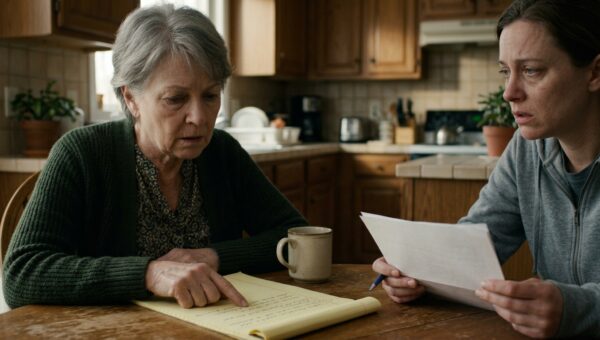
By eleven o’clock I was sitting across from Mrs. Higgins at the county probate desk, and she wasn’t even pretending to look surprised when I laid the card out on her FormICA counter.
“He was in here Tuesday asking about partition sales, Clara,” she told me, not looking up from her ledger as her yellow highlighter squeaked across the page. “Said you were agreeable to a buyout.
He had a draft of a quitclaim already filled out with some lawyer’s stamp down in Portland.”
“Did he file it?” I asked. My voice sounded thin, like dry grass under a boot.
“Needs both signatures or a judge’s order,” she said, tapping her pen against the metal inkpad. “Unless a caveat is entered on the docket. Then nothing moves. Not an inch. Not for a year.”
I paid the seventy-dollar filing fee out of my grocery envelope, signed my name three times in that scratchy cursive our old schoolmarm drilled into us, and walked back out to my Buick with the pink copy of the court caveat folded twice in my jacket pocket.
Monday morning came in cold and grey, the kind of damp fog that smells like rotting potatoes and river mud. I was at the kitchen table shelling dried beans into a blue bowl when I heard the crunch of gravel in the driveway.
Arthur’s sedan pulled up right behind the pump house, and he didn’t even wait to kill the engine before he hopped out. He was holding a leather folio under his arm, looking brisk and important, the way he used to look when he was trying to sell life insurance to the parishioners after church.
He pushed the back door open without knocking, bringing a rush of cold air into the kitchen that made the calendar on the wall flutter.
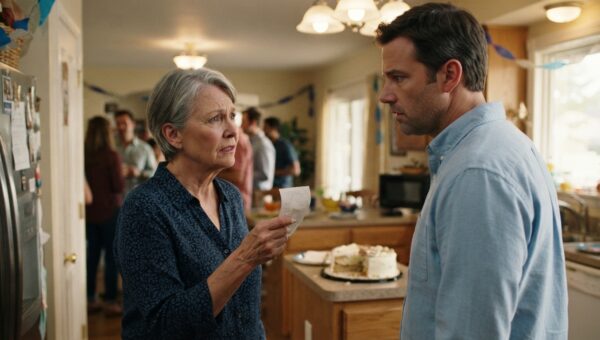
“Clara,” he said, pulling off his leather gloves and tossing them onto the flour bin. “I forgot my spare car key in the guest room nightstand. Good thing I had a free morning to swing back up.”
He didn’t look like a man who had forgotten a key. He looked like a man who had left something valuable in a place he shouldn’t have stash it, and he had come back to collect it before I noticed the hinge was missing from the door.
I didn’t stand up. I just kept my thumbs working on the dry pods, letting the papery husks pile up around my wrists.
“You didn’t leave your key, Arthur,” I said.
He stopped with his hand halfway to the narrow hallway that led to the bedrooms. His fingers curled into the leather of his gloves.
“What are you talking about?”
“You left this,” I said.
I slid the blue baggage tag across the laminate table, right past the salt shaker and the sugar bowl, until it hit the edge of his coffee mug. Then I laid the pink court caveat right on top of it, square and flat so he could read the bold red stamp from the probate clerk’s office without even having to lean over.
Arthur didn’t touch the paper. He stared at it the way a dog stares at a copperhead coiled in the weeds by the well pump.
“You went down to the courthouse,” he whispered.
“I was changing the linens,” I told him, my voice dropping down to that flat, level tone I used to use when we were kids and he tried to blame me for breaking the cellar window. “You always were sloppy about where you stuffed your trash, Arthur. Mom used to find your cigarette packs behind the oil heater every time she cleaned.”
His face didn’t go white. It went red, that dark, blotchy red that runs in the men on our mother’s side when they get cornered and realize nobody is going to hand them a ladder.
“It’s just business, Clara,” he finally spat out, his voice cracking on the second syllable as he took a half-step toward the table. “That land is sitting there doing nothing. We could have twenty thousand apiece by Friday if we let the syndicate clear the timber and parcel out the frontage. I have debts. You don’t understand what it’s like down there.”
“I understand you tried to sell our parents’ ground behind my back using a forged timeline and a lawyer who ought to be disbarred,” I said. I stood up then, slow enough that he didn’t think I was jumping him, and walked over to the back door so it stayed wide open between us. “The caveat is filed. Mrs. Higgins stamped it at eleven on Thursday. Any paper you signed down in Portland is worth less than the ink it’s printed on.”
“You can’t just block a partition like that,” he shouted, his hands coming down flat on the table so hard the salt shaker bounced. “I’m a co-owner. I have rights to that estate just as much as you do!”
“You have rights to walk the dirt if you come here honest,” I said, and the words felt like cold spring water in my mouth. “You don’t have the right to sign my name, and you don’t have the right to carve up the homestead so you can pay off whatever hole you dug yourself into in Bangor.”
He stood there breathing hard, his chest heaving under his wool jacket, looking at me like I was a stranger who had moved into his house while he was away. For a second I thought he was going to swing his fist at the doorframe, or say something about how Mom always liked me best, the old childish poison we used to sling around when the snow kept us cooped up too long.
Instead, he just reached down, picked up his leather folio from the flour bin, and shoved the pink paper into his pocket without folding it.
“You’re making a mistake, Clara,” he muttered, his voice dropping down to a dull, greasy rumble as he backed toward the screen door. “You can’t farm eighty acres by yourself forever. When the taxes go up next year, don’t come calling me to bail you out.”
“I won’t,” I said.
He didn’t say goodbye. He let the screen door slam behind him, hard enough to rattle the glass in the upper panes, and marched down the steps without looking back at the garden or the barn.
I watched through the kitchen window as he got into his car, threw it into reverse with a squeal of rubber that kicked up gravel clear across to the lilac bushes, and tore down the long dirt lane toward the paved road.
I stood there for a long time after the dust settled, listening to the wind come up through the cedar break at the edge of the pasture, running my hand over the scarred edge of the wooden table where our father used to sit and clean his hunting rifle every November. The land was still here, quiet and heavy and stubborn, and it wasn’t going anywhere until I was ready to let it go.