The kitchen smelled like lemon cleaner, cold gravy, and the burnt coffee Caleb had left sitting on the counter all morning. Sunlight came through the window in a hard white square, bright enough to show every smear on the tile and every crumb his wife had watched me crouch to collect. I was seventy-one years old, kneeling in my own kitchen.
Caleb stood behind me in polished boots that had never seen a day of real work, tapping one heel because I was taking too long. Marissa leaned in the hallway with her red nails wrapped around a champagne flute, smiling the way people smile when they think cruelty is private.
“Missed a spot, Mother,” Caleb said.
That was when he shifted his weight. His heavy rubber sole came down directly across the knuckles of my right hand, grinding hard against the linoleum. I didn’t cry out. I just felt the sharp pop of bone and the dull, greasy ache spreading up my wrist. He didn’t lift his foot right away either. He let it rest there for a second, testing the heft of himself against my hand, before he gave a lazy little scuff of his heel and stepped forward.
“Watch where you’re crawling,” he grunted.
From the hallway, Marissa gave a short, bubbling laugh, the kind that sounded like ice rattling in a cheap glass.
I didn’t rush. When you teach art for thirty-four years to high school sophomores who would rather set their sketchpads on fire than draw a still life, you learn that panic is just wasted energy.
I slowly pulled my bruised hand away from his boot, tucked it against my apron, and pushed myself up using the edge of the lower cabinet. My knees gave a dry, papery click. I reached out and wrapped my fingers around the handle of my heavy cast-iron skillet, the number eight Lodge my mother gave me when Arthur and I first bought this place back in nineteen-eighty-two. It had a slick, black surface seasoned by four decades of bacon grease and cornbread.
I didn’t swing it. I just lifted it off the burner and set it down on the center table with a flat, iron thud that cut right through Marissa’s giggling.
Caleb turned around, frowning. He thought I was going to make him his noon eggs. He had that soft, puffy look about him that men get when they haven’t swung a hammer or balanced a ledger since the Bush administration. “Is lunch coming or what? Mariss is starving.”
“Lunch is over,” I said. My voice didn’t shake. I was surprised by how steady it sounded, like an old iron gate clicking shut in the wind.
Marissa drifted into the kitchen, swirling the yellow wine in her glass. “Oh, stop being dramatic, Martha. Your hand is fine. You’ve been scrubbing that floor for an hour and it still looks greasy.”
I looked at Marissa. Then I looked at Caleb. I thought about eighteen months ago, when Caleb had shown up on my porch with two suitcases and a story about a bad real estate partnership in Peoria. He had cried in my front hall, his shoulders shaking against my wallpaper, telling me his life was ruined and he just needed a quiet corner to catch his breath while he sorted out his debts. I had taken down the framed photograph of my late husband Arthur to make room for Caleb’s polo shirts in the hallway closet.
I had turned my sewing room into a walk-in wardrobe for Marissa because she couldn’t possibly keep her heels in a wire rack. I had cooked their dinners, washed their linen sheets, and pretended not to notice when my silver dessert spoons started disappearing one by one into the bottom of their laundry basket.
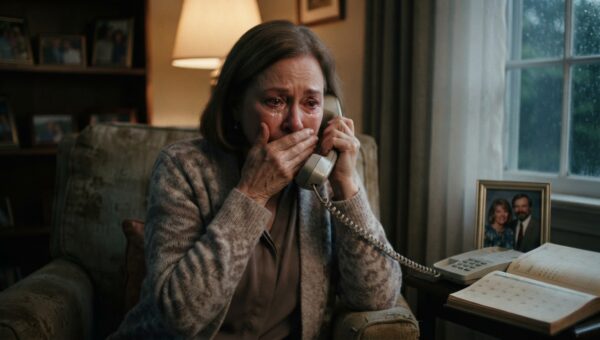
I walked over to the landline phone on the wall. My fingers throbbed where his boot had met them, but I punched the digits without a stutter.
“Who are you calling?” Caleb asked, his voice losing that bored, lazy slide. He took half a step forward. “Mom. Who are you calling at this hour?”
“Arthur Vance,” I said, keeping my eyes fixed on the yellow wallpaper Arthur and I had pasted up together on a rainy Saturday before Caleb was even born. “He handled your father’s probate, and he handles evictions now.”
Marissa stopped swirling her champagne. “Evictions? Are you losing your mind? This is family.”
Arthur answered on the third ring. I told him I needed the paperwork filed by three o’clock. When I hung up, the kitchen was so quiet you could hear the pilot light on the stove clicking.
Caleb tried the laugh again, but it sounded thin and dry, like paper scraping over gravel. “You can’t evict us. We live here. You invited us.”
“I invited a son who needed help,” I said, walking back to the table and resting my hand right beside the cast-iron skillet. “I didn’t invite two squatters who spend my retirement money on imported wine and plot behind my back to take my name off the deed.”
The color drained right out of Caleb’s face, leaving him looking pasty and small under the fluorescent light. He didn’t look like a successful businessman anymore. He looked like the twelve-year-old boy who had tried to set fire to the garage with a magnifying glass and then blamed the neighbor’s cat.
“What are you talking about?” he muttered, looking down at his expensive boots.
“I’m talking about the recycling bin,” I said.
That was where I had found it two nights before, wedged underneath an empty crate of imported gin. It was a preliminary consultation letter from a title company in Springfield, addressed to Caleb, asking for confirmation on a home equity loan application for seventy-five thousand dollars. At the bottom, in Caleb’s sharp, impatient handwriting, were notes about how to handle an elderly homeowner who might be showing early signs of mental confusion. Marissa had even underlined the word *incompetency* in red ink.
They had spent eighteen months wearing me down. They had hidden my reading glasses, told the ladies at the bridge club that my memory was going, and systematically convinced themselves that the house Arthur built with his own two hands was already theirs to carve up. The boot-step wasn’t an accident. It was just the first time they forgot to pretend.
“You’ve got no proof of anything,” Marissa snapped, taking a step toward the hallway like she wanted to bolt for their suitcases. “You’re an old woman living alone in the past. Nobody’s going to believe you over your own son.”
“The constable will be here by two,” I said quietly. “And he’ll believe the deed that has only my name on it.”
The next three hours moved with the cold, mechanical efficiency of a freight train. Arthur Vance didn’t mess around, and neither did the two county deputies who showed up at my front door just as the church bells down the road were striking noon. Caleb tried to argue, tried to puff his chest out and talk about tenant rights and family obligations, but one of the deputies took a single look at Caleb’s idle hands and then looked at me standing by the screen door with my apron on.
“Is this your house, ma’am?” the younger deputy asked, touching the brim of his hat.
“It was my husband’s and mine,” I told him. “And they don’t have a lease.”
“Get your bags, son,” the deputy said, turning back toward the hallway.
The packing didn’t take long because they didn’t have much of their own to begin with; mostly plastic bins of clothes, two cases of champagne, and the various gadgets Marissa had ordered using my credit card number while I was at the dentist. They carried their things out to the driveway in heavy plastic trash bags and expensive leather duffels, their boots crunching loudly over the white gravel Arthur had laid down back in ninety-four. Marissa wouldn’t look at me as she passed the screen door, her face pinched up tight like she’d swallowed a lemon whole. Caleb lingered by the hood of his sedan for a second, his mouth opening and closing like a fish out of water, looking like he expected me to soften at the very last second the way I always had.
“Mom,” he started, his voice cracking on the syllable. “We don’t have anywhere to go right now. The apartment in Peoria fell through. That’s why we, “
“You should have thought about that before you put your boot on my hand,” I said.
I didn’t yell. I didn’t cry. I just latched the screen door, dropped the brass hook into its little iron eye, and listened to the sharp click of the lock.
When the red taillights of their car finally disappeared past the mailboxes at the end of the drive, the silence came back into the house. It wasn’t the heavy, suffocating silence they had brought with them, but the clean, wide-open quiet of a place that belonged to itself again.
I walked back into the kitchen. The lemon cleaner had dried on the linoleum, leaving a faint white haze near the pantry door. I didn’t bother scrubbing it right away. Instead, I picked up the heavy cast-iron skillet, carried it over to the sink, and washed it out with warm water and a dab of yellow soap, just the way Arthur had taught me. I dried it with a clean linen towel, rubbed a single drop of canola oil across its bottom with my thumb, and put it back on the front burner where it belonged.
Then I filled my small blue kettle, set it on the iron grate, and waited for the water to sing. I sat down at the wooden table by the window, wrapped my fingers around my warm mug of fresh coffee, and watched the afternoon light stretch long and golden across my own spotless floor.