Why do we spend years swallowing our own hunger just to keep someone else comfortable at the dinner table? That is the question I kept asking myself on husband kept both hands locked tight on the steering wheel.
When Clara was four weeks old, my pediatrician sat me down with a chart and told me the raw truth. Her tiny system was rejecting the dairy proteins coming through my breastmilk, showing up as colic, rashes, and silent pain that kept her crying for hours.
That was the exact day dairy vanished from my pantry. No cheese, no butter, no cream, no hidden whey in the crackers. It was not a lifestyle choice or a trendy wellness kick. It was a medical necessity for my baby, and since I was her sole source of nutrition, my body had to become a safe zone.
For the first few weeks, I figured my in-laws would adjust. My father-in-law, Arthur, has hosted the extended family Sunday lunches for as long as anyone can remember, treating his dining room like a private club where he is the undisputed head chef. But right from our very first visit with infant Clara tucked into her carrier, the pattern was set in stone. Arthur would make roasted potatoes drenched in butter, toss together towering bowls of greens studded with crumbly feta cheese, and bake bread brushed with dairy glazes.
Whenever we walked through their front door, I already knew what my plate would look like.
A plain slice of dry Italian bread and a scrap of unseasoned meat if I was lucky. Every single time, I tried to make it easy. I would call ahead or catch Arthur in the kitchen and say, “Arthur, if you could just scoop out a plain portion of potatoes before you add the butter, or keep the feta on the side of the salad, I’d really appreciate it.”
Arthur would wave his wooden spoon in the air and give me that easy, dismissive chuckle that always made my shoulders tighten. “Oh, stop worrying, Clara gets a little cheese now and then, it builds character,” he would say, as if my breastfed infant’s medical allergy was just a quirky preference I needed to grow out of.
My husband, Liam, usually hovered nearby, offering a weak smile and murmuring, “Just make sure you check it, Dad,” before wandering off to watch the game or help with the grill.
And I, wanting to be the easygoing daughter-in-law, always swallowed my frustration. I would push the fetaed greens around my plate, eat my dry bread, smile through the afternoon, and then quietly raid our own refrigerator the second we walked through our front door at home.
That cycle lasted for twelve months. Twelve months of polite requests, ignored boundaries, and silent resentment accumulating like dust under a heavy rug.
Then came today. It was the bi-annual family friends lunch, an event Arthur treats with the solemnity of a state banquet. He insists on inviting half the neighborhood, crowding sixteen people around a table meant for ten, and running a tight, erratic schedule that never accounts for small children. We arrived precisely at eleven-thirty in the morning, right around Clara’s usual late-morning nap window, hoping she would catch a quick forty minutes of sleep in her stroller before the house filled up.
Step-mother-in-law Brenda met us in the hallway with a clipboard in hand and a harried look in her eyes. “Your father wanted the potatoes roasted in butter, you know how he gets about the recipe,” she whispered to Liam while sliding past us into the kitchen, offering not even a glance toward our overtired baby.
Three hours. We sat in that stifling living room for three full hours while Arthur fussed over meat temperatures and argued with old neighbors about local politics. The house grew hot, thick with the smell of roasting garlic and melting butter. Clara skipped her nap entirely, trapped in an environment of shouting voices, clattering silverware, and escalating overstimulation. By one o’clock, she was crying, a high, ragged pitch of pure exhaustion that grated against my nerves and made my own stomach twist with sympathetic knots.
I tried to pace the hallway with her, rocking her against my shoulder, whispering shushing noises until my throat felt raw. Brenda walked by twice, merely tutting and saying, “Oh, she’s just overtired, babies get like that,” without offering a quiet room or a glass of water.
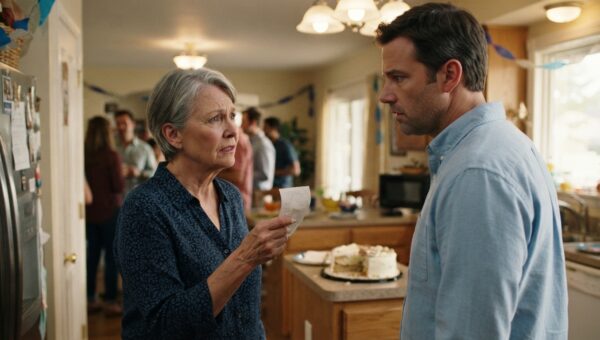
When lunch was finally announced at two o’clock, the table was a minefield of dairy. The large ceramic bowl of salad sat right in the center, buried under a thick blanket of crumbled feta. The potatoes glistened with melted butter, and even the rolls had a shiny egg-and-butter wash baked right into the crust.
I slid into my chair, my arms aching from holding a thirty-pound, sobbing child who refused to be put down. My blood sugar was tanking, my head throbbed from the two-hour delay, and I looked down at a plate that held nothing I could safely eat without passing a reaction straight to my daughter.
“Help yourself, everyone, we’ve got plenty,” Arthur boomed from the head of the table, carving into the roast beef with theatrical flair while family friends murmured polite compliments about the spread.
I quietly asked Liam to pass the plain sliced meat, my voice barely above a whisper because my throat felt tight. Across the table, Arthur caught movement and leaned forward, his fork pointing right at my empty plate.
“What’s the matter with you now, Elena? Still on that fussy diet?” Arthur asked, loud enough for the entire end of the table to quiet down and look over. “It’s just a little cheese. A little bit never hurt anyone back in my day. You’re starving yourself for nothing.”
The family friends sitting nearby stopped chewing, their eyes darting between Arthur and me like we were players in a tennis match. Brenda offered a tight, sympathetic grimace from her end of the table, whispering, “He just means you should enjoy yourself, dear.”
That was the exact moment something inside me simply snapped. Not with a shout or a dramatic gesture, but with a cold, hollow realization that I had spent an entire year shrinking myself to accommodate a man who viewed my daughter’s health as an inconvenience to his menu. I looked down at Clara, whose face was blotchy and red from crying, and then across the table at Arthur, who was smiling smugly, waiting for me to laugh it off and take a piece of bread.
Before I could force out a polite excuse, Liam dropped his fork onto his plate. The metal clatter rang out sharply against the porcelain, cutting straight through the murmurs of the room.
Liam did not yell. His voice was frighteningly quiet, steady, and hard as river stone. “Dad. Stop.”
Arthur blinked, his smile faltering for a fraction of a second. “What did you say?”
“You heard me,” Liam said, leaning forward so the wood of the table creaked under his forearms. “For twelve months, Elena has eaten dry bread at your table because you refuse to make one simple adjustment for her health and our daughter’s allergy. You make this lunch every six months, you make us wait three hours while Clara starves, and then you mock my wife for not eating your food.”
The table went completely dead silent. You could hear the hum of the refrigerator from the kitchen three rooms away.
Arthur’s face flushed a dark, mottled red, his pride instantly wounded in front of his invited audience. “I cooked a wonderful meal for twenty people, Liam. I’m not running a short-order restaurant for her picky habits.”
“It’s a medical allergy, not a preference,” Liam snapped back, his voice rising, carrying an edge of fury I had never heard from him in all our years together. “And your complete lack of basic hospitality is disgraceful. You care more about your menu than your own granddaughter.”
“Now hold on just a minute,” Brenda cut in, her voice shrill as she stood halfway up from her chair. “Your father worked hard on this food all morning, there’s no need to cause a scene in front of our guests over a little butter, “
“We are done,” Liam said, cutting her off completely. He stood up, pushed his chair back, and looked down at me. “Get the diaper bag. We’re leaving right now.”
I did not hesitate. I stood up, hoisted Clara onto my hip, and walked straight toward the front door while sixteen pairs of eyes burned holes into my back. Arthur muttered something about ungratefulness as we reached the hallway, but Liam didn’t look back, and neither did I.
The silence inside our car was thick and heavy as Liam backed out of the driveway, gravel spitting against the wheel wells. Clara whimpered once, buried her face in my neck, and finally drifted off into a deep, exhausted sleep from sheer physical overload.
For the first twenty minutes of the drive, neither of us spoke. My hands were shaking slightly, the adrenaline still humming through my veins like cold electricity.
“I’m sorry,” Liam finally murmured, his knuckles white against the steering wheel. “I should have put a stop to this ten months ago. I just… I kept hoping he would figure it out on his own.”
“He never was going to,” I said quietly, looking out the passenger window at the blur of telephone poles rushing past. “To him, hosting is about control, not about people.”
When we got home, the house felt blessedly cool, quiet, and safe. We didn’t talk about the in-laws for the rest of the afternoon. Instead, while Clara slept soundly in her crib, Liam pulled out our own kitchen pans. He didn’t cook anything fancy or complicated. He just browned some fresh turkey patties in olive oil, steamed a head of broccoli, and sliced up a couple of safe, dairy-free potatoes.
We sat together at our own small kitchen counter, eating plain, warm food in the quiet afternoon light. There was no feta, no butter, no commentary, and no apologies required.
That evening, Liam sent a single, clear text message to his father’s phone. We won’t be attending future family lunches unless we bring our own food, and we expect basic respect for Clara’s health when we visit.
Arthur hasn’t replied yet. My phone has buzzed twice with anxious texts from Brenda trying to smooth things over, but Liam hasn’t opened them, and I haven’t touched mine. For the first time in a year, the silence in our house doesn’t feel like a compromise. It feels like our own.