The kitchen counter always smelled of damp seaweed and cold chicory when Arthur was brewing his morning substitute, that bitter roasted chicory root he swore by because caffeine apparently offended his wife’s liver meridians. I stood there by the sink, holding my empty mug and watching the gray rain beat against the small pane of glass that looked out over the overgrown hydrangea bushes.
It was a Tuesday morning, or maybe a Wednesday, but the days had started sliding together into one long, gray smear ever since I sold the little house in Coos Bay and moved up here to live with my son. I had thought it was going to be peaceful. I had thought sixty-eight was too old to be rattling around an empty four-bedroom place alone, paying steep property taxes on a fixed pension while the roof leaked every time the winter gales rolled in off the Pacific.
Arthur had called me back in October, his voice sounding thin and hurried over the line while Clara was somewhere in the background rattling glass jars in the pantry. “Dad, you shouldn’t be down there by yourself,” he said, sounding like the boy who used to scrape his knees and come to me for iodine. “Come up here. We have the spare room, Clara’s got her garden projects, and we can actually be a family.
You can help in the yard.” It sounded sensible. It sounded like the kind of safety net a man is supposed to have at the end of his working life, after forty-two years of pulling shifts at the timber mill and keeping his mouth shut when the union meetings got loud.
When I arrived with my two battered suitcases and the cardboard box containing my old cast-iron skillet and a framed photograph of my late wife, Clara met me at the front door with a clipboard tucked under her arm. She didn’t hug me. She just pointed her pen at my boots. “We don’t track mud inside,” she said, her voice bright and clipped like a pair of hedge shears. “And let’s get one thing straight right out of the gate. This is MY house. Everything here is plant-based, organic, and cruelty-free. No dairy, no meat, no processed sugar, no exceptions.” I remember smiling, thinking she was just being thorough, the way young people get when they read too many books about health and longevity.
I gave a little nod and said I could manage whatever she was cooking. I had eaten camp rations in the woods; I figured a few vegetables wouldn’t kill a grown man.
By day four, the illusion had worn down to raw bone. Breakfast was a small bowl of watery oat porridge topped with three blueberries and a dusting of hemp seeds that got stuck in my teeth. Lunch was half an avocado mashed onto a thin cracker that tasted like cardboard. Dinner was where the real endurance test began, usually a scoop of unseasoned quinoa sitting next to a pile of steamed kale that looked and tasted like wet wool. I would sit at the large oak dining table across from Arthur, who wouldn’t look me in the eye, while Clara lectured us on the carbon footprint of dairy cows. My stomach felt hollow and light, a dull, nagging ache behind my ribs that wouldn’t go away no matter how much warm water I drank.
I started waking up at three in the morning with my hands shaking slightly, staring at the ceiling and listening to the wind rattle the gutters, wondering how long a man’s bones could hold together on grass clippings and optimism.
The breaking point came on a Saturday evening. Clara had made a lentil loaf that smelled faintly of wet cardboard and cumin, baked in the shape of a roast. She set a tiny slice on my plate, about the size of a deck of cards, right next to a spoonful of mashed parsnips. I looked down at it, then up at Arthur, who was chewing his portion with a vacant, glazed expression that looked like a man serving time. I pushed the lentils around with my fork, trying to find something substantial enough to chew, and the weakness in my legs from the past week finally boiled over into a hot, bitter anger. “Clara,” I said, and my voice sounded rougher than I intended in the quiet room. “I’m 68 years old. I need real protein. I’ve worked forty years for my keep, and I can’t live on grass and water.”
Clara didn’t drop her fork. She didn’t even blink. She just set her silverware down with a sharp, deliberate click against the ceramic plate and crossed her arms over her chest. “My house, my rules,” she snapped, her chin lifting an inch. “Show some respect. If you want to poison your body with saturated fat and animal suffering, you can do it somewhere else, but not under my roof.” Arthur kept his eyes fixed squarely on his parsnips, his shoulders pulled up toward his ears like he was trying to shrink out of his own skin. Nobody said anything after that, and honestly that felt worse than the shouting. I pushed my chair back, walked down the hall to my small room, and closed the door without finishing the lentils.
The next morning, the house was quiet with the heavy, calculated silence of people avoiding a fresh graze. Arthur and Clara left around ten for their weekly zero-waste farmers market three towns over, taking their canvas bags and their righteous attitudes with them. I stood by the front window watching their Subaru back out of the gravel driveway until the red taillights disappeared around the bend of the cedar trees. My hands were steady, but the hunger behind my ribs was loud. I walked out to the back patio where Clara’s neat rows of compost bins sat beside a rusted charcoal kettle grill that looked like it hadn’t been touched since they bought the place two years ago. Underneath the bottom rack, wedged behind a bag of cedar mulch, sat a half-empty sack of briquettes and a tin of lighter fluid left by the previous owners.
I didn’t think it through. I didn’t care about the smoke or the rules or the inevitable storm that would follow when they got back. I just knew I needed something that didn’t taste like dirt and water. I dragged the old kettle out onto the center of the flagstones, stacked the briquettes in a rough pyramid, and struck a match. The paper caught with a quick puff of gray smoke, smelling of old dust and paraffin, and then the charcoal began to crackle and pop as the edges turned white with ash. I had slipped down to the local butcher yesterday afternoon while Arthur was at the hardware store, sliding a thick ribeye into my canvas coat pocket like a guilty schoolboy. I unwrapped the butcher paper now, the cold weight of the red meat heavy and real in my palm, and laid it directly across the hot iron grates.
The sizzle was the best sound I had heard in six months. A thick plume of gray-blue smoke rose up into the pine boughs overhead, carrying the rich, heavy scent of rendered fat and charred beef across the quiet yard. I stood there on the patio with my eyes watering slightly from the smoke, watching the fat drip down onto the coals and flare up in little orange tongues of fire, and for the first time since I packed my bags in Coos Bay, I felt human again. My chest loosened. The hollow ache in my stomach quieted down as the heat of the fire warmed my face. I turned the steak over with an old pair of pliers I found in the potting shed, watching the dark crisscross grill marks form on the surface, and I didn’t even care about the consequences anymore.
Ten minutes later, the gravel in the driveway crunched under tires. The Subaru engine cut out with a soft ping. The back screen door swung open, and Clara walked out onto the patio holding her canvas market bags. She stopped dead three feet from the back door. Her nose twitched once, twice, like an animal catching scent of a predator in the brush. Her eyes dropped from my face down to the smoking iron grill, then to the dark, juicy steak resting on a paper plate in my hand, and then she went completely, terrifyingly silent. No screaming. No red-faced lecture. Just a cold, rigid stillness that made the air feel twenty degrees colder.
A second later, Arthur stepped out behind her, wiping his shoes on the mat. He looked at Clara, then looked at the smoking grill, and finally looked at me standing there with the paper plate and the pliers. The smell of charcoal and beef hung thick and heavy between us, mocking every rule Clara had taped to the refrigerator door. Arthur stood there for a long moment, his mouth slightly open, watching the thin curl of smoke drift up toward the eaves. He didn’t look angry. He just looked bone-tired, like a man who had finally realized he was standing on sinking sand and had stopped trying to paddle. He took a slow step forward, his eyes fixed on the gray ash in the bottom of the kettle, and quietly said the one sentence that broke the whole illusion wide open.
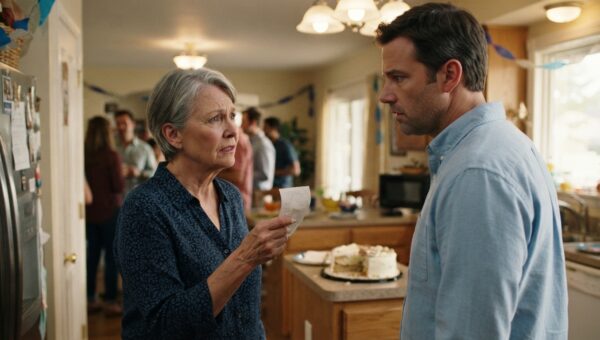
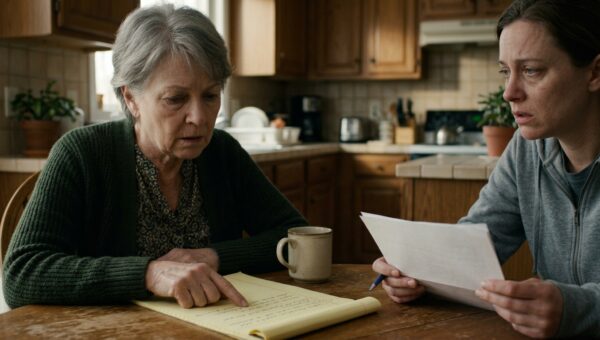
“Dad, you shouldn’t have to sneak around just to eat, but… we need to talk about what this means for us.” Clara let out a sharp, incredulous breath, her hands tightening on the canvas handles of her bags until her knuckles turned white, but Arthur didn’t look back at her. He just kept his eyes on me, steady and miserable and entirely done with pretending. The kitchen table conversation that followed lasted for three hours, but the fight had gone out of the room before we even sat down. Clara stated her terms again about purity and shared spaces, her voice high and tight, but this time Arthur didn’t shrink into his collar. He just sat beside me and said we had to find another arrangement because nobody was going to police what an old man ate under his own family’s roof. I packed my two suitcases back into the trunk of my old sedan two days later, not with bitterness, but with a strange, quiet sense of lightness. Now, back in my own rented two-room cottage down by the docks where the air smells of salt and diesel, my small kitchen counter holds a cast-iron skillet, a set of house keys, and a thick red steak waiting for the pan.