Why do we spend years swallowing our own hunger just to keep someone else comfortable at the dinner table? For six solid years, I asked myself that very question every time my alarm clock buzzed at 4:30 in the morning in my cramped Houston apartment. I worked fifty-hour weeks at the logistics terminal, sorting freight and managing night shifts, with my boots permanently caked in industrial grime and warehouse dust.
Every single two weeks, without fail, I wired the bulk of my paycheck back home to Kentucky. I did it because my father’s back was ruined from decades of coal mining, and my mother deserved a proper roof over her head that didn’t leak every time a spring thunderstorm rolled through the valley.
The plan was simple, or at least I thought it was. We had mapped it out over crackling landline calls during my first winter down south. I was going to fund a modest three-bedroom white cottage with a bright red metal roof and a long front porch facing the east ridge. My mother always talked about that porch, how she wanted to sit there in the evenings with a chipped ceramic mug of coffee, a thin blue quilt over her knees, and the sunset warming her face without any debt hanging over her shoulders. I also bought the flat five-acre field behind the house so my father could grow heirloom tomatoes and sweet corn instead of breaking his back for some landlord’s profit.
I kept my head down, skipped vacations, ate cheap canned soup, and watched my bank account grow just enough to keep the builders paid.
When I finally packed my old pickup truck for good and drove the seven hundred miles back home without calling ahead, I figured I would pull up to the sound of a screen door banging and my mother rushing out with a fresh batch of biscuits. I wanted it to be a surprise. I wanted to walk up those wooden steps, drop my keys on the rail, and tell them I was finally home to stay.
The first thing I saw when I pulled into the driveway after six years of working myself raw in Houston was not the white house with the red roof I had paid for so my parents could finally grow old without fear. It was not the long front porch my mother used to talk about, the one where she wanted to sit in the evenings with a cup of coffee, a thin blanket over her knees, and the sunset warming her face.
It was not the little field behind the house I bought so my father could grow what he wanted instead of breaking his back for someone else’s table.
Instead of the modest white cottage, a sprawling two-story brick manor sat squatly on the rise, complete with a three-car garage and manicured boxwood shrubs that looked entirely out of place in our county. A massive black pickup truck I didn’t recognize was parked right in the center of the fresh asphalt turnaround, leaking a dark drop of oil onto the clean stone. I sat there in my beat-up sedan with the engine idling, my hands locked hard around the steering wheel until my knuckles turned yellow. Nothing about the scene matched the blueprints my mother had mailed me three years back when the original contractor supposedly walked off the job.
I cut the engine and stepped out into the damp Kentucky air, the gravel crunching beneath my boots with a hollow, unfamiliar sound.
The front double doors of the brick house were heavy oak with polished brass knockers, but the porch light was off and the place looked dead silent. I walked around the side, following the narrow concrete path toward what should have been the back kitchen window, when I noticed a rusted aluminum lawn chair sitting outside a separate side entrance. A pair of worn canvas gardening shoes rested neatly on the welcome mat beside a faded plastic watering can.
The side door creaked open before I could knock, and my mother stepped out holding a basket of wet laundry against her hip. She froze right there on the threshold, her face going slack as she looked at me standing in the work shirt and grease-stained jeans I had driven sixteen hours in. She didn’t drop the basket, but her fingers tightened around the plastic rim until her knuckles went white.
“Roy,” she whispered, her voice sounding thin and small in the wide-open yard. “You didn’t say you were coming up this weekend.”
“I finished up down south for good, Mama,” I said, my voice dropping lower than I intended. “I wanted to see the porch. Where is the front porch you wanted?”
She wouldn’t meet my eyes. She looked down at the concrete step, shifting her weight from one foot to the other like she was trying to disappear into the brickwork. “Well, things changed a bit after the third year, honey. You know how contractors are. Prices went way up, and we had to pivot.”
Pivot wasn’t a word my mother usually used. That was Marcus’s word.
I left her standing there by the laundry basket and walked past the brick wall toward the back field where my father was supposed to be tending his tomatoes. The air smelled of damp earth and stale fertilizer. When I reached the edge of the acreage, I found my father kneeling between two long rows of stunted green beans, his knees braced on a foam pad. He didn’t look up when my boots hit the dirt behind him until I cast a long shadow across his basket.
He looked older than he had on my last quick visit two years prior, his neck corded with deep veins and his hair gone completely gray. When he turned around, he squinted against the afternoon glare, wiping his calloused hand across his forehead and leaving a smear of dark loam on his temple.
“You’re home early,” he muttered, not sounding particularly glad about it.
“I’m home for good, Dad,” I said, looking out past the garden fence where a pile of rusted commercial roofing panels and heavy machinery parts littered the grass. “What happened to the field? I sent money specifically to clear this bottomland for your garden, not to store scrap iron.”
My father sighed, dropping his trowel into the dirt with a dull clatter. He pulled off his frayed cotton work gloves and rubbed his eyes with the heels of his palms. “Marcus needed a staging area for his new contracting business. He had some government bids fall through over in Russellville, and he needed a place to keep his rigs close by where the county wouldn’t ticket him for zoning violations.”
“Marcus’s business?” I asked, my voice rising a notch. “I didn’t fund Marcus’s business. I funded your retirement home. Where is the white cottage?”
“It’s right here,” my father said defensively, pointing a thick thumb over his shoulder toward the massive brick structure towering behind us. “This is the house. Marcus just helped us design it so it would have more resale value if anything happened to us. He lives in the front half with his wife and the boys, and your mother and I have the suite out back by the utility room. It’s more modern. We got central air now.”
Central air. In a house built with my sweat and six years of my missed Christmases, my parents were living in a converted utility suite while my thirty-two-year-old brother and his freeloading family occupied the main quarters.
“Let’s go inside,” I said, turning on my heel before I said something I couldn’t take back.
We walked back toward the kitchen through the side entrance, the screen door slamming behind us with a sharp metallic twang. Inside, the kitchen was all granite countertops and stainless steel appliances that looked like they had never been used to cook a real meal. A stack of unopened mail sat on the marble island next to a bottle of expensive bourbon and a set of car keys.
My mother was already sitting at the small breakfast table, her hands folded tightly in her lap. She looked like a guest in her own home, sitting on the edge of a velvet-upholstered stool that didn’t match anything else in the room.
“You want some coffee, Roy?” she asked, her voice trembling slightly. “I can put the pot on.”
“No coffee, Mama,” I said, pulling out a chair and sitting down directly across from her. “I want to see the wire transfer records and the building permits. Every single one of them from the last six years. Because last time I checked, my name is on the land deed, and I didn’t authorize a brick mansion for Marcus.”
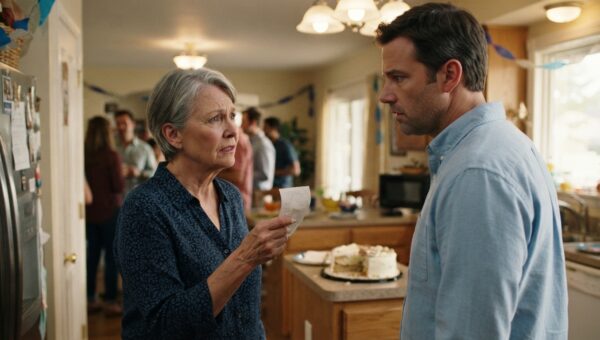
The heavy front door clicked open just then, followed by the sound of heavy boots stamping mud onto the hardwood foyer. Marcus walked into the kitchen wearing a clean designer golf shirt and sunglasses propped up on his forehead, holding a takeout bag from the BBQ joint down in town. He stopped dead when he saw me sitting at the island, his face tightening into that familiar, easy grin he always used when he wanted to talk his way out of a debt.
“Well, look who decided to show up,” Marcus said, tossing his keys onto the counter with a loud clatter. “Big city boy finally got tired of the humidity. How’s Houston, Roy?”
“Shut up, Marcus,” I said, not even looking at him. “Sit down.”
Marcus dropped the BBQ bag on the counter, his smile fading into a hard line. “Excuse me? This is my house. I live here, in case you didn’t notice the square footage.”
“You live here on my dime,” I said, standing up slowly so I was looking right down at him across the granite island. “Every single beam in this kitchen, every bag of concrete in that three-car garage, and every square inch of asphalt outside was paid for by six years of twelve-hour shifts at a freight terminal. I sent $142,000 to Mama and Dad for a modest cottage and a working farm. Instead, you took the funds to bail out your failing grading company and built yourself a castle while our parents sleep next to the water heater.”
Marcus looked over at our mother, throwing his hands up in the air. “See? I told you he was going to throw a fit about this. We kept the family together, didn’t we? We gave them a better place than some drafty old wooden shack. You should be thanking me for managing the project while you were hiding out in Texas.”
My mother started crying then, soft, wet tears running down her cheeks as she stared at the marble tabletop. “He needed the start-up capital, Roy. His business was going under, and the bank was going to repossess his trucks. He was right here, and you were four states away. A family has to stick together when times get hard.”
“That wasn’t your money to give, Mama,” I said, and the flatness in my own voice scared me a little. “That was my life you handed over to him. Every time I stood on that loading dock at midnight with my back screaming, I was thinking about that front porch. And you traded it for Marcus’s commercial trucks.”
“Well, what do you want us to do now, tear it down?” Marcus snarled, stepping closer with his chest puffed out. “The deed is in Dad’s name and mine, and the mortgage on the expansion is in my business portfolio. You can’t do a damn thing about it.”
“The deed is in Dad’s name, sure,” I said, pulling a folded legal envelope out of my back pocket and dropping it right onto the middle of the granite island. “The original parcel with the five-acre field was deeded directly to me by Uncle Earl before he passed, and I never signed those secondary transfer papers you mailed me last winter, Marcus. I had a lawyer in Louisville look them over yesterday morning before I crossed the county line.”
Marcus stopped moving. His eyes dropped to the envelope, and the color drained right out of his cheeks. “What are you talking about?”
“I’m talking about the fact that this land is still legally split,” I said, leaning over the counter so he could see every bit of cold fury in my face. “The back three acres with the barn and the field belong to me free and clear. And effective as of ten minutes ago, every cent of financial support you’ve been leeching off this family stops permanently.”
“You can’t do that,” Marcus shouted, slamming his hand down on the marble counter so hard the bourbon bottle rattled. “We have overhead! We have property taxes!”
“Then you better start working fifty-hour shifts in a freight terminal like I did,” I said.
I didn’t wait for them to answer. I turned around, walked out the side door, and got back into my truck without looking back once. As I backed down the long gravel driveway, I glanced out the passenger window toward the empty stretch of the field behind the house, still unplanted and waiting, exactly where my father should have been growing his corn years ago. I shifted into drive, kicked up a cloud of dust that settled thick over the unpaved stone, and didn’t tap my brakes until I hit the state highway.