I came home unannounced to surprise my parents in the house and on the land I bought them after years of sacrifice, and the first thing I saw made my blood turn cold. The first thing I saw when I pulled into the driveway after six years of working myself raw in Houston was not the white house with the red roof I had paid for so my parents could finally grow old without fear.
It was not the long front porch my mother used to talk about, the one where she said she wanted to sit in the evenings with a cup of coffee, a thin blanket over her knees, and the sunset warming her face, nor the little field behind the house I bought so my father could grow what he wanted instead of breaking his back for someone else’s table.
Instead of the white siding and the cheerful red shingles, there was just an empty patch of caliche dirt and a weathered gray machine shed with a padlock on the side door. The old windmill was gone, replaced by a rusted-out flatbed trailer stacked with empty fertilizer jugs. I sat there in the cab of my battered pickup truck with the engine idling, waiting for the familiar screen door to slam or for my mother to step out with her apron tied around her waist.
Nobody came out. The wind just rattled the dry mesquite bushes along the fence line, making a dry, rasping sound that set my teeth on edge.
For six years, my life in Houston had been measured in concrete pours, missed holidays, and sixty-hour weeks at the distribution yard. I had sent wire transfers home almost every single month. Eight hundred here. Twelve hundred there. Sometimes three thousand when the overtime bonuses hit and I knew the roof needed flashing or my father’s hip was acting up. Every dollar I didn’t spend on cheap rent and instant coffee went straight back to this county. I kept telling myself it was worth it. I kept telling myself that when the time came, I would drive up this exact county road, turn into the drive, and find my folks sitting on that wide wooden porch drinking iced tea out of mason jars.
I turned off the ignition and the silence rushed in. I stepped out of the truck and walked over to where the front steps should have been.
My boots crunched on crushed limestone that looked nothing like the rich topsoil I had paid to haul in back in 2018.
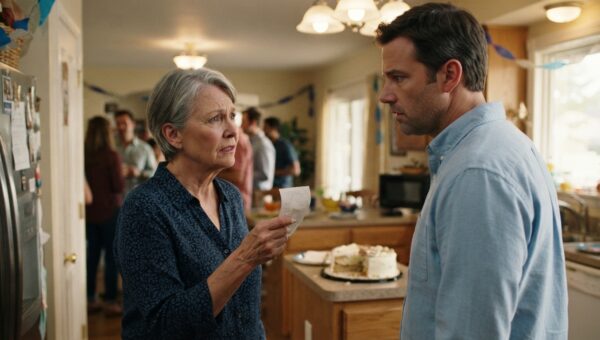
The front door of the machine shed creaked open two inches and my mother peered out. She looked smaller than she had six months ago when she visited for Thanksgiving, her shoulders rounded under a faded blue cardigan that had seen better days. When she saw my face, the color drained right out of her cheeks and she gripped the wooden doorframe so hard her knuckles turned white.
“Clara,” she whispered, her voice shaking like a dry leaf. “You weren’t supposed to be here until Saturday.”
“I finished the inventory early,” I said, my chest tightening into a hard knot. “Mom, where is the house? Where is the white house with the red roof?”
She wouldn’t meet my eyes. She looked down at the hem of her skirt, smoothing the fabric over and over with trembling fingers. “We had some trouble with the builder, honey. Things got complicated.”
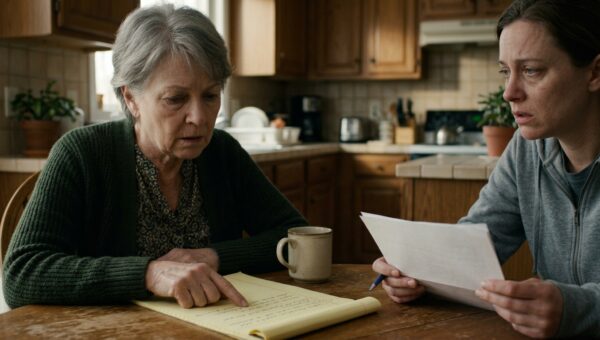
“Complicated?” I asked, taking two steps toward the threshold. “I wired seventy thousand dollars for the framing and the roof alone last spring. I have every single bank receipt in the glove box of my truck. Where did the house go, Mom?”
Before she could answer, heavy boots thudded against the plywood floor inside the shed and my father stepped around her. He looked older, too, his face lined with a deep, hunted exhaustion that didn’t belong to a man living on his own land. He had a stub of a pencil behind his ear and his flannel shirt hung loose on his chest.
“Leave it be, Clara,” he said, his voice flat and tired. “You shouldn’t have driven down without calling.”
“I wanted to surprise you,” I said, and the sound of my own voice came out thin and sharp. “What is going on here? Whose truck is that by the well?”
That was when Wayne Miller walked around the corner of the shed carrying a plastic gas can. Wayne was a cousin on my mother’s side who had spent his entire life jumping from one half-baked business scheme to the next, leaving a trail of unpaid debts from here to Abilene. He wiped his greasy hands on a rag and grinned that easy, toothy grin I had despised since we were kids.
“Well, if it isn’t the city girl,” Wayne said, tossing the rag onto the fender of the flatbed. “We didn’t figure you’d show your face down here until the weekend. Your folks were just telling me how busy you are up in Houston.”
I didn’t look at Wayne. I kept my eyes fixed on my father. “What is he doing on this property? I bought this land in your name, Dad. I paid for every square foot of it.”
My father finally looked up, and the shame in his eyes made my stomach turn over. “We had to take out a loan, Clara. The taxes got away from us the year the tractor went out.”
“A loan?” I felt a ringing start in my ears. “I sent money for the taxes. Every November.”
Wayne stepped in, shaking his head with a little chuckle that made my hands curl into fists. “Now, don’t go getting riled up, Clara. Your daddy got mixed up with some bad seed on the machinery loans over in Sanderson. By the time we looked at the books, the bank was fixing to foreclose on the whole quarter-section. I just stepped in to help out family. Took the title into my name so the county couldn’t take the dirt out from under them.”
“You took the title?” I asked, my voice dropping an octave.
“Well, legal transfer,” Wayne said, waving a hand dismissively. “We set up a little LLC. Your folks get to stay in the shed rent-free, and I use the acreage for my cattle operation. It’s smart business.”
I looked from Wayne to my mother, who was crying silently now, her apron pressed to her mouth. “You signed it over to him?”
“We didn’t have a choice,” my mother sobbed out. “Wayne said it was the only way to keep the sheriff from putting the padlock on the gate. He promised he’d build the house for us once the cattle sales went through.”
I stood there on the hard dirt for a long time, listening to the wind hiss through the mesquite trees. Six years of missing my friends’ weddings, six years of eating baloney sandwiches in a rented room while working double shifts at the terminal, six years of believing I was building a haven for the people who raised me. And they had handed the keys to a grifter because they were too proud to tell me the tractor broke down.
“Get off this land, Wayne,” I said quietly.
Wayne laughed again, though it was a little shorter this time. “Now hold on, cousin. I’ve got the deed right down at the county clerk’s office with my signature and your daddy’s right beside it. You can’t just, “
“I said get off,” I repeated, stepping toward him until he stopped smiling. “I have six years of wire receipts, bank statements, and builder contracts stamped with my Social Security number. Every dollar that bought this dirt came out of my account. If you are off this property by sunset tomorrow, I won’t spend my Monday morning filing federal wire fraud charges against you and civil conversion charges against everyone who signed a document that wasn’t theirs to give.”
Wayne opened his mouth to say something smart, but he looked at my face and thought better of it. He dropped the gas can with a dull thud, spat into the dust, and walked over to his truck without another word.
Three days later, the county clerk’s office smelled of old paper and floor wax. The clerk, a thin man with half-moon glasses named Mr. Henderson, looked over the packet of receipts and the original purchase contract I slapped down on his counter.
“Well,” Mr. Henderson said, adjusting his glasses. “The transfer to Wayne’s LLC was filed under some pretty questionable duress clauses, seeing as the purchase capital originated entirely from an outside account held solely in your name, Ms. Vance. If you want to contest the validity of the signature based on financial fraud, the court will likely unwind the whole thing by next month.”
“Unwind it,” I told him. “And put it in a family trust where nobody else can touch a pencil to it.”
When I got back to the property that evening, the flatbed trailer was gone and the gate was finally shut. My mother was sitting on a folding lawn chair by the side of the shed, staring out at the empty field where the white house was supposed to be.
I walked over and sat down on the ground beside her, resting my back against the rough wood of the wall. The sun was dropping low behind the hills, turning the sky the color of a bruised peach.
“I’m sorry, Clara,” my mother whispered, her hand reaching out to touch my shoulder. “I was just so scared they were going to put us out on the highway.”
“I know,” I said, covering her old, calloused hand with mine. “We’re going to fix it. Not all at once, but we’ll do it right this time.”
There was no white house yet, and there was no long front porch with a screened door to catch the breeze. But the dirt was ours again, and for the first time in six years, the sun went down without anyone having to look over their shoulder.