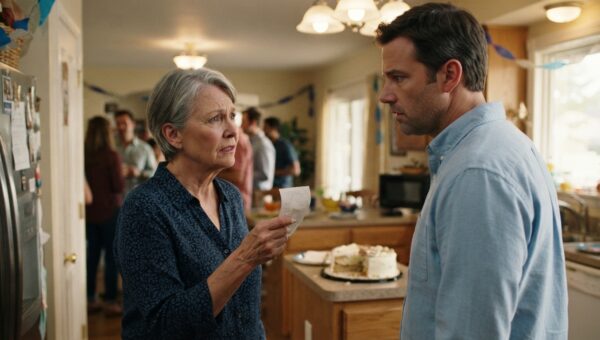
The cedar floorboards in our hallway have this one spot near the linen closet that gives a dry, sharp click under the heel, no matter how soft you try to step. I heard Brenda hit that exact spot at 6:42 in the morning. She didn’t knock on my home office door. She just pushed it open with the flat of her palm, holding a stack of pale blue county tax papers like they were a citation for a misdemeanor.
“You never put me on the title,” she said. Her voice didn’t shake. That was the trouble with Brenda when she was truly angry. She didn’t raise her voice; she just narrowed her eyes until they looked like flint. “Not for twelve years, Dwayne. Twenty-four parcels of land and a three-bedroom house sitting in town, and my name isn’t on a single line.”
I didn’t look up from the ledger on my desk. I kept my pen moving across the column until the ink caught on a dry grain in the paper. I knew this day was coming ever since the county assessor started mailing the secondary statements to our new address instead of the rental property.
“I told you how that house was held,” I said, keeping my tone flat. “Back when we bought the bigger place on the ridge. I told you then.”
“You told me you were keeping it as an investment,” she snapped, stepping further into the room and dropping the papers right on top of my open ledger.
The staple clipped the corner of page four. “You didn’t say you carved out half of it for a boy who wasn’t even my blood.”
My oldest son, Caleb, was twenty-four now. He lived twenty miles away down in the valley, working as an assistant surveyor for the county road department, driving a truck that still smelled faintly of hot oil and pine air freshener. He didn’t know Brenda was holding those papers. He didn’t know Brenda spent her Tuesday mornings checking the online registry for the courthouse in Pendleton.
Back when Clara and I bought that little starter home on Elm Street, the grass was mostly weeds and the front porch had a bad lean to the left. Clara had saved every extra dollar from her job at the feed store, hiding cash in an empty salt tin inside the pantry until we had enough for the earnest money.
We painted those three small bedrooms ourselves over one long weekend in July, the smell of cheap white latex hanging in the air for weeks.
When Clara passed away in that hospital room in Portland, I sat on the edge of the twin bed in the nursery for three days straight holding a rattle that Caleb had dropped between the rungs. The silence in that house was deafening. I raised him alone in those rooms for four years before I ever met Brenda at the hardware store counter while I was picking up copper pipe fittings.
When Brenda and I got married and she moved into Elm Street with us, I kept the deed in my own name. It just felt right. That roof had Clara’s sweat in the timber and my own hands on the shingles. Brenda brought two suitcases and a quiet sort of ambition into the front door, the kind of woman who looked at a room and immediately started measuring where the furniture ought to go.
“We need more space,” she told me one evening while we were washing supper dishes, her belly rounded with our first child together. “We can’t raise four kids in a three-bedroom starter box, Dwayne. We need to sell this place and put the equity into something on the ridge.”
“We aren’t selling Elm Street,” I told her, setting a skillet down hard on the dry rack.
“Why not? It’s dead money sitting here while we’re cramped up.”
“It’s not dead money,” I said. “It’s Clara’s share. It’s for Caleb.”
That was our first real fight. Not the kind where you yell and throw mugs, but the cold kind where neither person speaks across the kitchen table for two days, and the butter knife stays on the left side of the bread plate because you both refuse to reach across the invisible line. She gave in eventually because she had to; we packed up the kids, moved up to the ridge into the four-bedroom house with the wide-plank floors, and turned Elm Street over to a nice young couple from the creamery who paid $850 a month in rent.
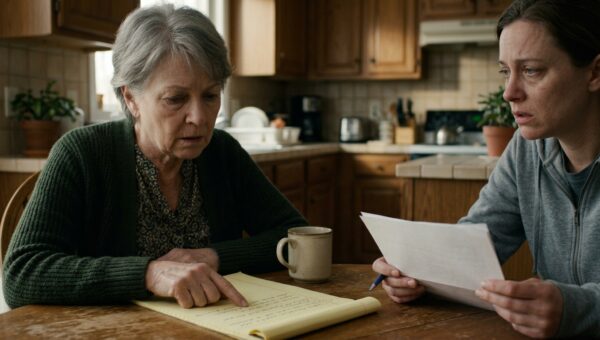
For ten years, that rent money never touched our joint checking account. I opened a separate ledger at the credit union downtown. Every dollar went straight into paying the county taxes, the hazard insurance, and a maintenance fund for the roof and the plumbing. Brenda hated that ledger with a quiet, burning intensity.
“That’s household income, Dwayne,” she said to me every December when the tax forms came in. “We’re paying for piano lessons and braces out of my grocery budget while you’re hoarding cash in a passbook savings account that benefits a boy who already has a mother’s pension.”
“Caleb doesn’t have a pension, Brenda. He has what Clara left him,” I said.
“He has you,” she fired back. “And he has our kids running around his legs every time he comes over for Sunday pot roast. Why do you treat him like a guest in his own family?”
“I don’t treat him like a guest. I treat him like an owner.”
That was the line that crossed the ridge. Three months ago, when Caleb turned twenty-four and finished his surveying certificate at the junior college, I drove him down to the county clerk’s office during my lunch hour. We sat at a scarred oak table while Mrs. Gable, who had known my father, stamped the new warranty deed. I added Caleb’s name right beside mine as joint tenants with right of survivorship.
Now Brenda was standing over my desk in the home office, staring down at those printed pages with her jaw set hard.
“You signed it over,” she said, her voice dropping into a register that made the hair on the back of my neck stand up. “You actually put his name on my back porch, Dwayne.”
“It’s not your back porch, Brenda. You never lived on Elm Street for more than two years before we moved up here.”
“I lived there long enough to clean the grease off your stove,” she said, her voice shaking now, the thin veneer of calm cracking right down the middle. “I lived there long enough to listen to you talk about how we were building a family together. But you weren’t building anything. You were just keeping a shrine to a ghost and a spare room for your firstborn.”
“Caleb earned his place in that house,” I said, standing up from my chair so we were eye to eye. “His mother bought the lumber for the back deck with her own grandmother’s inheritance. You know that. I told you before we ever walked down the aisle.”
“And what about our children?” she shouted, the noise finally breaking loose and carrying out into the hallway where our youngest girl was supposed to be doing her homework. “What do Luke and Sarah get? A father who saves his best property for the one child who doesn’t need us?”
“Luke and Sarah get this house on the ridge,” I said. “They get every acre we bought together. They get my full paycheck, my health insurance, and every dollar in our joint account. But Elm Street stays where it was.”
She stared at me for a long time, her chest heaving under her wool cardigan. The anger in her eyes didn’t turn to tears; it turned to something colder, something settled and permanent, like frost on a late-October pumpkin.
“You think you’re being noble,” she whispered. “You think you’re honoring some sacred promise. But all you’ve done is draw a fence right through the middle of our kitchen table.”
She didn’t slam the door on her way out. She just pulled it shut behind her with a soft, dull click that sounded entirely too much like the cedar floorboards in the hall.
That evening, the house was too quiet. The younger kids ate their meatloaf and potatoes without asking for seconds, sensing the pressure in the air the way cattle sense a low-pressure front rolling in off the mountains. Brenda stayed in the master bedroom with the door half-closed, the low murmur of the small television being the only sound coming from down the hall.
My phone buzzed on the kitchen counter around 8:15. It was Caleb.
“Hey, Dad,” he said, his voice cheerful, background noise of a television game show coming through his end. “You guys coming down for Sunday dinner this week? Sarah was asking about the pie recipe.”
I looked out the kitchen window toward the ridge road, where the tail-lights of a passing pickup truck cut red streaks through the pine dark.
“We’ll be there, son,” I said, my thumb rubbing the smooth edge of the desk key in my pocket. “Tell Sarah we wouldn’t miss it.”
I hung up the phone and walked over to the heavy oak filing cabinet in the corner of the pantry. I pulled out the top drawer, sliding past the utility bills and the vehicle titles until my fingers found the thick manila folder labeled with the address on Elm Street. Inside lay the original warranty deed from twenty-four years ago, and right beside it, the fresh blue-inked copy bearing both my name and my oldest boy’s name, registered and sealed by the county.
I tucked the folder back into the dark, slid the drawer shut until it caught with a heavy thud, and walked out to the front porch to watch the dark settle over the land we built.