Maggie didn’t cry when her mother passed away four years ago, and maybe that worried me more than if she had. Kids at three don’t always have the vocabulary for empty chairs and quiet hallways, so she just held tighter to that faded pink rabbit with the chewed-up ear and watched the front door like mail delivery. I raised her alone for thirty-six months in this old brick house near the river, keeping the routine simple with oatmeal at seven and school drop-offs at eight, figuring we were a complete unit even if the edges were a bit frayed.
Then Clara walked into my hardware store on a Tuesday in October looking for galvanized hinges, and for the first time since the hospital monitors stopped beeping, the silence in my chest didn’t feel quite so heavy.
We dated for a year before I put a ring on her finger. Clara was thirty-two, steady-handed, with a laugh that made Maggie’s face light up like a string of Christmas bulbs. She moved into the house with two suitcases and a box of old college books, and within three months she knew which floorboards creaked in the hallway and how Maggie liked her peanut butter spread thin on graham crackers. I thought we had built something solid out of the wreckage of our separate griefs. I figured the foundation was poured deep enough to hold whatever weather came our way, because when you are a widower with a little girl, you look for permanence the way a sailor looks for a lighthouse in a fog.
The break came on a Thursday night in late November. The furnace had kicked on with a dry metallic rattle that always made the floor hum, and I was sitting at the kitchen island trying to balance the quarterly ledger for the store when Maggie wandered in past her bedtime. She was dragging that rabbit by its ear, her bare feet padding softly against the linoleum. She climbed up onto the stool beside me without a word, resting her chin on her small palms, and her eyes looked too big for her face in the kitchen light. That was when she asked the question that stopped the blood in my veins.
“Daddy, new Mom asked me to keep a secret from you. Is that okay?”
I put the pen down so hard the plastic barrel cracked against the oak. My heart gave a hard, ugly thud against my ribs. In our house, secrets were the one currency we didn’t trade in, not after losing her first mother to a sudden pulmonary embolism that took her before she could even say goodbye.
“No, sweetheart,” I said, keeping my voice level even though my hands had started to shake. “You can tell me anything. What kind of secret?”
Maggie blinked, staring down at the rabbit’s worn flannel nose. “Yesterday, I woke up early because I heard a thump by the back door. I went out to the hallway and saw her with a man coming out of the basement stairs. She told me not to tell you because it would make you sad.”
The kitchen felt ten degrees colder. “What did he look like, Maggie?”
“He was really handsome, Daddy,” she whispered, her voice small and serious. “He had nice blond hair, like a prince in my storybook, and a red jacket. He smelled nice, too. Like fancy soap.”
My mind raced through every cousin, neighbor, and delivery driver I knew, coming up completely empty. Clara didn’t have any local family to speak of, or so she had told me during our late-night talks on the front porch.
The only men who crossed our threshold were the mailman and my aging business partner, neither of whom owned a red jacket or smelled like cologne.
“Did he say anything to you?” I asked, leaning in close so she knew she was safe.
“He just put his finger to his mouth like this,” she said, pressing her index finger against her lips. “And then Clara gave him her car keys and told him to wait in the shed until dark. But he didn’t look like a bad man, Daddy. He just looked scared.”
I tucked Maggie back into bed fifteen minutes later, watching the steady rise and fall of her small shoulders until her breathing evened out into sleep. Then I walked back down the hallway, every muscle in my neck locked tight. Clara wasn’t home; she had gone out to the pharmacy for cough syrup twenty minutes earlier, leaving her old tablet sitting right beside the butter dish on the counter.
The screen was dark, but as I walked past, a notification light blinked amber. A text preview flashed across the glass in bright white letters.
“Need another two grand by midnight or I’m coming through the front door,” the message read, coming from an unlisted number. Below it, a banking app alert showed an outgoing wire transfer of $11,450 to an account bearing the name Julian Vance.
I didn’t wait for Clara to come back with the cough syrup. I took the basement key from its hook by the pantry, my hand slick with nervous sweat, and walked down the wooden steps into the damp dark. The house above me creaked as the heater settled, but down here the air smelled stale and distinctly wrong. It smelled like cheap tobacco and expensive cologne mixed with the damp limestone of the foundation.
I clicked on my phone flashlight, sweeping the beam across the rows of storage shelves where we kept old Christmas decorations and spare paint cans. Behind the tall shelving unit that held our winter coats, the concrete floor had been swept clean of dust. Near the utility door that led out to the overgrown side yard, a single thread of bright red nylon fabric was snagged on a rusty latch. On the shelf right above it, the velvet-lined mahogany box where I kept my grandfather’s antique silver pocket watch and emergency cash reserve was sitting wide open and completely empty.
By the time Clara’s sedan crunched down the gravel driveway at 9:15 that night, my stomach had knotted into a hard, cold fist. I was sitting at the kitchen table with the empty mahogany box in front of me and her tablet propped up against the sugar bowl. The house was dead quiet except for the hum of the refrigerator.
The front door clicked open, and Clara stepped into the entryway, shaking the November mist from her hair. She looked tired, the dark circles under her eyes deeper than usual, holding a small paper bag from the pharmacy like a shield against her chest.
“You’re up late,” she said, her voice dropping an octave when she saw my face across the wood. “Is Maggie okay?”
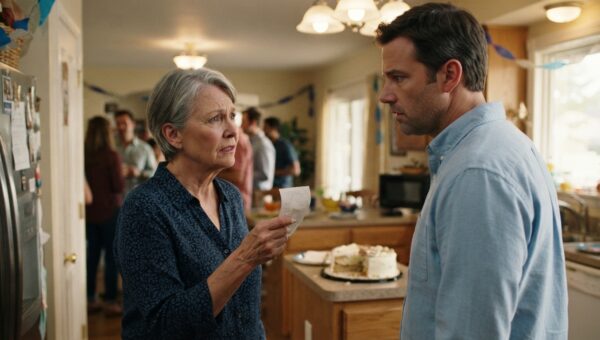
“Maggie’s fine,” I said. My voice didn’t sound like mine; it sounded flat and hollow, stripped of all the warmth I usually reserved for her. “She told me about the prince in the red jacket.”
Clara froze halfway across the kitchen. The paper bag slipped from her fingers, hitting the linoleum with a dull thud, though nothing inside broke. The color drained out of her face so fast her skin looked like old parchment under the overhead bulb. She didn’t try to smile or pretend she didn’t know what I meant. She just reached out and grabbed the back of the wooden chair opposite me, her knuckles turning white as chalk.
“How much did he take, Clara?” I asked, pointing down at the empty mahogany box between us.
She opened her mouth, but no sound came out at first. Her chest rose in a ragged, shaking breath, and when she finally spoke, her voice was barely a whisper. “He’s my brother, Caleb. Julian.”
“Your brother,” I repeated, the words tasting like ash. “The one you told me was estranged and living out west.”
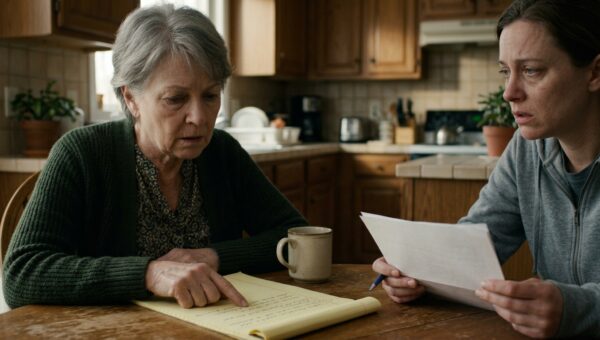
“He was,” she sobbed, sinking slowly into the chair as if her legs had finally given out. “He came to the back door three nights ago, soaking wet and half-starved, talking about loan sharks and men who were going to break his legs if he didn’t pay up. He found me at the grocery store last month and tracked me down here. I didn’t know what else to do. If you found out about his debts, I thought you’d look at me differently. I thought you’d think my family was poison and throw us both out.”
“You hid a fugitive in our basement while my seven-year-old daughter was sleeping upstairs,” I said, leaning forward until the wood groaned beneath my elbows. “You lied to my face every morning while you were emptying our savings to feed a gambler.”
“He’s my blood,” she cried, her hands coming up to cover her face as the tears finally broke through. “What was I supposed to let them do to him? He promised it was the last time. He swore he’d leave the state.”
“He texted you two hours ago demanding another two thousand dollars,” I said, sliding the tablet across the table so the glowing screen hit her eyes. “And he’s not leaving the state, Clara. Because right now, we are going to finish this.”
She looked down at the screen, then up at me, her lower lip trembling violently. “What are you going to do?”
“I’m not throwing you out,” I said, and the words surprised even me, coming out heavy and deliberate in the quiet room. “And I’m not going to let your brother destroy what we built here. But your enabling ends tonight.”
I reached out and picked up my landline receiver, pushing it across the table toward her hands.
“You are going to dial the sheriff’s department,” I told her, my voice hard as iron. “You are going to report a trespasser and an extortionist, and you are going to tell them exactly where he is hiding. If he’s still in that shed, the authorities are going to deal with him. If he’s gone, we’re changing the locks before morning.”
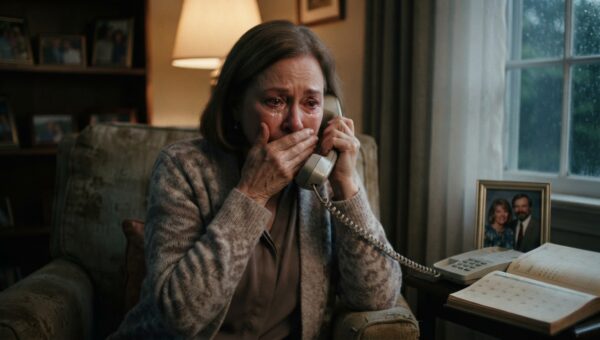
Clara stared at the phone for a long, agonizing minute, her shoulders shaking with quiet sobs. The clock on the wall ticked off the seconds with a heavy, damp sound. Finally, with trembling fingers, she reached out and picked up the handset, pressing the buttons one by one while I sat watching her through the harsh light, knowing our lives would never be as simple as they were yesterday, but knowing too that the truth was the only thing left that could save us.
The morning sun came up pale and watery over the river, casting long gray shadows across the front porch where Maggie sat wrapped in a heavy wool blanket, sipping her warm milk without a word. By the door sat a single taped-up cardboard box containing Julian’s forgotten jacket and a few changes of clothes, marked for the deputies to pick up as evidence of the trespassing complaint. Clara stood just inside the open front screen door, one hand resting lightly on the wooden frame, watching us with tired, red-rimmed eyes that didn’t ask for forgiveness yet. I sat down on the porch swing beside my daughter, pulling her close against my side, and when the metal chains gave their familiar dry squeak in the morning wind, it sounded like the house was finally breathing again.