The hardwood in the upstairs hallway has this one dry spot near the linen closet that gives a little click under your heel if you don’t step right over it, and I must have stepped over it a hundred times in my life without thinking twice. That night at 2:04 in the morning, my heel caught it anyway. The faint click was swallowed instantly by the low, steady murmur coming through the cracked door of the guest room where Warren said he was staying because his allergies were acting up and he didn’t want to keep me tossing and turning.
I didn’t turn the overhead light on. I just stood there in the dark with my bare feet flat against the cool grain of the wood, listening to a voice that belonged to my husband of fourteen years whispering things he hadn’t said to me since we bought this house. He was leaning against the guest room window frame looking out at the dead flowerbeds in the front yard, holding his phone down low near his belt line like he was trying to muffle the sound with his own ribs.
“I love you, baby. She doesn’t suspect a thing,” he murmured into the small black rectangle. “Just hold on until after the holiday. We’ll sell the place and be clear of all this by January.”
I stood in that hallway for eleven minutes. I didn’t count the seconds when I first stopped, but my legs started to ache around minute four and by minute nine my hands were cold enough that I had to cross my arms and dig my fingernails into my flannel sleeves to keep from shaking.
Eleven minutes of standing in the dark while a man I had cooked breakfast for every single Sunday morning mapped out the liquidation of my entire life to someone whose name I didn’t even know yet.
When he finally clicked the end button and the soft blue glow of his screen went black, I didn’t march in there. I didn’t throw a lamp or scream or wake the quiet house up with the kind of ugly crying I had always assumed I would do if I ever found myself in this exact stupid cliché of a marriage. My chest felt hollow, like someone had scooped out the middle with a melon baller, but my head was remarkably clear. I backed away from the door, careful to clear that dry spot in the hallway, and crawled back into our bed where Warren slid in five minutes later smelling of mint toothpaste and cold night air.
The morning light came through the sheer curtains with that pale, flat grayness that always settles over the Texas panhandle in late November. Warren was already downstairs whistling under his breath, clattering the ceramic coffee mugs around like a man who had nothing on his mind heavier than what he was going to order for lunch at the yard. I sat on the edge of the mattress and dialed a number I found after twenty minutes of scrolling through my phone while pretending to check the weather.
“Law offices of Miller and Vance,” a sharp voice answered.
“I need an appointment,” I said, my voice sounding stranger to my own ears than Warren’s midnight whispers had. “First thing this morning. It’s about marital assets and a joint account.”
By 9:30 AM I was sitting across a scarred oak desk from a woman named Sandra Miller who wore heavy silver rings and didn’t blink when I laid out the details of the phone call, the fourteen years of bookkeeping I had handled down to the last receipt, and the $340,000 sitting in our primary joint savings account from the sale of my mother’s land down in Midland.
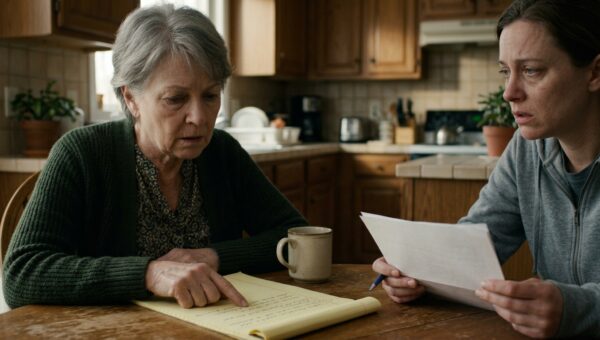
Sandra didn’t offer me a tissue or tell me she was sorry. She just slid a yellow legal pad across the blotter and started writing down account numbers at a speed that made my head spin.
“Under our state code, liquid assets held in joint accounts are accessible to either party,” Sandra said, her pen scratching rhythmically against the paper. “If you move it now before any formal filing, into a restricted trust with a corporate trustee, it stops being joint property he can drain for his new life. Do you want to do it today?”
“I want to do it right now,” I told her.
The next three weeks were the strangest stretch of time I have ever lived through. Warren went to work every morning at seven, kissed my cheek at the back door, and texted me heart emojis around noon just like he had since the Bush administration. Every evening he came home, kicked off his work boots by the back mat, and asked me how my day at the community center went while he poured himself a glass of bourbon. I poured my own iced tea, sat across from him at the walnut dining table, and smiled at his jokes about the new district manager.
He thought he was being clever. He thought because I didn’t storm out or ask why he was spending an extra hour at the office on Tuesdays that I was simple, that I was the kind of woman who would just fold up her laundry and move into a studio apartment without asking questions when he finally dropped the hammer after Christmas. Every time he mentioned the upcoming holiday dinner with his sister in Fort Worth, I nodded and asked if he thought we should bring the good cranberry relish or the store-bought one.
“Whatever you think, honey,” he’d say, swirling the amber liquid in his glass. “You always make it better anyway.”
Sandra called me twice during those three weeks to confirm the paperwork. The $340,000 was moved, the trust was sealed tight with a corporate firewall that required two signatures Warren didn’t have access to, and the formal separation filings were sitting in a Manila folder in the bottom drawer of my cedar chest upstairs. The house was mine by pre-nuptial agreement before we even married, a detail Warren had apparently forgotten or assumed didn’t matter now that he was scaling up his life for someone younger.
Last night the wind kicked up from the north, rattling the loose flashing around the chimney and making the old cedar siding creak the way it always did when a blue norther blew in. Warren came through the back door at six o’clock shaking snow off his shoulders and holding a long plastic sleeve from the supermarket floral department containing a dozen red roses that were already starting to turn brown around the petal tips.
“Rough day on the site,” he said, dropping his keys into the ceramic bowl by the door and walking over to kiss the back of my neck while I was stirring the pot of stew on the stove. “Traffic was backed up all the way past the grain elevator.”
He set the tired-looking roses down right next to the salt shaker and wrapped his arms around my waist from behind, pressing his chin into my shoulder blade with that heavy, performative sigh he always used when he wanted me to feel sorry for how hard he worked.
“You’re the only woman I’ll ever love,” he whispered into my hair, his breath smelling faintly of the peppermint patties he kept in his truck console.
I didn’t stiffen up. I didn’t pull away from his grip. I turned around in his arms, smoothed down the lapel of his wool coat with both hands, and gave him a small, perfectly normal smile.
“I know you are, Warren,” I said, and kissed his cheek right where his razor had left a little patch of stubble he missed.
I reached down behind the bread box where I had slid the thick Manila envelope right before I heard his truck pull into the gravel drive. I lifted it out and laid it flat across the white laminate counter between the mail holder and the fruit bowl.
“Here,” I said quietly. “Open this before you wash up.”
Warren gave a short, nervous little laugh, the kind of sound a man makes when he thinks his wife has finally bought him that chainsaw he’s been hinting at for his birthday. He reached out with two fingers, hooked the metal clasp on the envelope, and slid the flap open. He pulled out the first three pages, his eyes scanning the dense columns of legalese, the asset inventory, and the bold court headings from Sandra’s office.
The color didn’t just drain from his face; it seemed to vanish underneath his skin entirely until he looked like something carved out of old tallow. His lips stayed parted in that half-formed smile for three full seconds before his jaw finally went slack. He dropped the papers back onto the counter, where they scattered across the laminate like dead leaves, and his hands came down flat on either side of the fruit bowl to keep himself from swaying.
He looked up at me with his eyes wide and dark, his chest moving in short, shallow hitches that didn’t sound like breathing at all.
“How long have you known?” he whispered, his voice cracking on the last word like dry timber.
I leaned back against the edge of the stove, folding my hands over my apron strings, and looked right into his face without blinking.
“Since eleven minutes after two in the morning, three weeks ago,” I said. “And the $340,000 moved into the trust last Tuesday, Warren. You can call Sandra Miller in the morning if you want to talk about your half, but I’m pretty sure she’s going to tell you the same thing she told me: you’re already late.”
He stood there staring at me for a long, heavy second, his mouth opening and closing once or twice like a fish pulled up onto the dock before he finally realized there wasn’t a single thing left in this house for him to say.