Seven hundred and twenty-two dollars. That was the exact balance on my personal store card when Clara decided she needed a new set of salon-grade shears and three bottles of professional toner delivered straight to our front porch by Thursday afternoon.
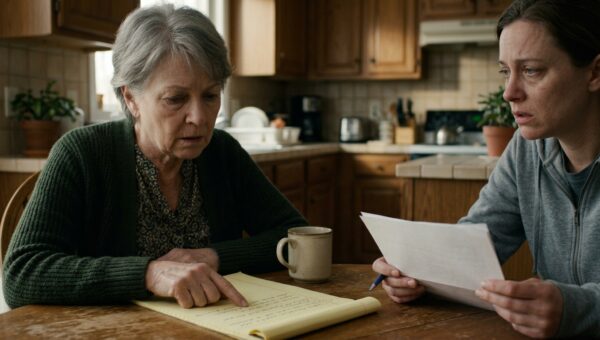
I was sitting right there at the oilcloth-covered kitchen table with my ledger open, trying to balance our grocery money against the rising cost of propane, when Paul tossed the mail bill aside and dropped the plastic square between my coffee mug and the sugar bowl.
He didn’t even look up from his oatmeal. He just flicked it across the laminate like he was dealing a card in a basement poker game.
“Clara’s got a client at two,” Paul said, his voice flat and heavy like wet clay. “Give her the card. She’ll run it and drop it back in the mailbox before dark.”
I picked up the little piece of blue plastic and turned it over between my thumb and forefinger. The numbers were worn smooth from years of being tucked into the side pocket of my purse, right next to the spare house key and my mother’s small silver rosary. It wasn’t even a joint account. I had opened that card five years ago back when I was working thirty hours a week down at the county extension office, before Paul convinced me that a wife’s place was managing the homestead while he hauled gravel for the highway department.
“Paul, she maxed out the department store card last month buying those perm rods,” I said, keeping my voice down because I knew how quickly the blood rushed into his ears when he didn’t get an immediate nod. “We have the truck insurance coming due on the twelfth. There isn’t spare room on this account right now.”
That was the wrong thing to say. I knew it was the wrong thing to say the second the words left my tongue, because Paul stopped chewing. He didn’t swallow his bite. He just sat there with his jaw locked, staring right past my left ear at the calendar hanging by the pantry door.
The coffee pot on the stove gave a dry, metallic hiss as the last few drops cooked down on the burner. Paul reached out his large, red-knuckled hand and wrapped his fingers around the handle of my heavy ceramic mug.
The coffee inside wasn’t fresh-brewed; it was the second-reheated sludge from thirty minutes prior, dark and thick and holding just enough heat to sting. He didn’t yell a warning. He didn’t stand up to clear his head. He just jerked his wrist sideways with a sharp, ugly snap.
The scalding liquid hit the right side of my face like a handful of hot gravel, splattering across my cheekbone, catching the corner of my mouth, and soaking straight through the collar of my cotton blouse. The heat didn’t feel like warmth at first. It felt like cold steel pressing hard against my skin, sharp and freezing until the burn set in two seconds later with a vicious, throbbing crawl.
I let out a sharp gasp, dropping my hands to the table and knocking my chair backward onto the linoleum with a heavy clatter. My skin started to prickle and swell almost immediately, the heat radiating right up into the bone beneath my eye.
Paul stood up so fast his chair legs screeched against the floorboards. His face was mottled dark red from his collar up to his hairline, his chest heaving under his flannel shirt like an old pump priming dry. He leaned right across the table, his breath smelling of chicory and stale tobacco, and pointed a thick finger straight between my eyes.
“Hand over your stuff or get out,” he shouted, his voice cracking on the last word. “You want to pinch pennies over a few salon supplies while my sister helps pay the light bill around here? Hand over the plastic or pack your bags right now because I am sick to death of your miserable little hoarding habits.”
Burning with a mix of blinding pain, raw humiliation, and a sudden, cold fury that cleared my head better than ice water ever could, I didn’t cry. I didn’t reach for a towel. I just stood there for three long seconds, watching the dark coffee drip off my chin onto the front of my shirt.
“You’re done,” I whispered. My own voice sounded thin and far away, like someone else talking across an empty room.
I didn’t argue. I didn’t try to reason with a man whose eyes had gone flat and narrow like a cornered dog’s. I turned on my heel and walked straight past him down the narrow hallway to the spare bedroom, leaving my ledger open on the table and the blue plastic card sitting right beside the sugar bowl. My face felt like it was sitting too close to an open stove burner, the skin tightening and pulling every time I blinked.
I grabbed my canvas duffel bag from the top shelf of the closet and started throwing things in without looking. Three pairs of work slacks, four cotton shirts, my heavy winter coat, and the small mahogany box containing my mother’s jewelry. I didn’t take anything Paul had bought me. I didn’t take the silver casserole dish or the matching lamps in the parlor. I took my grandfather’s pocket watch, my birth certificate from the tin box under the bed, and the clothes on my back, damp and smelling of burned chicory.
The screen door banged shut behind me as I hauled the canvas bag out to the porch. Paul was still standing in the kitchen doorway, arms crossed over his chest, looking smug and untouchable in the dim morning light.
“Don’t bother coming back before dark,” he called out, his voice carrying down the gravel drive. “You’ll find your bags on the grass.”
I didn’t look back. I climbed into my old sedan, turned the key, and pointed the hood toward the county hospital down on Maple Street. My cheek was throbbing in time with the engine idling, a dull, pulsing ache that made my teeth hurt on the right side.
The waiting room at Mercy General was quiet at six-forty in the morning. A young nurse with tired eyes and a clipboard took one look at the mottled, blistering skin across my cheek and jawline, bypassed the sign-in window entirely, and led me straight back to an examination room with a rolling metal stool and a sink that smelled strongly of pine disinfectant.
The doctor on duty was a quiet, gray-haired man named Dr. Vance who moved with deliberate slowness, asking questions while he gently irrigated the scalded skin with cool saline solution. He didn’t make a fuss, and he didn’t offer any cheap comfort. He just treated the burn with soothing antibiotic ointment, wrapped a loose sterile dressing around the side of my face to keep the air off it, and asked me how the injury had happened.
“Hot liquid,” I said, staring at the little white paper roll on the counter. “My husband threw a cup of coffee at me during an argument.”
Dr. Vance paused, his gloved fingers resting on the edge of the metal tray. He looked at my chart, then up at my eyes, holding my gaze with a steady, professional weight that didn’t leave any room for evasion.
“We have to document this,” he said quietly. “And we have a deputy stationed out front this morning for the early shift. Do you want to file a formal complaint?”
I sat there on the examining table, feeling the cool air-conditioning draft across my bare arms, and thought about the way Paul had stood in that kitchen doorway with his arms crossed. I thought about the department store card, the salon shears, and the twenty years of keeping my voice low so I wouldn’t set off his temper before he left for the county yard.
“Yes,” I said. My voice didn’t shake at all.
Ten minutes later, a young deputy with a neatly pressed uniform and a pocketful of wooden pencils came into the room. His name tag read Miller. He listened without interrupting while I told him about the breakfast table, the coffee, the credit card, and the exact words Paul had used when he threw me out. He took three photographs of my face from different angles using a department camera that clicked with a sharp, tinny snap, and he wrote down every detail in a small yellow notebook.
“You have a legal right to retrieve your personal property and belongings from the residence, ma’am,” Deputy Miller said, snapping his notebook shut with a definitive thud. “We can provide an escort so there’s no breach of the peace. Are you ready to go back now?”
“Let’s go,” I said.
We drove back to the house in separate cars, my sedan following the black-and-white cruiser down the long gravel stretch that lined our property. The sun was just clearing the top of the timberline behind the barn, casting long, sharp shadows across the frost-covered grass. Paul’s pickup truck was still sitting by the machine shed, which meant he hadn’t left for work yet, or he had come back after dropping Clara off at her shop.
Deputy Miller parked right behind the pickup, blocking the exit, while a second cruiser pulled in behind him with its headlights still burning in the gray morning light. The two officers walked with me up the wooden porch steps, their heavy boots making a solid, reassuring thud against the painted floorboards.
I unlocked the front door and pushed it open. The house was dead silent, smelling faintly of cold coffee and bacon grease from the skillet left unwashed on the stove.
Paul came around the corner from the hallway leading to the back bedroom, his eyebrows drawn together in a dark, heavy scowl. He had a mug in his hand, but when he saw the two uniforms standing behind my shoulder, his expression didn’t just change; it completely collapsed, the color draining right out of his cheeks until he looked the color of skim milk.
“What is this?” he stammered, taking a half-step back toward the dining room table where my ledger was still lying open. “What are these men doing in our house?”
“They’re here to keep the peace while I pack the rest of my gear, Paul,” I said, walking past him into the kitchen without looking at his face. “You told me to get out. I’m just finishing the job.”
The next twenty minutes were a blur of quick, efficient movement under the watchful eyes of the two deputies. I grabbed my winter coats from the hall closet, three more boxes of linens from the spare room, my grandmother’s cast-iron skillet from the bottom shelf, and the heavy plastic tote containing my tax papers and work records. Deputy Miller stood by the bedroom door with his hands resting casually on his utility belt, while Paul hovered near the doorway like a ghost, his mouth opening and closing a few times without any sound coming out. He looked smaller somehow in the morning light, his shoulders slumped beneath his gray flannel shirt, realizing too late that his voice wasn’t the loudest thing in the room anymore.
When I reached the kitchen island, I stopped. The blue department store card was still sitting right there beside the sugar bowl, untouched since morning.
I reached out, picked up the card, and slid it into the side pocket of my canvas duffel bag. Then I reached up to my left hand, pulled my gold wedding band off my knuckle, the simple, plain band Paul had bought at the jeweler down in Poplar Bluff twenty-two years ago, and dropped it right onto the center of Deputy Miller’s clipboard, resting on top of the open incident report.
“For the file,” I told the deputy.
Deputy Miller looked down at the little circle of gold resting against the white paper, then up at my face. He didn’t ask any questions. He just made a small checkmark with his wooden pencil and slipped the report into a heavy leather binder.
We carried the last boxes out to the trunk of my sedan while Paul stood frozen in the middle of the kitchen, watching through the screen door like a stranger locked out in the cold. I didn’t say goodbye. I didn’t look back to see if he was watching me drive down the gravel drive.
Twenty minutes later, I pulled into the parking lot of the apartment complex over on Elm Street, where my sister had told me a ground-floor unit was sitting empty and waiting for a tenant. I turned off the engine, sat in the quiet driver’s seat for a long moment while my cheek throbbed against the cool air from the cracked window, and reached for the keys.
The deadbolt on the inside of the front door clicked shut with a solid, unhurried turn, heavy and clean and entirely my own.