Seventeen years, three months, and twelve days. That is how long my father carried the quiet weight of a secret he never asked for, long before I ever understood what it cost him to keep his hands steady on the handlebars of an old Schwinn.
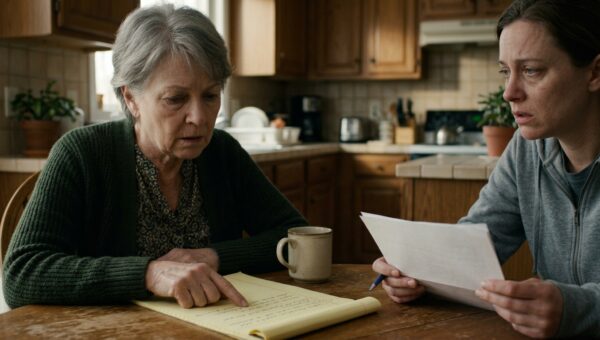
I still remember the smell of iron and wood varnish in our hallway, and how my dad, Curtis, used to sit at our round laminate kitchen table long after midnight with a yellow legal pad and a cheap ballpoint pen, calculating the cost of groceries down to the nickel.
He never complained about the hours at the machine shop, and he never let me see the raw blisters on his palms when he came home from the second shift at 11:45 at night. He just washed his face, kissed the top of my head while I was half-asleep on the sofa, and started boiling water for morning oatmeal.
The story of how I arrived in his life was something I knew by heart before I was old enough to read. It was the night before his high school graduation in a river town in southern Illinois, when Curtis found his old bicycle leaning against the side fence by the garden. Inside the rusted wire basket was a bundle of flannel blankets, a plastic baby bottle filled with lukewarm formula, and a torn piece of lined notebook paper. The note was written in blue ink that had already started to smudge from the evening damp.
She is yours. I can do this. That was all it took to change the trajectory of two lives forever. He did not know my mother was pregnant, and he never saw her again.
The next morning, while other seventeen-year-olds were arguing about neckties and graduation tickets, Curtis walked across the football field bleachers holding his cardboard-backed diploma in one hand and me in the other, with my tiny pink fingers curled around his thumb. He gave up his scholarship to the state university three hours north, took a job sweeping floors at the grain elevator, and spent his weekends learning how to braid fine brown hair without pulling my scalp. He was my father, my mother, my home, and my shield all at once.
So when my own college graduation day finally arrived under a blinding mid-morning sun at the university quad, I thought I knew the exact shape of my gratitude.
The air smelled of hot asphalt, sweet popcorn from the concession carts, and cut grass. Thousands of families were packed into the aluminum bleachers, waving small plastic banners and shouting names over the loudspeakers. I was sitting in the third row of the graduate section, wearing my heavy black gown, smoothing down the folds of my dress, and looking out over the crowd to find Curtis sitting right where he promised he would be, holding a battered camera with a cracked viewfinder.
The provost was halfway through reading the names from the College of Education when the disruption started three rows behind my father. It was not a loud commotion at first, just a sharp intake of breath and a woman’s voice cutting cleanly through the polite murmur of the audience.
“Before you celebrate,” the voice rang out, sharp and trembling with an old bitterness. “There is something about your father you don’t know.”
The words hit the back of my neck like a splash of ice water.
The noise of the stadium seemed to fold in on itself, shrinking down to the dry rustle of programs and the heavy thud of my own pulse. I didn’t turn around immediately. I looked straight at Curtis. His shoulders, usually broad and relaxed beneath his faded plaid button-down shirt, had locked completely rigid. The camera in his hands stayed frozen, his thumb resting halfway down the shutter button as the color drained straight out of his face, leaving him staring straight ahead at nothing at all.
I stood up from my folding chair, letting my graduation program slide off my lap and flutter to the aluminum floorboards. The girl next to me whispered my name, but I ignored her, stepping past my row and turning around to face the source of the interruption.
The woman standing in the aisle was in her late fifties, wearing a tailored navy blazer that looked entirely too heavy for the humid June morning. Her silver hair was pulled back into a severe French twist, and her fingers were clutching a worn leather handbag so tightly her knuckles were stark white. She was looking right at me, her eyes wet with tears she was trying very hard not to shed.
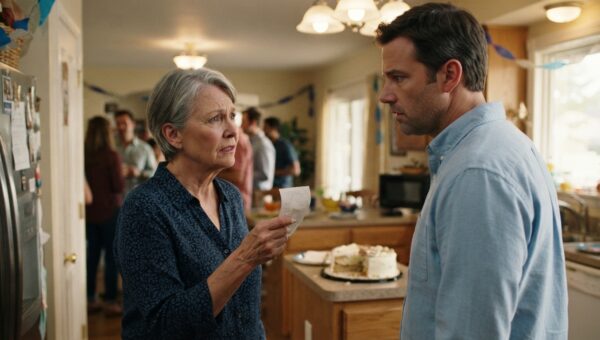
“You are Lauren,” the woman said, her voice dropping an octave, though it carried easily in the sudden, heavy silence of our section. “And he never told you about the check, did he? He never told you what he tore up in the kitchen the morning he found you.”
“Who are you?” I asked, my voice shaking with a sudden, fierce anger that pushed right past the shock. “Sit down. You don’t know anything about my dad.”
“I am Elena,” she said, taking a ragged breath that caught in her throat. “I am the sister of the girl who left you in that basket. And our mother spent her entire life believing Curtis ruined our family, until last week when she finally told me the rest of the truth on her deathbed.”
People around us were staring now, heads turning from the stage to watch the confrontation unfold in the aisles. Curtis stood up slowly from his seat, his knees making a faint, dry pop, and pushed his way through the row of strangers until he was standing right beside me, placing one heavy, calloused hand gently on my forearm.
“Let it go, Elena,” Curtis said, his voice lower than I had ever heard it, stripped of all its usual warmth, sounding like gravel shifting under a heavy truck tire. “The girl is graduating today. Leave it be.”
“No, Dad, he’s not leaving anything,” I said, looking back and forth between them, the protective instinct flaring up hot and bright in my chest. “If she has something to say, she can say it right here, or she can follow us outside right now.”
We didn’t wait for the end of the ceremony. The three of us walked away from the sea of black gowns and cheering families, moving past the concession stands toward the shaded stone courtyard behind the administration building where the fountains were dry and quiet. The noise of the brass band faded into a dull, rhythmic thud against the brick walls.
Elena dropped her handbag onto a concrete bench and sat down heavily, covering her face with both hands for a long moment before she looked up at my father.
“He tore it up,” she whispered, looking at me instead of him. “Our father, your grandfather, tracked Curtis down three days after you were left on that porch. He wasn’t a poor boy with no options. He was a man who wanted a clean break for my sister because she was eighteen and had a scholarship to Northwestern waiting for her. They left you in that basket as a test. They thought a seventeen-year-old kid with a broken-down bicycle would take the check, sign the relinquishment papers, and walk away.”
My breath hitched. “What check?”
“Ten thousand dollars,” Elena said, her voice breaking on the number. “In 2007, that was enough to buy a small house in this town. My father drove out to your house on the edge of the county road, laid the cashier’s check right on top of that grease-stained kitchen table, and told Curtis he could have his youth back if he just signed his rights away and forgot he ever found a baby in his bicycle basket.”
I slowly turned my head to look at my father. He wasn’t looking at Elena. He was staring down at his own calloused hands, rubbing his thumb slowly over the scar across his left knuckle where he had caught it in a lathe machine back when I was eight years old.
“What did you do, Dad?” I whispered.
Curtis finally looked up, his steady brown eyes meeting mine without a trace of shame, only a deep, quiet exhaustion that had taken seventeen years to settle.
“I told him to get off my property before I took the garden rake to his windshield,” Curtis said simply. “And then I tore the paper into four pieces and threw them in the wood stove. You don’t hand back a child like she’s a misdelivered package, Lauren. You just don’t do it.”
Elena let out a long, shuddering sob and reached into her leather handbag, pulling out a small, heavy envelope yellowed with age. She held it out toward me, her hand trembling so badly the paper fluttered in the warm breeze.
“My mother kept this,” Elena said softly. “She didn’t want me to bring it, but after she passed away last Tuesday, I found it locked in her cedar chest. It’s the original letter my sister wrote before she left home, the one our father made her rewrite into that cold note you found in the basket. She wanted you to have it. She wanted you to know that someone did love you from the very beginning, even if she was too scared to stay.”
I didn’t take the envelope at first. I looked at Curtis, waiting for a sign, a flicker of the anger he must have carried every single day since I was an infant. But my dad just gave a small, almost imperceptible nod, his face softening into that familiar, gentle expression I had known every morning of my life.
“Take it, kiddo,” he said, using the nickname he had given me when I was small enough to fit inside his winter coat. “It’s part of your story, too.”
We didn’t stay to hear the rest of Elena’s apologies. She walked away down the gravel path toward the parking lot, her head bowed against the bright midday sun, leaving the yellowed envelope resting on the cold stone of the bench. I picked it up, but I didn’t open it right away. Instead, I wrapped both arms around my father’s waist, burying my face against his broad shoulder, right where the faint, permanent smell of machine oil and laundry detergent always lived. He held me tightly, his strong arms closing around my back just like they used to when I was little and scared of the thunder.
Later that evening, after the graduation dinner was over and the house had grown quiet, we sat together at the same round laminate kitchen table where he used to calculate our grocery money by the light of a single overhead bulb.
In the center of the table, resting side by side in the warm glow of our old lamp, were two things that didn’t belong in the same room, yet somehow told the entire story of my life. One was the tattered, grease-stained high school graduation cap from seventeen years ago, its cardboard brim warped from an old rainstorm. The right next to it sat my brand-new university degree certificate, bound in heavy blue leather with gold lettering that caught the light.
Curtis reached out, his rough thumb brushing lightly against the corner of my diploma before resting on the edge of the old cap. Neither of us said a word. The house was completely still, save for the low, steady hum of the refrigerator in the corner and the familiar, quiet rhythm of a life built out of nothing, held together by nothing more than a seventeen-year-old boy who refused to let go.