The transfer orders from Fort Meade were sitting right next to my coffee mug when the knock came at 11:42 in the morning. They were crisp, official, and entirely routine. A standard lateral move to a logistics command two states over, stamped and signed by a major who probably hadn’t looked at my face twice. But my parents didn’t see routine. They saw a dismissal. They saw failure.
Mr. Alvarez stood on the other side of my threshold holding a thick manila envelope that smelled faintly of brand-new currency. He looked uncomfortable, his thumb rubbing the edge of his collar the way he always did when the tenants downstairs were fighting about parking. He cleared his throat twice before he even looked me in the eye.
“Your parents came by the front desk about twenty minutes ago,” Mr. Alvarez said, his voice dropping into that low, confidential register he used when he thought someone might be listening in the hall. He set the envelope right on the small wooden table by the door without asking. “They said you were done with the service. Discharged. They were pretty worked up about it.”
I picked up the transfer orders, folding the bottom edge once between my thumb and forefinger. I already knew how my mother operated.
Every transition in my life had to be managed, scrutinized, and ideally intercepted before I could ruin things on my own.
“Let me guess,” I said, looking down at the heavy paper. “They figured I was out on my ear.”
“They were convinced,” Mr. Alvarez said, shaking his head. “Mr. Harrison told me you needed a hard lesson. He said forcing you out today would help you face reality. They left that for you.” He tapped the corner of the thick envelope. “Five thousand dollars in cash. They told me to clear your things out before sunset and change the deadbolts before you could make a scene.”
I let out a short, dry breath that wasn’t quite a laugh. My father had spent my entire adult life waiting for the moment my military salary wouldn’t cover the rent, waiting for the exact second I had to crawl back to the family foundation with my hat in my hand.
He loved the idea of me stumbling. It justified every lecture he had ever delivered across our dining room table about discipline and real-world economics.
“Did you count it, Mr. Alvarez?” I asked.
“Every bill,” he said, looking genuinely apologetic now. “I took it because Mr. Harrison said he was acting on behalf of the family, and honestly, I didn’t know what kind of trouble was brewing between you two. But then I remembered whose name is actually on the county tax assessor’s ledger for this entire block.”
“My name,” I said quietly.
“Your name,” Mr. Alvarez confirmed. “Which is why I brought the envelope straight up here instead of calling a moving company. I’m not about to evict the person who signs my payroll checks.”
The apartment wasn’t some rented box that my parents assumed I was struggling to pay for. Two years before, after a deployment that left me with a healthy hazard-duty bonus and some quiet investments that had paid out better than expected, I bought the entire three-story brownstone.
I kept the title strictly in my own name, using a blind trust for the closing paperwork so nobody back home would catch wind of it. Mr. Alvarez stayed on as property manager because he knew the building better than anyone else, and he knew how to keep quiet. My parents lived three hours away in a subdivision filled with brick facades and manicured lawns, entirely convinced I was barely scraping by in a tiny studio apartment downtown.
I reached into the desk drawer and pulled out my phone. My thumb hovered over my mother’s contact card for a few seconds before I pressed call. It rang twice before she picked up, her voice already pitched to that bright, brittle tone she used when she wanted everyone around her to know she was handling a crisis with grace.
“Well,” she said, before I could even get a word out. “I suppose you’re sitting there looking at those papers wondering what went wrong.”
“Hello, Mom,” I said. My voice stayed flat, matched to the steady hum of the refrigerator in the corner. “Mr. Alvarez just stopped by my apartment.”
There was a brief pause on the line, just long enough for her to gather herself, and then I heard my father’s voice booming in the background, sharp and triumphant. Ask her if she’s packed her bags yet. Tell her the moving truck isn’t coming.
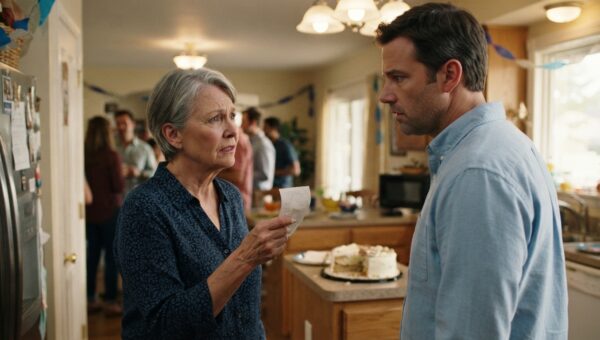
“We did what we had to do,” my mother said, her tone hardening just a fraction. “You never listen to reason. When you called about the transfer, your father knew immediately. The army doesn’t just move people around for fun. You got yourself into trouble again, didn’t you? Discharged with no pension and nowhere to go.”
“You think I got kicked out,” I said.
“We know you did,” she said, almost pitying. “And a night sleeping outside with your belongings on the curb will finally humble that soldier attitude you’ve carried around since you enlisted. Your father paid to have the locks changed as a lesson. You need to learn how the real world works when you don’t have us cleaning up your messes.”
In the background, my father shouted something else about character building and respect. I didn’t need him on speakerphone to hear every syllable. It was the same speech he had given me when I lost my first high school track meet, the same speech he gave when I chose the recruiter’s office over his friend’s insurance firm.
“You’re right about one thing,” I said, staring out the front window at the late-morning traffic crawling down the avenue. “The real world does operate on consequences. Why don’t you and Dad drive up here this afternoon? Around four o’clock. You can see the consequences for yourselves.”
My mother let out a sharp, incredulous laugh. “You want us to drive three hours just to watch you throw a temper tantrum? We are not enabling this, whatever absurd game you’re playing.”
“I’m not playing a game,” I said. “Come see the apartment. Bring Dad. See what happens when someone tries to evict a tenant here.”
“One night sleeping outside will humble that soldier attitude,” my father shouted directly into her phone, his voice cracking with righteous satisfaction. “We’ll be there at four. And you better have your things on the sidewalk where they belong, or we’ll call the police ourselves to have you removed.”
The line went dead with a sharp click.
I spent the next few hours reviewing the building portfolio, making sure every digital lease agreement and property tax record was pulled up on my laptop screen. Mr. Alvarez went back down to the lobby to handle the afternoon tenants, leaving the envelope of cash sitting squarely in the middle of my kitchen table. The bills were crisp and rubber-banded, fresh from a local bank branch near my parents’ house. It was almost poetic how neatly they had documented their own intrusion.
By 3:45, the street outside was quiet. I sat by the front window with a cup of black coffee, watching the traffic light down at the corner cycle through red and green three times before a familiar dark sedan pulled up right against the hydrant in front of the building.
My father stepped out first, adjusting his jacket with that heavy, deliberate authority he wore like a second skin. My mother followed right behind him, her purse clutched tightly under her arm, scanning the brick facade with a look of disappointed disapproval, as if she had hoped the building looked even more dilapidated than it did. They looked like inspectors auditing a failing business, entirely convinced they held all the leverage.
I met them at the inner glass door of the lobby before they could even reach the buzzer.
My father stopped dead in his tracks, his eyes narrowing as he took in the polished terrazzo floor, the restored mahogany trim, and the heavy brass mail slots that bore the building’s original 1912 registry. He looked around as if he had walked into the wrong address.
“What is this place?” he asked, his voice losing a bit of its initial thunder. “You moved into some sort of shared workspace?”
“Welcome to my building,” I said.
My mother’s chin came up instantly, her eyes flashing with that familiar defensive irritation. “Don’t play games with us. Where is your suitcase? We told Mr. Alvarez to have your things on the curb by noon. If you’re still squatting in the lobby, we’ll call the authorities right now and have you dragged out for trespassing.”
“Trespassing,” I repeated.
“You heard your mother,” my father said, stepping forward and puffing out his chest. “You think you can play soldier and then come home to live off charity? We gave Mr. Alvarez instructions to clear you out, and your little stunt is over. Now pack your things and start acting like an adult.”
I didn’t raise my voice. I didn’t need to. I reached behind me and pulled the heavy manila envelope off the reception console, sliding it across the polished marble surface until it hit the edge right in front of my father’s hands.
“You left this with Mr. Alvarez this morning,” I said. “Five thousand dollars cash. A bit heavy-handed for a casual visit, don’t you think?”
My father stared down at the rubber-banded bills as if they were a snake coiled on the counter. His fingers twitched once, but he didn’t touch them.
“Mr. Alvarez is an employee,” my father said, his voice dropping into a lower, more dangerous register. “He was following instructions to clear an unrented, abandoned unit belonging to a deadbeat tenant.”
“He was following instructions,” I agreed, “until he checked the deed.”
I pulled a single laminated copy of the property title out from under my arm and laid it flat on the glass display case beside the mail slots. The county seal caught the afternoon light, gleaming gold against the white paper. My name sat right at the top under the transfer of ownership registry, dated twenty-four months ago, clear and unambiguous. Below it was the commercial mortgage satisfaction note, paid in full using hazard-duty bonuses and investment dividends my parents had never even known existed.
My mother stepped forward, her eyes darting across the legal text, reading the names and the dates and the parcel numbers. Her face didn’t go pale; it simply tightened into a hard, rigid mask of disbelief. She reached out one gloved finger and touched the corner of the paper as if she expected it to dissolve into smoke.
“This is a fake,” she whispered, her voice shaking slightly. “You printed this. You’re trying to trick us.”
“Call the county clerk’s office,” I said, pointing toward the public phone on the wall. “Their office is open for another twenty minutes. Ask them who owns block four-hundred, lot twelve.”
My father finally looked up from the cash envelope, his eyes fixed on mine with a cold, simmering fury that had nothing to do with real estate and everything to do with humiliation. He realized, all at once, the trap he had walked himself into. He had driven three hours to evict his own child from a building he didn’t own, using a cash bribe delivered to an employee who reported directly to the landlord. Under state law, paying an agent to unlawfully oust a legal resident from a primary domicile wasn’t just a family dispute. It was tortious interference, attempted illegal ouster, and a documented conspiracy backed up by written instructions and five thousand dollars in untraceable cash.
“You set this up,” my father said, his voice barely above a hiss. “You knew we were coming.”
“I didn’t know you’d be arrogant enough to bribe my building manager before lunch,” I said. “That part was entirely your contribution.”
Mr. Alvarez stepped out from the back office just then, holding a formal receipt and a carbon copy of the incident log he had already signed and filed with the local precinct’s legal liaison, just to protect the property’s liability. He didn’t look at my parents; he simply slid the envelope of cash back into his pocket and nodded to me.
“Everything’s documented, owner,” Mr. Alvarez said clearly. “The police precinct called back about the inquiry regarding unauthorized entry attempts. They have the security footage from the front vestibule saved on the server.”
My mother looked from Mr. Alvarez to me, her breath catching in her throat. The realization seemed to hit her all at once, not just that they had lost their grip on the narrative, but that they had completely exposed themselves to legal vulnerability over their own petty need to see me fail.
“We are your parents,” she said, her voice cracking on the edge of panic. “You can’t threaten us with the police over a family misunderstanding.”
“It’s not a misunderstanding,” I said. “You didn’t come here to help me. You drove three hours because you wanted to watch me lose everything on the sidewalk. You wanted to teach me a lesson about humility.”
My father didn’t say another word. He grabbed my mother by the elbow, his jaw clenched so tight the muscle leaped beneath his skin, and pulled her back toward the glass doors. He didn’t pick up the cash envelope. He didn’t look at the deed again. He just shoved the heavy front door open and practically dragged her back toward the sedan parked at the curb.
I stood in the center of the lobby and watched through the glass as they got back into the car. My father stalled the engine twice before he finally managed to put it in reverse, his tires spitting a light spray of gravel against the curb as he pulled away without ever looking back at the windows.
The lobby went quiet again. The afternoon light shifted, casting long, clean shadows across the terrazzo floor.
Mr. Alvarez walked over, set the heavy manila envelope of cash back on the reception desk, and gave me a respectful nod before heading back down the hall toward the maintenance office.
I walked back upstairs to the second-floor apartment, the transfer orders still resting on the mahogany desk where I had left them that morning. I picked them up, folded them neatly along the crease, and slid them into my leather portfolio beside the property deed. My parents were three hours away by now, driving back through the twilight to a house where they still had to pretend they were in control of everything around them.
The city lights were just starting to flicker on across the skyline, steady and indifferent to anything that had happened below. For the first time in my life, the quiet in the room didn’t feel like an empty space waiting for someone else’s judgment. It just felt like mine.