The letter arrived on a Tuesday morning while I was scrubbing down the third-floor nurses’ station at Mercy Hospital. It sat right on top of my utility bill like a bad joke, bearing the heavy, cream-colored crest of the state university admissions office. I didn’t think much of it at first because my tuition had been paid off for three years, and I figured they were just hitting up alumni for a new parking garage or an updated library wing.
My nursing degree had cost thirty-four thousand dollars a year back when I started at twenty-two, a mountain of debt that nearly made me drop out before I even put on scrubs. I applied for every scholarship listed on the bulletin boards, begging financial aid counselors for anything that might keep me afloat. Out of nowhere, an anonymous grant appeared, covering eighty-five hundred dollars a semester, semester after semester, for four straight years until I graduated on the dean’s list. Totaled up, it came to sixty-eight thousand dollars from a ghost who never asked for a thank-you note or a progress report.
I tore open the flap with my thumb, expecting a form letter. Instead, there was a single typed page from the university’s legal department.
Your anonymous donor has passed away, the letter stated plainly. Per his instructions, we are now permitted to lift his identity.
Below that sentence was a name I hadn’t heard in twenty-one years, followed by an address six miles north of my apartment on Elm Street.
My father left when I was nine years old. One morning he packed a single canvas duffel bag, set his car keys on the kitchen counter, and walked out the front door without saying goodbye.
No phone call. No holiday card. No child support check sliding under the door. For over two decades, I built my entire life around the jagged shape of his absence, convincing myself that anger was a safer armor than grief. Whenever I wore my stethoscope around my neck or watched new nursing students nervously check their charts, I told myself I was entirely self-made.
I stared at the address on Elm Street until the ink blurred behind my eyes. I didn’t go back to work. I dropped the letter onto the passenger seat of my sedan, turned the ignition, and drove straight across town.
The house was a modest, single-story brick ranch with faded green shutters and a postage-stamp lawn that needed mowing. The driveway was empty except for a rusted red wheelbarrow turned upside down in the weeds. I sat in my car for ten minutes with my hands locked around the steering wheel, watching the front porch for any sign of movement.
My chest felt tight, the way it always did when I walked into a trauma room with a bad code, but there were no alarms here, just the hum of cicadas in the overgrown hedges.
I finally killed the engine, walked up the cracked concrete path, and pressed the doorbell. It gave a tinny, high-pitched chime that echoed somewhere deep inside.
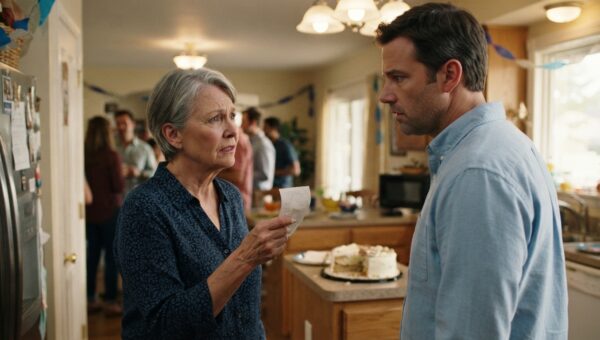
The door opened slowly. A woman in her late sixties with silver-streaked hair pulled back into a messy clip looked out at me. She wasn’t wearing makeup, and her faded floral apron had a smudge of flour near the pocket, but her eyes locked onto my face with a shock of instant recognition that made me take a half-step backward.
“You’ve got his chin,” she said softly, before I could even draw a breath to speak. “I’m Martha.”
“You knew who I was,” I managed to say, my voice sounding thin and small in the afternoon heat.
“He kept every single newspaper clipping,” Martha said, stepping aside and holding the door wide. “Come inside. It’s too hot to stand out on the porch.”
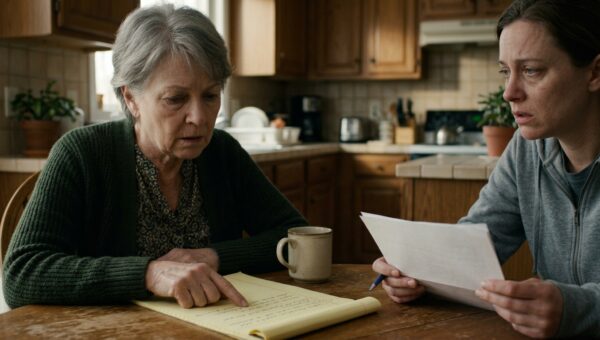
The interior of the house smelled faintly of old paper, lemon wax, and peppermint tea. It was remarkably tidy, almost monastic, with dark wood furniture that looked like it had been bought at estate sales thirty years ago. Martha led me straight to the kitchen table, where a heavy cardboard shoebox sat squarely in the center, bound with a thick rubber band that had dried out and cracked.
“He didn’t want you to know while he was breathing,” Martha said, pulling out a chair for me. “He was terrified that if you saw him, all that old hurt would come rushing back and poison whatever life you managed to build.”
I sat down because my knees wouldn’t hold me up any longer. “Why did he leave in the first place? I was nine years old. He just vanished.”
Martha sat across from me, her hands resting flat on the oilcloth tabletop. She looked tired, the kind of bone-deep exhaustion that only comes from watching someone waste away from the inside out.
“He had a sickness in his head, honey,” she said quietly. “Clinical depression, they call it now, though back then he just called himself poison. After your mother and him split up, he truly believed that anyone he loved would end up ruined because of him. He thought walking away was the only merciful thing he could do. He stayed away because he thought he was protecting you from himself.”
“Protecting me?” I shook my head, the bitterness rising fast in my throat. “By abandoning me? Leaving us with nothing?”
“He didn’t leave you with nothing. He just had to do it from the shadows.” Martha reached out and snapped the old rubber band off the shoebox. She lifted the lid and slid it toward me. “Look inside.”
I hesitated, then reached down and pulled out the top item. It was my third-grade school picture, the one where my bangs were crooked because I’d taken scissors to them the night before. Written on the back in his messy, hurried handwriting was the exact date, my height, and a note about how I’d lost my front tooth that morning.
Underneath that photo was another, and another. Fourth grade. Seventh grade. A program from my middle school track meet, folded neatly in half. A newspaper clipping of the local honor roll from high school. My wedding announcement, clipped straight out of the Sunday paper five years ago, with a small circle drawn around my name in blue ink.
“He never missed a single milestone,” Martha whispered, her voice cracking slightly. “Every parent-teacher conference, every dance recital, every graduation. He was always there.”
“I never saw him,” I said, my chest heaving. “Not once.”
“He watched every graduation from the parking lot,” she said, and the words hit me like a physical blow. “He wanted to come in. He bought a suit for your high school ceremony and hung it in the closet. But on the morning of, he looked in the mirror and told me he couldn’t do it. I told him you’d forgive him. He said you shouldn’t have to.”
I reached deeper into the box, my fingers brushing against a stack of official-looking papers held together by a metal paperclip. I pulled them out. They weren’t school records. They were yellowed hospital receipts and medical bills from Mercy Hospital, dated twenty-three years ago, back when I was seven years old and nearly died from a severe internal hemorrhage during a routine appendix removal. My family had been drowning in medical debt before he vanished, a crisis that broke whatever was left of his mind.
I looked closer at the top receipt. It wasn’t a bill. It was a donor registry slip from the hospital blood bank.
“He had the exact same rare blood type you do,” Martha said softly, watching my face as the pieces finally ground together in my head. “When you were seven and things went sideways on that operating table, the hospital put out an emergency call for donors. He drove down there in the middle of the night, gave two units, and made the nurses promise they would never tell your mother it came from him. He saved your life on that table, and then he walked back out into the parking lot.”
The silence in the small kitchen grew heavy, pressing down on my shoulders until I couldn’t breathe. I sat there with the hospital slips in my trembling hands, staring at the faded ink of a signature I hadn’t seen since I was a little girl. He wasn’t just the ghost who ran away. He was the invisible donor who kept my heart beating twice, once on an operating table when I was seven, and again years later when he anonymously paid for the education that put me on the very same hospital staff as a professional.
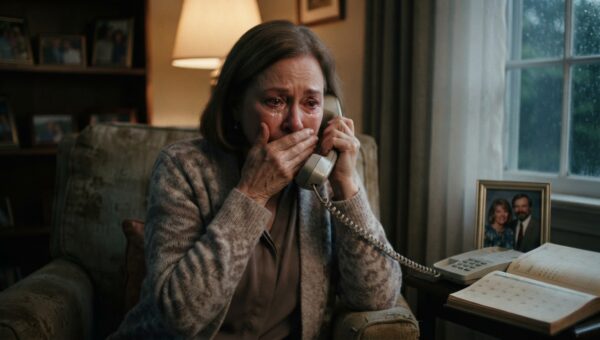
“He died last Thursday,” Martha said, breaking the quiet. “In his sleep. His heart just gave out. Before he went, he made me promise to give you this box the moment the university cleared the restriction. He said you deserved to know the truth, even if it didn’t fix the damage.”
I didn’t cry right away. I just sat at that oilcloth table, turning the hospital receipts over in my fingers, tracing the ink lines of a man who loved me so desperately that he starved himself of my presence just to keep me safe from his own wreckage. He was a broken, flawed, terrified human being who didn’t know how to be a father in the light, so he spent twenty-one years guarding me from the dark.
An hour later, I left the small house on Elm Street with the shoebox tucked safely under my arm.
I didn’t go back to the hospital that afternoon. Instead, I drove out to the municipal cemetery on the south side of town, following the winding gravel lanes until I found the small, unmarked plot where Martha had laid him to rest two days prior. There was no headstone yet, just a rectangle of freshly turned dark earth and a temporary metal marker from the funeral home with his name stamped into the aluminum.
I knelt down in the damp grass, ignoring the dirt that soaked through the knees of my slacks. I opened the shoebox, took out my silver Mercy Hospital nursing pin, the one I had earned with the money he secretly provided, and pressed it firmly into the soft mound of earth right beside the metal marker.
“You shouldn’t have to forgive him,” she had told me.
Maybe she was right. But as I sat there watching the sun dip low behind the treeline, letting the cold wind off the river bite at my face, I realized I didn’t need to hand out absolution to understand what he had done. He gave me my life twice, once with his blood and once with his sacrifice, and that was more than enough to carry forward.