The linoleum in the produce aisle of the local Save-More always had a faint smear of crushed parsley near the cart return, right where the stock boy missed with the broom on Tuesday mornings. I was standing right there with a heavy green pumpkin in my left hand when my phone buzzed against my thumb. It was a short vibration.
The kind that usually meant a coupon or a reminder from the dentist about my three-month cleaning.
Instead, it was Leo. My only child. My boy who used to help me sort paper clips at the county annex when he was ten years old.
The screen lit up the gray plastic handle of the grocery cart. Mom, I know you just bought us the house, but Sarah’s dad says you can’t come to Thanksgiving.
I read it once while the overhead fluorescent tube hummed its usual three-note C-sharp. I read it a second time because my brain tried to make the words say something else, something about a mix-up with the guest list or an extra leaf needed for the dining table. But the words stayed right there on the glass. Arthur Vance. Sarah’s dad. The man who owned three import dealerships and wore silk ties that cost more than my winter coat.
Around me, the store was full of noise. A woman two carts down was arguing with her husband about whether they needed three bags of dinner rolls or four. A toddler in a red corduroy jacket was banging a plastic spoon against a tin of cranberry sauce. Everything sounded normal. Everything looked like the Tuesday before Thanksgiving had looked for the last thirty years of my life.
My thumb hovered over the glass. I thought about typing out a list of things. I thought about reminding him that the ink on the cashier’s check hadn’t even fully cured in the escrow office down on Fourth Street. I thought about mentioning the thirty-four years I spent sitting under the humming fluorescent lights of the records department, packing my own lunch in a grease-stained brown bag so I could save three hundred and fifty thousand dollars down to the final nickel.
I typed out three different sentences and deleted every single one of them.
The little typing bubbles blinked and vanished. In the end, I didn’t see any point in wasting good breath or ink on someone who was already reading from a script someone else wrote.
I pressed the single letter O. Then the k. Then a. Then y.
I didn’t add a period. I didn’t add an explanation point. I just hit send. Then I let go of the metal handle of the shopping cart, turned my back on the pyramids of Russet potatoes, and walked right out the sliding glass doors into the cold November wind.
The drive back to my apartment on Elm Street took twelve minutes. I didn’t turn on the radio. The hum of the heater in my little gray sedan was enough. My hands felt stiff on the steering wheel, but they didn’t shake. When you spend three decades dealing with angry developers trying to skirt county zoning laws, you learn how to keep your fingers steady when people lie to your face.
I let myself into the front hallway and hung my wool coat on the wooden peg. The apartment smelled of the chamomile tea I had boiled that morning before I went out. It was small. Just four rooms and a tiny kitchen where the linoleum curled up slightly near the stove. It wasn’t much to look at, but every square inch of it belonged to me. No mortgage. No liens. No Arthur Vance telling me who could sit at the table.
I sat down at the kitchen table and dialed Gerald’s number from memory. Gerald had been handling the county’s minor title disputes back when we both had brown hair and smoked cheap menthols behind the annex during our fifteen-minute breaks. He had retired two years before I did, but he still kept an office in the back of a brick building near the courthouse, surrounded by stacks of plat maps that smelled like old cedar and rain.
He answered on the second ring. “Margaret,” he said. His voice sounded like gravel rolling in an empty bucket. “You’re calling late. Turkey giving you trouble?”
“Not yet, Gerald,” I said. I smoothed my thumb over the grain of the laminate table. “Do you remember the paperwork we filed last Thursday for the colonial on Maple Ridge?”
“The one your boy picked out? The three-hundred-and-fifty-thousand-dollar beauty with the brick fireplace and the double garage?”
“That’s the one.”
“Sure I remember. Fast closing. Cashier’s check straight from your credit union.”
“Tell me again about the final recording,” I said, leaning my forehead against my palm. “The part about the title transfer and the county register.”
Gerald went quiet for a second. I could hear the faint rustle of paper on his end, maybe a legal pad being turned over. “Well, Margaret, like I told you when we started this business. The funds cleared, and the seller signed the deed over, but the final county recording window stays open for ten business days to clear the municipal sewer assessment. Until that stamp hits the final page at the recorder’s office, the transfer is technically in an administrative holding pattern. You’re still listed as the primary financier with the power of rescission under the family gift clause we drafted.”
“And when does that ten-day window close?”
“Let’s see,” Gerald muttered, his pen tapping against the desk. “Today’s Tuesday. That means the final recording doesn’t hit the docket until next Monday morning at eight sharp.”
I looked at the kitchen clock on the wall. It was 5:14 in the afternoon.
“Good,” I said.
“Margaret? What’s going on?”
“Nothing, Gerald. Just making sure my paperwork is in order. Have a good evening.”
I hung up before he could ask another question.
The next morning, the sun came up pale and thin over the rooftops across the street. I didn’t sleep much, but that wasn’t anything new. When you spend your whole life worrying about whether the tax rolls match the physical acreage, your brain forgets how to turn off just because the sun goes down.
I got dressed in my good wool slacks and the navy cardigan with the pearl buttons. I didn’t rush. By nine o’clock, I was driving up the winding asphalt of Maple Ridge.
The houses up here looked like they belonged in a magazine. Big lawns, manicured boxwood hedges, and three-car garages with carriage-house doors. Number 412 sat near the top of the hill, a handsome brick colonial with black shutters and a massive stone chimney. It looked sturdy. It looked expensive. And every single brick of it was paid for by thirty-four years of my life sitting under those fluorescent lights.
I pulled my sedan into the circular driveway, right behind Sarah’s white BMW SUV. The front porch was already decorated with giant orange pumpkins and a wreath made of dried wheat that probably cost forty dollars at the boutique downtown.
I walked up the flagstone steps and didn’t even bother to knock. I used the brass key that Leo had handed me just three weeks ago with a sheepish grin and a mumbled promise about Sunday dinners.
The front door swung open with a soft, expensive click.
Inside, the house smelled of fresh cedar and expensive wax. Voices drifted down from the upstairs landing. Sarah was laughing, that high, musical laugh she used whenever her father was in the room.
“Daddy, I just think it’s better if we keep things clean for the weekend,” Sarah’s voice floated down the stairwell. “Your associates from the board are coming up from Philadelphia, and the last thing we need is someone asking awkward questions about where Leo’s side of the family comes from. It’s just… optics.”
“You did the right thing, honey,” Arthur Vance’s voice rumbled back, heavy and self-satisfied. “A boy needs to cut the apron strings if he’s going to run the regional sales division. You can’t have working-class baggage hanging around when you’re trying to close six-figure accounts with the Main Line crowd. Leo handled it well?”
“Oh, he folded instantly,” Sarah said, followed by the sound of light hand-clapping. “Sent her a text before I even finished my coffee.”
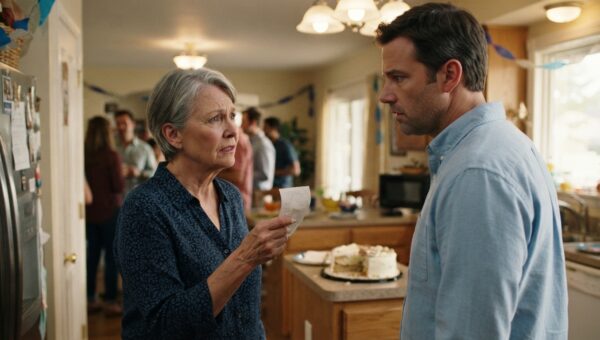
I didn’t say a word. I just walked past the grand staircase, stepping onto the imported hardwood flooring that didn’t have a single scratch on it yet. I went straight into the open-plan kitchen where Leo was standing by the marble island, holding a copper coffee mug and looking very pleased with himself.
He looked up when my shadow fell across the granite countertop. The color drained right out of his face, leaving him looking smaller than six-foot-two men usually look.
“Mom,” he whispered. His coffee mug clinked against the marble. “What… what are you doing here?”
Before he could answer, Sarah and Arthur came walking down the short hallway from the den. Arthur was wearing a cashmere sweater tied around his shoulders like he lived in a sailing catalog, his silver hair combed straight back from a forehead that never had to sweat for a paycheck.
“Margaret,” Arthur said, his mouth curling into a practiced, polite smile that didn’t reach his eyes. “This is a bit of a surprise. We were just finalizing our holiday arrangements.”
“I can see that, Arthur,” I said. My voice sounded entirely normal. Calm. Almost boring.
I reached into the pocket of my navy cardigan and pulled out the manila folder Gerald had handed me yesterday afternoon before I left his office. I laid it right on the center of the granite island, right next to Leo’s copper mug.
Sarah crossed her arms, her eyes narrowing as she looked down at the folder. “What is that? Some kind of receipt?”
“It’s the rescission of the gift deed, Sarah,” I said, looking right at her father. “Under section four of the conditional real estate transfer act for the Commonwealth, any family property transfer financed entirely by a single party can be revoked within ten business days if the recipient engages in bad-faith exclusion or breach of the domestic agreement.”
Arthur’s smile didn’t vanish, but it tightened around the edges like old rubber left out in the sun. “Now see here, Mrs. Gray. That’s just a lot of legal theater. The closing went through on the fourteenth. The house is theirs.”
“The money cleared, Arthur,” I said, my voice dropping an octave into that flat register I used whenever a contractor tried to tell me a county bridge didn’t need a load-bearing inspection. “The funds moved. But the final county recording stamp doesn’t go on the official docket until next Monday morning at eight o’clock. And right now, as the primary financier holding the revocation papers, I haven’t signed the final release.”
Leo took a step forward, his hands twitching at his sides. “Mom… you can’t do that. We live here. Our things are upstairs.”
“You live here because I bought the roof over your head, Leo,” I said, turning to look at my son. Really look at him. Not the boy who used to help me sort paper clips, but the grown man who traded his own mother for a seat at Arthur Vance’s Thanksgiving table. “And if Arthur and Sarah want a clean house for their friends from Philadelphia, I figured I’d help them out. You won’t have to worry about my working-class background messing up your optics anymore.”
“Margaret, let’s be reasonable,” Arthur started, taking a half-step forward with his hands out palms up. “There’s no need for dramatics over a holiday seating chart. Families have disagreements, “
“This isn’t a disagreement, Arthur,” I said, pulling a second set of papers from the folder. “This is a conclusion.”
I slid the formal notice across the marble toward Leo.
“You have until Friday at five o’clock to pack your clothes,” I said quietly. “Gerald has already filed the injunction holding the title in my name. The locks are being re-keyed on Saturday morning.”
Sarah let out a sharp, breathless laugh that sounded a bit like a sob. “You can’t just kick us out! We have a life here! We’re getting married!”
“Then I suggest you find a house that Arthur can buy for you,” I said.
I turned around, my heels clicking evenly against the imported hardwood floors that weren’t theirs anymore. I didn’t look back at the marble island, or the copper mug, or the man who used to be my son.
The drive back down Maple Ridge was smooth. The wind was picking up off the river, kicking dry oak leaves across the asphalt in little grey swirls.
When I got back to Elm Street, I parked my sedan in the gravel lane, got out, and walked up my front steps. I unlocked the heavy oak door, stepped inside, and closed it behind me.
I turned the deadbolt with a firm, steady click that echoed pleasantly in the small hallway. Then I walked into the kitchen, set my keys on the worn laminate counter, and set the kettle on the burner. While it heated up, I pulled down my favorite ceramic mug with the chipped handle and dropped a bag of chamomile tea inside.
When the water whistled, I poured it slow and steady, watching the pale steam rise toward the ceiling. I sat down at my kitchen table, right where I had sat the night before, and took my first sip. It tasted hot, clean, and entirely mine.