The card box was sitting right on my welcome mat when I came home with groceries at 5:14 in the evening. It was one of those standard brown mailers from the online retailer, taped up with plastic film and stamped with a barcode that didn’t belong to me. I picked it up mostly because the delivery driver had left it half off the concrete edge where it might catch the wind.
The street name was right, but the house number was 412 instead of 410, and the surname printed beneath the barcode was Miller. That was Michael’s last name. Or rather, the last name he told me we would be sharing next spring when we finally picked a date for the church hall down on Maple Street.
I stood there on the porch for a second with my car keys digging into my palm and the grocery bags cutting into my fingers. Michael lived across town in that brick townhouse near the park, the one he kept so neat because he said it reminded him of the place he had to clear out after his first wife passed away. He talked about her a lot during our first year together. Her name was Clara, according to him, and she had gone fast in the autumn of 2019 after a three-year fight with breast cancer that wiped out his savings before the insurance finally kicked in.
I remember crying right along with him the first time he told me over a basket of fries at the diner. He had this way of looking down at his coffee mug, his shoulders dropping just a fraction, like the weight of it was still sitting right there on his neck.
I figured fourteen miles wasn’t much of a drive before supper. The address on the label was over on Elmhurst Lane, right past the old grain elevator where the streets turn into those cookie-cutter subdivisions with names like Oak Ridge that don’t have a single oak tree standing. I didn’t think much of it. People mix up house numbers all the time, especially when the delivery drivers are rushing their routes before dark. I put the box on the passenger seat of my sedan, tossed my purse on the floor, and drove out toward the east side with the radio turned down low.
The house at 412 Elmhurst was one of those split-levels with gray siding and a black mailbox post shaped like a duck. A station wagon was parked in the drive with a bumper sticker about local soccer practices. I walked up the three concrete steps and rang the doorbell. It played that two-note chime you buy at the hardware store for twenty dollars. Through the frosted glass of the front door, I heard kids shouting and a television playing some cartoon with high-pitched voices.
The door swung open after a minute. A woman about my age, maybe thirty-four or thirty-five, answered with a dish towel tucked into the waistband of her jeans. She had light brown hair pulled back in a messy clip and flour dusted on her forearm like she’d been rolling out dough for dinner. She looked down at the box in my hands before she looked at my face, and her expression was just mildly curious, the way you look at a neighbor bringing in your mail.
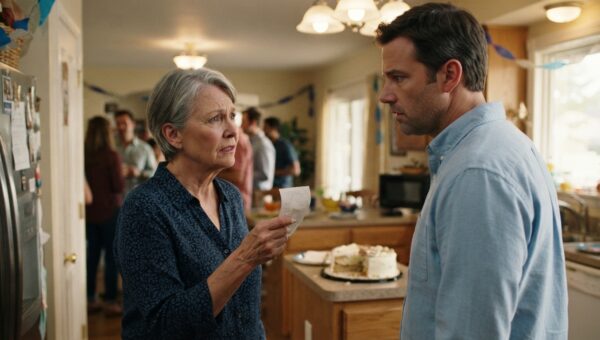
“Sorry to bother you,” I said, holding out the package. “This got dropped on my porch over on Tenth Street. Same last name, so I figured I’d bring it across instead of letting it sit.”
She reached out and took the cardboard from my hands. As her fingers brushed mine, the kitchen light hit the gold band on her left ring finger. It wasn’t just any gold band. It had a split-prong cathedral setting holding a half-carat round diamond with two tiny channel-set baguettes on the shoulders. I knew that setting by heart because I had spent four Saturday afternoons sitting across the glass counter at Zales with Michael while we looked at catalog pages until my eyes crossed. It cost $6,200 before the warranty. I had put down two hundred of my own cash just to help him cover the holiday financing special.
I stared at her hand. She noticed me staring, and her mouth curved into a small, neighborly smile.
“Oh, thank you so much,” she said, shifting her weight. “Michael must have used the old shipping profile again. He’s always ordering parts for his truck or tools online, and half the time his work address doesn’t update right in the app.”
The sidewalk under my sneakers seemed to drop about six inches. My brain didn’t want to connect the words. Michael didn’t have a truck. He drove a gray sedan just like mine, only four years newer, because he said he needed good gas mileage for his regional procurement job out in the tri-county district.
“How do you know Michael?” I asked. My voice sounded thin, like it was coming from inside a tin can.
She laughed a short, easy laugh, the kind you make when someone asks a silly question at a PTA meeting. “He’s my husband. We’ve been married eleven years.”
I didn’t move. I couldn’t move. My fingers curled into my palms until my nails bit into the skin. Slowly, deliberately, as if I were moving underwater, I raised my left hand and held it out right in front of her face so the diamond caught the porch light.
The smile on her face didn’t fade all at once; it just cracked right down the middle like dry mud. She stared at my finger, then up at my eyes, and then back down at the ring again. The color drained out from under her skin until she looked gray around the edges of her nose.
She whispered, “He bought you the same ring.”
I looked right at her, and the taste of copper came up into the back of my throat. I said, “He told me you were dead.”
Nobody said anything for a second, and honestly that felt worse than shouting. Inside the house, the cartoon characters were still singing some cheerful song about sharing toys. A little boy with a blue shirt poked his head around her shoulder, asking when meatloaf was going to be done, and she didn’t even turn around to answer him. She just reached out with a trembling hand and grabbed the sleeve of my jacket.
“Come inside,” she said. Her voice wasn’t loud, but it had that sharp, jagged edge of someone who had just been handed a bomb. “Step inside the kitchen right now.”
Her name was Sarah. Her kitchen smelled like garlic powder and dish soap, and there was a basket of clean laundry sitting on the two-seater bench by the kitchen table waiting to be folded. She didn’t offer me coffee, and I didn’t want any. We sat across from each other at the round oak table while her two kids, six and nine, boys with Michael’s exact cowlick and stubborn chin, sat in the next room watching their show with bowls of cereal on their laps.
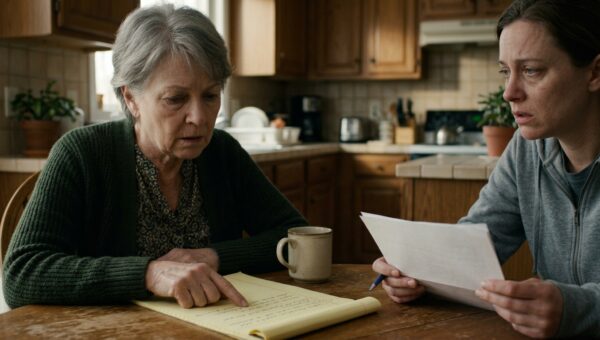
Sarah pulled a small leather-bound planner out from under a stack of junk mail and dropped it on the table between us. The spine was worn down to the gray fabric underneath.
“He’s been out in Peoria since Monday morning,” she said, her finger tracing the date on the calendar. “Three days every week. Sometimes four if the warehouse inventory runs late. That’s what he tells me when he packs his leather duffel bag by the back door.”
I looked at the dates. Every single Tuesday, Wednesday, and Thursday matched the exact nights Michael stayed over at my townhouse on Tenth Street. He used to make me these elaborate omelets on Wednesday mornings before he headed out to what he called his district office downtown. He would kiss my forehead, tell me I smelled like vanilla, and promise he’d be back by Friday afternoon to take me out for fish fry.
“He told me his wife died in nineteen-nineteen,” I said, my voice sounding flat and stupid even to my own ears. “Breast cancer. He had all these medical bills he was still paying off. That’s why we kept our apartment simple. That’s why we didn’t buy a house yet.”
Sarah let out a dry, rattling breath that sounded like a laugh with the humor sucked out of it. “Medical bills. Right. That’s where the extra travel allowance went. He told me the company cut his travel stipend last year because of supply chain issues.”
We sat there for twenty minutes, pulling the threads out of the sweater until nothing was left. We compared credit card receipts she had pulled from a shoebox in the hall closet with the digital statements on my phone. We looked at old vacation photos on her phone where he stood smiling on a beach in Florida with her and the boys, wearing the exact same blue swim trunks he wore when we went down to the lake two summers ago. He had two sets of everything. Two toothbrushes, two phone chargers, two distinct lives running on a synchronized schedule that never missed a beat.
“He’s coming home tomorrow around five,” Sarah said. She wasn’t crying anymore. Her eyes looked hard, like two pieces of blue glass pushed into clay. “He usually stops to get gas at the station off the bypass and brings home a rotisserie chicken from the grocery store so we don’t have to cook.”
I looked down at my left hand, at the $6,200 Zales ring that suddenly looked like a cheap piece of tin from a carnival machine. I pulled it off my finger. The skin underneath was white and indented where I’d worn it every single day for two years. I laid it right in the center of the oak table, next to her planner.
“What do you want to do?” I asked her.
Sarah looked at the ring, then up at me, and a slow, terrible kind of calm settled over her face. “I want to make sure he doesn’t have a key to either door by six o’clock.”
The next evening at 5:12, Michael’s gray sedan pulled into the driveway over on Elmhurst Lane. I watched from the living room window while Sarah sat at the kitchen island with a cup of black coffee that she hadn’t touched in an hour. We had already packed his things into four heavy-duty contractor trash bags and set them neatly on the porch behind the duck mailbox. Her car keys were in my pocket, and my keys were on the hook by the back door where they belonged.
The front door unlocked with a crisp click. Michael stepped into the small foyer carrying a brown paper bag from the deli and his leather duffel bag slung over one shoulder. He looked tired in that particular way he always did when he walked through my door on a Thursday night, loosening his tie as he shut the door behind him.
“Hey, hon,” he started, stepping around the corner into the kitchen with a tired grin on his face. “Traffic on the bypass was absolute murder, “
He stopped dead. The grin didn’t fade; it just froze on his face like grease on a cold pan. He looked from Sarah sitting at the island to me standing by the pantry with my arms folded across my chest.
Nobody yelled. Nobody threw anything. The house was dead quiet except for the hum of the refrigerator in the corner.
Michael’s mouth opened, then closed. He took half a step backward toward the front door, his hand still holding the paper bag with the rotisserie chicken inside. “What is… what are you doing here?” he asked, looking right at me, his voice pitching up an octave into something thin and panicked. “Sarah, what’s going on?”
Sarah didn’t stand up. She just looked at him the way you look at a stray dog that tracked mud across a freshly mopped floor.
“We were comparing calendars, Michael,” she said, her voice steady and low. “You missed a delivery. Apparently, you’re still using the old address for your online shopping.”
He looked at the two of us, his eyes darting back and forth like a trapped animal trying to find an open slat in a crate. All that smooth, practiced confidence, the three years of tearful stories about a grave in the cemetery, the carefully timed out-of-town meetings, it all just dissolved into nothing right there under the kitchen light. He didn’t have an excuse. He didn’t have a lie that could span fourteen miles and two identical rings.
“Look,” he stammered, taking a step forward and dropping the bag on the counter. “It’s not… I can explain how all of this, “
“No, you can’t,” I said. I walked over to the counter, pulled my Zales ring out of my coat pocket, and dropped it right into the middle of the warm chicken bag. “And you don’t have to.”
Sarah reached into her pocket, pulled out his house key on its brass ring, and tossed it across the floor so it skidded and stopped right against the toe of his shoe.
“The rest of your things are on the porch,” she told him, her voice as cold as winter water. “Don’t bother knocking on either door.”
He stood there for a second, his mouth still working silently, looking like a man who had just realized the floor beneath him was gone. Then he turned around, picked up his leather duffel bag from the floor where he’d dropped it, and walked out the front door without another word.
The heavy wooden front door clicked shut behind him, sealing the latch with a dull, final thud. Through the front window, we watched him walk down the concrete steps into the gray twilight, heading toward his sedan with his head down and his shoulders hunched against the evening chill.
Sarah and I didn’t rush to the door to watch him drive away. We just sat back down at the kitchen table, the silence settling around us like an old quilt, and she poured two fresh cups of coffee while we started talking about what came next.