Twelve years. One hundred and fifty-six thousand dollars in rent, heating oil, groceries, and pharmacy co-pays. And then another forty-five thousand when her hip went out in November, bringing the real total past the two-hundred-thousand-dollar mark while my three brothers didn’t even send a postcard.
Dad died on a Tuesday in the back bedroom of that drafty house in Kingston, his skin the color of skim milk and his breath rattling like dry leaves in a gutter.
He looked right at me, his fingers clawing at the quilt until my knuckles were trapped under his palm.
Take care of your mother, he whispered. Don’t let her lose the roof.
I promised him. I was thirty-eight years old, single, with a steady job at the county water authority and a small apartment five minutes away. I thought it would be groceries on Sundays. I thought it would be helping her shovel the front walk when the lake-effect snow piled up against the porch.
I didn’t know the brothers would vanish into thin air the second the death certificate was signed. Marcus moved to Denver three weeks later for a landscaping job that somehow never materialized. Julian got married to a woman with three horses and stopped answering his phone because cell reception in their county was terrible. Ethan stayed in town, but he had a new business selling customized golf carts and told me his cash was tied up in inventory every single time I called to say Mom needed a new water heater or a specialist in Albany.
So I paid. Month after month, year after year.
I watched my savings account drain from a healthy cushion down to a few hundred dollars. I skipped vacations, drove a Honda Civic with a rusted rocker panel until the muffler fell off on Route 9, and spent my Saturdays driving Mom to cardiology appointments while she complained that Julian hadn’t called on his birthday.
In 2018, when she had that first major abdominal surgery and the hospital wouldn’t discharge her without twenty-four-hour home care for six weeks, the bill came to twelve thousand dollars up front. Ethan laughed when I asked him for a check.
We can’t all be rich bureaucrats like you, he said, tapping his beer bottle against the counter in Mom’s kitchen.
Mom just sat there in her floral bathrobe, nodding along like he had made a profound observation. That was the night I drove down to the title office in downtown Kingston and talked to Mr. Harrison, an old-school lawyer who had known my father from the Elks Lodge.
If you keep draining your own future for this house, Harrison told me over his reading glasses, you are going to be living in a shelter by the time you’re sixty while your brothers split the equity.
We drew it up right there. A formal promissory note for two hundred thousand dollars, secured by a legal lien against the deed of the house. Mom signed it in Harrison’s office on a rainy Thursday afternoon in October. Her hand shook a little bit, but she signed it. She knew her boys weren’t putting a single cent toward her keep. She knew if she didn’t sign, I would have to walk away, and she couldn’t bear the thought of neighbors knowing her sons had abandoned her.
She whispered to me in the hallway outside the office, her fingers digging into my coat sleeve. You won’t ever actually use this, will you? It’s just for peace of mind.
Just for peace of mind, I told her.
Eight years passed after that afternoon. The snow came and went. The maple tree in the front yard dropped its leaves, and I raked every single one of them into contractor bags while Ethan drove past in his new pickup truck and gave me a casual two-finger wave from the steering wheel.
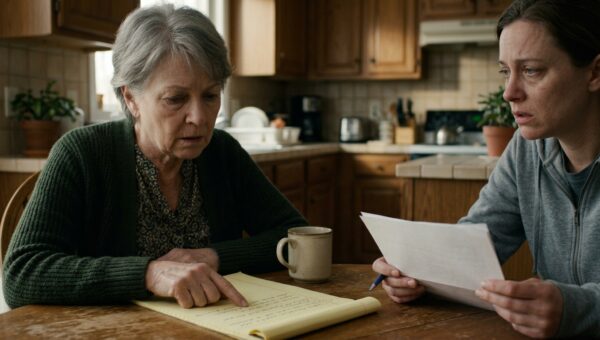
Then came the fall in the kitchen last winter. A broken hip, emergency surgery at Kingston Hospital, three weeks in a rehab facility that smelled faintly of boiled cabbage and floor wax. I managed the insurance paperwork, coordinated the physical therapy aides, and paid the forty-five thousand dollars out of my retirement fund because the secondary insurance denied the claim.
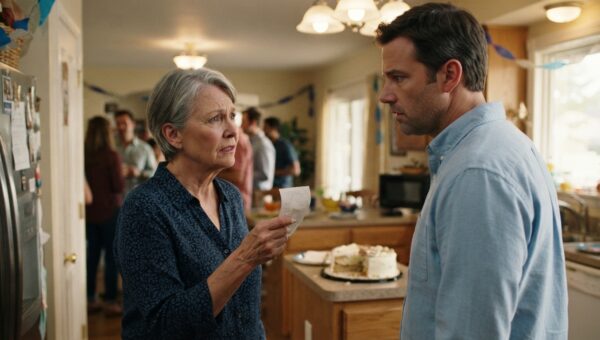
When she finally came home and was strong enough to sit at the dining room table without getting dizzy, she called the family meeting.
Ethan showed up thirty minutes late, smelling of stale vape smoke and cheap cologne. Julian drove in from Pennsylvania in a leased BMW, looking prosperous and slightly bored. Marcus phoned in on speaker, his voice tinny and loud through the little black puck on the lace tablecloth.
I’ve been thinking about the future, Mom announced. She was sitting in her high-backed velvet chair, her hair freshly permed, looking like a queen holding court in a kingdom she hadn’t built.
She looked right at me, her expression softening into that warm, patronizing smile she always used when she wanted me to swallow something bitter.
I’ve decided to divide the house and all my accounts equally among the four of you when I pass. Twenty-five percent each. It’s only fair. Family is family, after all.
Nobody said anything for a second, and honestly, that felt worse than the words themselves.
Julian smiled, leaning back against the floral wallpaper. Sounds about right. Equity has gone up quite a bit since Dad passed.
Ethan nodded, reaching for a sugar cookie from the glass dish. Honestly, it’s about time we put all that past friction behind us.
I sat there with my hands flat on the polished mahogany. I didn’t yell. I didn’t slam my fist against the wood. I just let the silence stretch out until Ethan stopped chewing.
Mom, I said, my voice sounding quieter than I meant it to. I’ve spent two hundred thousand dollars keeping this roof over your head and your heart beating over the last twelve years.
She waved her hand dismissively, her rings catching the light from the overhead chandelier. Oh, stop keeping ledgers, she said, her voice turning sharp. You’ve always had a small mind about money. Your brothers had to get their lives started. You were always the stable one.
Ethan grinned, his teeth very white against his sunburned face. Fair is fair, right? We’re all her kids.
That was when I stood up.
I reached down to my briefcase on the floor and pulled out a thick brown accordion folder. The cardboard was creased and slightly stained from years of being hauled back and forth between banks and hospitals.
I didn’t say a word as I unbuttoned the flap. I slid out twelve years of bank statements, itemized wire receipts, pharmacy invoices, and contractor bills. I laid them out across the lace tablecloth, right over the top of the sugar cookies.
Julian stopped smiling. His eyes tracked the neat stacks of paper, each one labeled with yellow sticky notes in my own handwriting, dated and totaled down to the penny.
What is this? Ethan asked, his voice dropping an octave as he leaned over the table.
It’s the price of your twenty-five percent, Ethan, I said.
I reached into the very back of the folder and pulled out the single sheet of heavy cream paper bearing the raised gold seal of the county notary from October of 2018.
Mom went pale. Not white like a sheet, but that strange, gray-green color people get right before they faint. Her jaw went slack, and she gripped the arms of her velvet chair until her knuckles turned the color of lard.
Where did you get that? she whispered.
I looked her in the eye. You signed it, Mom. In Mr. Harrison’s office. Right after your first major surgery. When you agreed that the house would serve as collateral for every dollar I spent keeping you alive while my brothers were nowhere to be found.
Julian surged to his feet, knocking his wooden chair back against the wall with a loud clatter. You tricked her! She was on medication! She didn’t know what she was signing!
I didn’t look at Julian. I looked toward the front entryway where heavy footsteps had just sounded on the porch.
The front door opened without a knock, and Mr. Harrison stepped into the hallway, shaking the wet snow from his wool overcoat. He had a leather briefcase tucked under his arm and a pair of wire-rimmed glasses hooked over his vest pocket.
He walked into the dining room, nodding politely to the room at large.
Afternoon, he said, his voice deep and steady like a church bell. I was asked to be here to ensure the estate documentation aligns with the active encumbrances on the deed.
Ethan jumped up, pointing a trembling finger at the lawyer. This is a scam! She bullied an old woman into signing away the family home! It’s fraud!
Mr. Harrison didn’t blink. He walked over to the table, picked up the cream-colored sheet of paper, and adjusted his glasses. He ran his thumb along the raised seal, checked the signature against the duplicate copy he pulled from his own briefcase, and looked up at Mom.
Is this your signature, Martha?
Mom couldn’t look at him. She stared down at her lap, her fingers shredding a paper napkin into tiny white lint balls.
She whispered something so low we barely heard it.
Speak up, Martha, the lawyer said gently.
Yes, she muttered. I signed it.
Mr. Harrison laid the document back down on the lace table runner, right beside a stack of medical receipts from last November.
Then the math is quite simple, he announced to the room. The total verified debt registered against this property stands at two hundred thousand dollars, plus statutory interest. Under the terms of the lien, the estate’s primary asset must satisfy this debt in full before any residual equity can be distributed among heirs. Since the current market value of the home is approximately three hundred and fifty thousand, the remaining balance after settling the promissory note will be one hundred and fifty thousand, divided four ways among the siblings, resulting in thirty-seven thousand five hundred per person. However, since the primary debt absorbs the first two hundred thousand, the claimant takes clear title to the property as satisfaction of the loan.
The room went dead silent. You could hear the old refrigerator in the kitchen humming through its cycle.
Thirty-seven thousand? Julian muttered, his voice cracking like a teenager’s. That’s nothing! That doesn’t even cover what I owe on my truck!
Then you should have helped pay for the rent in 2014, I told him.
Mom started to cry then, real, ugly sobs that made her shoulders hitch beneath the floral blouse. Her face crumpled into a mess of wrinkles and wet mascara.
How could you do this to your own family? she choked out, looking at me with eyes full of pure, unadulterated betrayal. After everything I gave you?
You gave them everything, Mom, I said, my voice finally shaking with twelve years of exhaustion. And you expected me to finance the bill while they took the credit.
Ethan lunged toward the table as if he wanted to grab the folder, but Mr. Harrison stepped into his path with surprising speed for an old man, his hand resting firmly on the handle of his leather case.
I wouldn’t touch that, young man, the lawyer said quietly. That’s a matter of public record now. Filed at the courthouse this morning at 8:30 sharp.
Marcus’s voice blared out from the little black puck on the table, sounding panicked and tinny. Hey! What’s happening? Can you guys hear me? Who’s getting the house?
Nobody answered him.
I closed the brown folder. The cardboard made a dull, heavy slap against the table that sounded like a door latching shut. I slid the papers back into my briefcase, snapped the brass latches into place, and turned toward the front door.
Mom didn’t look up as I walked past her chair. She was weeping into her hands, rocking back and forth in the velvet seat while Ethan cursed under his breath and Julian kicked the leg of the dining table so hard a chip of walnut wood flew across the floor.
I stepped out onto the front porch. The air was cold, biting my cheeks with the smell of woodsmoke and coming snow.
I walked down the shoveled concrete path, the path I had cleared myself every winter for over a decade, and got into my car.
I slid the empty, heavy folder back into the passenger seat, turned the ignition, and drove away down the road without once looking in the rearview mirror.