The digital clock on the old microwave in the hallway read 4:14 in the afternoon when I finally found the metal box tucked behind the extra winter blankets.
I was eighteen today. That was supposed to mean freedom, or at least a clean break from the frayed linoleum and the smell of industrial bleach that always seemed to cling to my aunt’s sweaters.
Instead, it meant standing in the dim hall of the only home I had ever known, holding a cream-colored envelope from a local probate attorney that my name happened to be printed on.
My parents died in a ditch off Route 9 when I was four years old. I barely remembered them, save for a blur of yellow jacket fabric and a smell like pipe tobacco. Aunt Clara took me in without blinking an eye. She didn’t have much of her own, just a two-bedroom saltbox house with a rusted porch swing and a mortgage that dragged on like a bad cough.
For fourteen years, I watched her work herself into the ground. She took the early shift at the Walmart deli counter starting at five in the morning, then rushed across town by three to scrub floors at the medical park until nine at night. We lived on generic rice, canned black beans, and whatever dented cans of corn she could salvage from the clearance bins.
When my shoes wore out and the cardboard inserts started soaking through in the autumn rain, she taped them up with duct tape and told me to watch my step.
“Money isn’t a thing you waste,” she always told me while scrubbing the kitchen sink with a green Scotch-Brite pad. “It’s a tool for keeping the roof over your head.”
I believed her. I grew up feeling heavy with the debt of my own existence, convinced that every bite of food I swallowed was another brick in the burden she carried for my sake. I studied late into the night under the glow of a sixty-watt bulb, skipped school dances because I didn’t have five dollars for a ticket, and got myself a job bussing tables at the diner down the road the minute I turned sixteen just so I could buy my own winter coat.
I thought I knew the ledger of our lives by heart. Every debit was exhaustion; every credit was survival.
Then the envelope arrived in the mail with my name typed in neat, old-fashioned capitals, and the entire balance sheet of my childhood shattered into pieces.
The documents inside weren’t hard to understand. They were certified bank statements, probate filings, and insurance disbursements dating back fourteen years. At the top of the primary page, printed in stark black ink, was a lump-sum payout from a term life insurance policy held by my late father.
Seven hundred and fifty thousand dollars.
I stood there in the hallway, the paper shaking so hard in my hand that the thin edges crinkled. Seven hundred and fifty thousand dollars deposited into an account bearing Aunt Clara’s name as trustee.
I walked into the living room, my legs feeling like they were stuffed with wet sand. Clara was sitting in her usual corduroy recliner by the wood stove, a yellowed newspaper spread across her lap, working through the daily crossword with a stub of a wooden pencil.
She didn’t look up when I crossed the threshold, even though the floorboards groaned beneath my boots the way they always did.
“Clara,” I said. My voice didn’t sound like mine. It sounded thin, like dry paper tearing.
She paused, the pencil hovering over a box. “Your grilled cheese is on the stove. Don’t let it sit too long or the bread gets hard.”
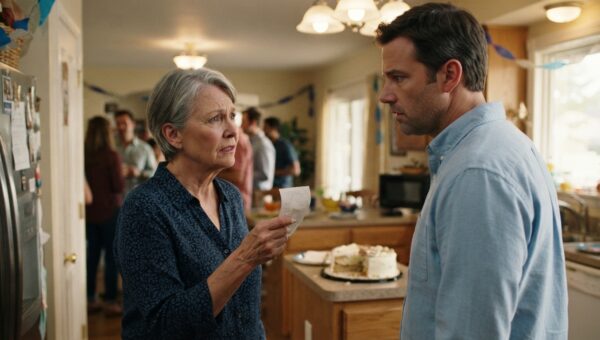
“Where is it?” I dropped the statement onto her crossword puzzle, right over the Sunday ink.
She blinked slowly, lifting her chin to look at the papers scattered across her lap. Her eyes were milky with the beginnings of cataracts, rimmed in pink from forty years of fluorescent lighting and lack of sleep. She didn’t snatch the papers back. She didn’t gasp. She just looked at them the way a tired mechanic looks at an engine that finally threw a rod.
“You found the box,” she said, her voice raspy from the dry winter air.
“Seven hundred and fifty thousand dollars,” I said, my voice rising, cracking at the edges. “My parents left nearly a million dollars when they went off that road. I wore shoes with holes in the soles, Clara. We ate rice and beans every single night of my life. I watched you break your back at Walmart for thirteen dollars an hour while I scraped up tips for a winter coat. Where is the money?”
She set her pencil down on the armrest, the little wooden stub rolling off and hitting the braided rug with a dull thud.
“I spent it,” she said.
“On what?” I shouted, the quiet resentment of fourteen years finally tearing through my throat. “On what? There’s twelve thousand dollars left in this account. Where did seven hundred and thirty-eight thousand dollars go?”
She finally looked me straight in the eye, and there was no shame in her face, only a terrible, ancient exhaustion that seemed to weigh her shoulders down another inch into the chair.
“I didn’t spend it on you,” she said softly. “I spent it on your brother.”
The room went completely still. The hum of the refrigerator in the kitchen sounded loud enough to rattle the windowpanes.
“I don’t have a brother,” I whispered.
Clara adjusted her glasses, her fingers steady in a way mine never would be again. “Yes, you do. He lives with your…”
“Stop it,” I yelled, taking a step forward and grabbing the back of the sofa. “My parents died in that car. It was just me. You took me in. You said so.”
“Your mother was six months pregnant when they went off Route 9,” Clara said, her voice dropping into a flat, level monotone that hurt worse than shouting. “They pulled her out before the engine caught fire, but the baby came early. Real early. He spent his first four months in a neonatal unit three counties over, hooked up to machines that cost more than this house. And when he came home, he didn’t come home whole.”
I couldn’t breathe. My chest felt like it had been clamped in a vise.
“Cerebral palsy,” she continued, looking down at her worn slippers. “Severe. He couldn’t swallow on his own, couldn’t sit up, couldn’t blink without help. Your father’s family took one look at the medical prognosis and tried to force your parents into institutionalizing him, tried to claim the unborn trust to pay off their own gambling debts. That’s why your folks were driving through a blizzard at two in the morning when they hit that black ice. They were running to meet a lawyer who was going to lock down the insurance trust strictly for the baby’s care.”
She reached down slowly, her joints popping in the quiet room, and pulled a heavy metal lockbox out from beneath the footrest. She didn’t lock it. She just flipped the brass latch and slid a thick manila folder across the coffee table toward me.
“Open it,” she said.
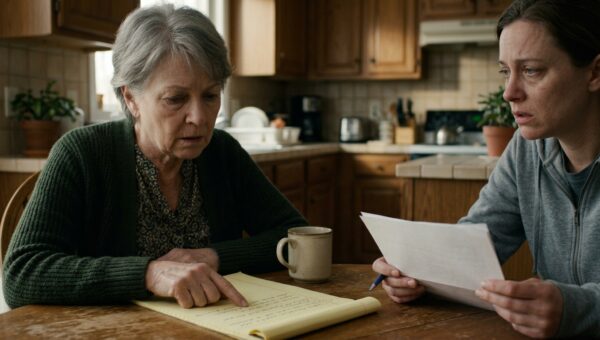
My fingers were shaking so badly I could barely pull the flap open. Inside were receipts, medical directives, guardianship agreements, and monthly wire transfer confirmations stretching back across fourteen years.
Residential care facility. Specialized pediatric nursing. Physical therapy. Equipment rentals.
Every single month, like clockwork, fifty-two hundred dollars left that insurance account and went straight to a private facility in the rolling hills of West Virginia.
I sat down hard on the edge of the coffee table, the papers sliding into my lap. “Why didn’t you tell me?” I whispered. “Why did we live like we were starving?”
Clara leaned her head back against the corduroy and closed her eyes. “Because if anyone in this town knew there was a pile of insurance money sitting in a bank, your father’s brothers would have dragged us through court until there wasn’t a penny left for the boy. And because if I told you that I was spending your inheritance to keep your brother alive in a bed three hours away, you would have grown up bitter at him instead of me.”
She looked at me then, and for the first time in my life, I saw the woman behind the exhaustion. She wasn’t just my aunt. She was a woman who had buried her sister, taken in a four-year-old orphan, worked two dead-end jobs to keep the lights on, and secretly managed the survival of a disabled child she never asked for, simply because nobody else was left to do it.
“You hated me sometimes, didn’t you?” she asked quietly.
“Every time my shoes leaked,” I said, my voice breaking.
“I know,” she said. “I bought you the best I could with what was left after the wire went through. My wages paid for our groceries, our electricity, our clothes. Every cent of that policy went to keeping him breathing in a place where people actually knew how to care for him.”
She reached out and patted my knee, her hand rough and calloused from decades of scrubbing floors.
The next day, we drove.
We didn’t talk much during the three-hour drive south. The heater in Clara’s old sedan ticked rhythmically against the dashboard, and the winter trees blurred past the frosted windows like gray bars.
When we pulled into the parking lot of the brick residential center, my stomach felt hollowed out. Clara walked slow, leaning slightly on my arm the way she never used to do.
A nurse with kind eyes and gray hair led us down a pale green hallway that smelled faintly of floor wax and baby powder. She stopped in front of a sunny corner room with a window overlooking a grove of bare oak trees.
In the bed sat a boy who looked like he had been carved out of my own bones.
He was fifteen, though his body was small and twisted into the mattress like a broken branch. His dark hair curled around his ears just like my father’s in the old photographs on Clara’s mantel. When we walked in, he turned his head slowly toward the sound of our footsteps, his eyes wide and bright, fixing on my face with an intensity that made me stop deadin the doorway.
He didn’t speak, but a small, uneven sound came from his throat, and one thin hand twitched against the blue cotton blanket.
I didn’t cry. There were no dramatic words or cinematic speeches, just the heavy, quiet thud of my own heart in my ears as I walked over to the side of the bed and reached out to touch his knuckles. They were cold, just like mine always were in the winter.
When we got back home that evening, the kitchen was freezing. Clara didn’t turn on the television or pick up her crossword puzzle. She just set the kettle on the stove and sat down at the worn wooden table, her hands resting flat on the laminate surface while the water began to whistle softly against the metal.
I didn’t say anything either. I walked over to the sideboard where I had left the manila folder, pulled out the single faded photograph of the baby from the hospital file, and slid it across the table until it rested right between us, right where her puzzle pieces used to live.