The kettle was whistling on the stove, a sharp little shriek that cut through the quiet of an empty house, but I stayed right where I was on the top step of the attic stairs. My hands were gray with fifty years of chimney dust and old paper. The small metal lockbox sat between my knees, its green paint chipped around the corners where a heavy screwdriver had finally forced the latch.
Christmas Eve of 2023 was supposed to be about packing up china and deciding which of my mother’s coats to give to the charity bin, not about unearthing things that were clearly meant to stay under lock and key.
I had always thought our house in Asheville was a simple place. My mother, Helen, had lived there since the seventies, working part-time at the county library and tending her hydrangeas with a fierce, quiet devotion. She was a widow before I was old enough to remember my father clearly, and it had always been the two of us against the world, or so she told me every time the winter winds rattled the windowpanes. But the contents of this box did not fit the quiet life I had memorized.
Inside, beneath a stack of electric bills from nineteen-eighty-six and a receipt from Memorial Mission Hospital for $2,475 dated in the autumn of 1998, sat a heavy cream envelope.
The handwriting on it was unfamiliar, elegant and hurried, not my mother’s tight, careful cursive. When I slipped the flap open, a crisp birth certificate from Knoxville, Tennessee, slid into my palm. It was dated November fourteenth, 1979. The infant’s name was David. The mother’s name was Helen, and the father’s space was left completely blank.
I sat there on those dusty stairs for a long time, listening to the old floorboards settle in the cold. I am forty-four years old. I am an only child. My mother never once mentioned a brother, never dropped a hint during all those Sunday dinners, never let slip a single syllable about another child born twenty blocks across a state line five years before I came along. My heart was pounding hard against my ribs, a dull, heavy thud that made my ears hum.
Beneath the birth certificate was a bank statement from a local credit union, showing a balance of $87,300 sitting in an account that had not seen a single deposit or withdrawal since July of 2005.
Right beside it was a photograph. It showed a young man in a dark military uniform standing outside some barracks, squinting against the sun. He had my mother’s deep-set hazel eyes and the exact same way of holding his chin, just slightly tilted to the left when he smiled.
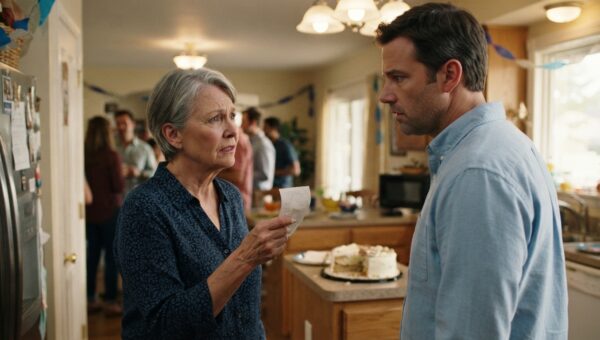
The kitchen kettle finally boiled dry and clicked itself off down the hall, leaving the house dead silent. My fingers were trembling as I picked up my phone and dialed the number in Tulsa, Oklahoma, where my aunt Clara lived out her retirement. Clara was seventy-eight, sharp as a tack, and usually picked up on the first ring. It took four long rings before her raspy voice came through the speaker.
“Sarah? Is everything alright with the estate sale?” she asked without preamble.
I didn’t bother with pleasantries. I couldn’t. “Clara, I found a box in the attic. There’s a birth certificate in here from Knoxville. Nineteen-seventy-nine. A boy named David.”
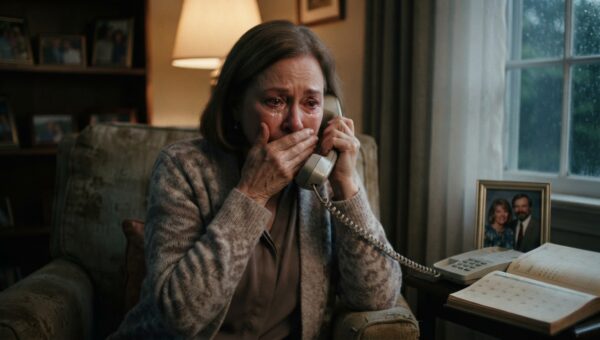
The line went entirely dead for three or four seconds. I could hear the faint hum of a television playing in the background on her end, then a sharp intake of breath.
“Some secrets are meant to stay buried, Sarah,” she whispered. Her voice didn’t sound angry; it sounded hollow, like someone who had been rehearsing an inevitable phone call for decades.
“Buried?” I said, my own voice rising higher than I meant it to. “My mother had another child, Clara. There’s nearly ninety thousand dollars in an account with his name on it. Who is he?”
“Don’t go digging in old graves,” Clara said, and her tone hardened into something cold and defensive. “Your mother made her choices when things were different. You weren’t even born yet. Leave it alone.”
“Tell me where he is.”
“I don’t know,” Clara lied. I could hear it in the sudden catch of her breath before she spoke again. “And even if I did, I wouldn’t tell you. Drop it, Sarah. For your mother’s sake.”
Before I could ask another question, the line went dead with a sharp click. I stared at the phone screen for a full minute, watching the call timer tick upward until I pressed the red button with a trembling thumb. My aunt Clara had always been the family keeper of boundaries, but this wasn’t protection. This was a wall built out of fear and forty-year-old shame.
The next morning, instead of sorting through winter coats, I drove down to the branch of the credit union listed on the yellowed bank statement. The holiday decorations in downtown Asheville were still glowing in the gray morning mist, but my stomach was tied in hard knots. I walked through the heavy glass doors, clutching the metal lockbox under my arm like a shield.
The teller behind the counter was a middle-aged woman with kind eyes and a silver name tag that read Martha. She looked up as I approached, her smile polite until she saw my face and the worn metal box I set down on the marble ledge.
“Can I help you with something today, ma’am?” Martha asked, her voice dropping into professional caution.
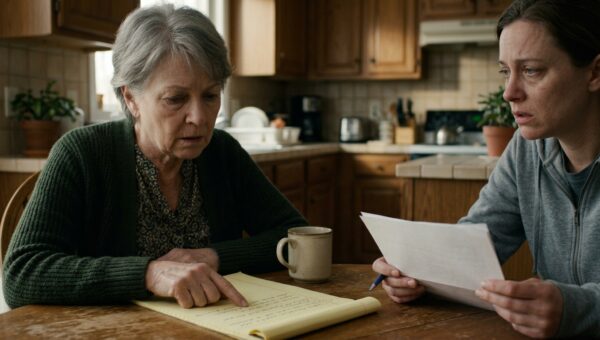
I slid the bank statement across the counter. “I’m Sarah Miller. This was my mother’s account. She passed away on Christmas Eve. I’m her executor, but when I saw the balance and the lack of activity since 2005, I realized I needed to know what this account is actually for.”
Martha took the paper, her eyes scanning the account number at the top. She didn’t look back up at me right away. Instead, she turned to her computer terminal, her fingers tapping a slow, rhythmic series of keys. After a moment, she stopped typing completely. The color seemed to drain out of her face, leaving her pale around the mouth.
“Oh,” Martha murmured softly. She looked around the lobby, then leaned across the counter toward me. “The account… it has specific instructions attached to it. Your mother came in about five years after she stopped using it. She updated the file before she got sick.”
“What kind of instructions?” I asked, leaning in until the heavy glass barrier was all that separated us.
Martha reached into a locked drawer beneath the counter and pulled out a plain manila envelope sealed with red wax bearing the impression of a simple monogram. She laid it gently on the counter between us.
“She left this letter,” Martha said quietly. “She said that if anyone ever came asking about the Knoxville account after she was gone, it should only be her daughter. She didn’t want anyone else opening it.”
My hands felt cold as I reached out and took the envelope. The paper was heavy, yellowing slightly at the corners. I broke the wax seal with my thumbnail and pulled out three folded sheets of lined notebook paper covered in my mother’s tight, familiar handwriting. I stepped away from the counter, standing near a tall plastic ficus plant in the corner of the lobby where nobody could watch me read.
The letter began without a greeting.
*Sarah, if you are reading this, it means I am gone and you have finally found the iron box in the attic. I am sorry I never told you about your brother. In 1979, before I met your father, I was young and entirely alone in Knoxville. My family made it clear there was no room for a child born out of wedlock, and I was forced to sign papers I have regretted every single day of my life. They told me he was adopted by a good family across the state. I tried to find him in 1998, as the hospital receipt will show you, but the agency doors were locked and the records were sealed tight.*
I paused, wiping a sudden tear from my cheek with the back of my sleeve. The kitchen kettle memory flashed through my mind again, that sudden whistle of steam, and I realized how little I truly knew about the woman who raised me.
*The money in this account,* the letter continued, *is not mine. I saved every spare dollar from my library job, dollar by dollar, year after year, hoping that one day someone would help me bridge the gap. When the bank manager told me in 2005 that I couldn’t trace him without a court order, I locked the account and prayed God would find a way. If you are reading this now, Sarah, I am leaving the rest in your hands. Find David. Tell him his mother never forgot his face, not for a single day.*
At the bottom of the last page, there was a small slip of paper with a reference number and the name of an adoption registry office in Knoxville, along with a handwritten notation of a last known address from a military directory in Clarksville.
I stood there in the quiet bank lobby for a long time, listening to the hum of the fluorescent lights overhead. The anger I had felt toward my aunt Clara the night before began to dissolve, replaced by a heavy, aching understanding. We had all been living in the shadow of a grief my mother carried in secret for forty-four years, a quiet sorrow that she hid behind her hydrangeas and her library books.
When I got back home to the little house in Asheville, the winter sun was starting to dip behind the Blue Ridge ridges, casting long purple shadows across the front porch. I didn’t touch the packing boxes. Instead, I walked into the living room and cleared a small space on the mantelpiece right beside the framed photograph of my mother on her wedding day.
I took the photograph of the young man in the uniform out of the metal lockbox and propped it up against a small brass candlestick. Then I placed a fresh, smiling picture of myself right beside it, leaving a space in the middle for the brother I was finally going to find.
I sat down on the old floral sofa, pulled my mother’s letter into my lap, and opened my laptop to the adoption registry site. My fingers were steady now. I typed in the reference number from the bottom of the page, hit enter, and watched the cursor spin in a slow circle against the white screen, ready to let the past finally come home.