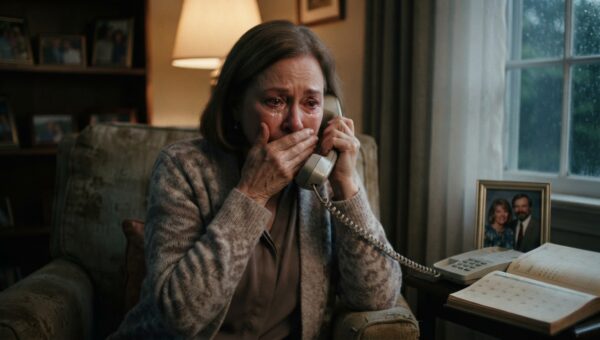
The smell of boiled fat and stale floor wax always stayed in the hallway of my parents’ house, no matter how many times they changed the linoleum. It was a heavy, permanent kind of smell that lived in the drywall.
When I drove up the gravel lane that Tuesday evening, my phone was still buzzing with emails from the corporate office in downtown Atlanta.
The ink on the offer letter was barely dry. Six hundred and fifty thousand dollars a year, plus performance bonuses. For a kid who grew up wearing sneakers with cardboard taped to the soles, those numbers didn’t look real. They looked like a misprint on a spreadsheet.
I sat in the driveway for three full minutes with my hands gripping the steering wheel, trying to quiet the buzzing in my chest. I wanted to feel like I had finally won something. Instead, my stomach felt tight and cold, the way it always did whenever I turned the ignition toward home.
They were waiting at the laminate table in the kitchen before I even hung my coat up on the brass hook. My father, Gordon, sat at the head with his reading glasses pushed up on his forehead, looking like a judge getting ready to sentence a petty thief. My mother, Helen, had her hands folded over a yellow legal pad that sat right beside a dinner plate holding a square of cold salmon she must have cooked an hour earlier.
My sister, Brenda, was picking at her nails by the window, her phone glowing against her thumb.
Nobody said congratulations. Nobody asked how many rounds of interviews I survived or how many sleepless nights went into building that portfolio.
“Sit down,” Gordon said, pointing a heavy finger at the wooden chair across from him. “We need to talk about logistics.”
I sat down, sliding my leather briefcase onto the floor between my feet. The air in the kitchen smelled like burnt onions and old grievances.
“I got the position,” I said, keeping my voice even. “The contract came through about four hours ago.”
Gordon didn’t blink. He just tapped the yellow legal pad with the blunt end of a ballpoint pen. “We figured it would. Brenda has been telling us your firm was expanding into the tech sector for months now. Which is why your mother and I went ahead and mapped things out.”
He spun the yellow pad around so the red margin faced me. Written in his cramped, aggressive handwriting were three neat percentages. Fifty percent for household overhead and parental care. Thirty percent for Brenda’s ongoing business venture and debt servicing. Twenty percent left over for my personal expenses, taxes, and savings.
I stared down at the paper. The ink was still slightly smeared near the bottom where his palm had dragged across it.
“What is this?” I asked, though my throat felt thick.
“It is the division,” Helen said, her voice dropping into that flat, icy tone she used whenever I brought home a report card with anything less than an absolute A. “You didn’t think a single person needed six hundred and fifty thousand dollars, did you? That money belongs to the family that raised you and supported you through every stupid mistake you ever made.”
“Supported me,” I repeated quietly.
“We kept a roof over your head,” Gordon barked, leaning forward so the light from the overhead dome bounced off his bald spot. “We let you stay in the spare room until you were twenty-four.
Now it is time for a return on investment. Your sister has obligations, and the mortgage on this place needs to be restructured before the bank starts asking uncomfortable questions.”
I looked over at Brenda. She didn’t look up from her phone, but a small, smug smile tugged at the corner of her mouth. She had been living off parental bailouts and my old paychecks for a decade, drifting from one failed boutique idea to another while I worked eighty-hour weeks in a windowless cubicle.
I picked up my fork and pushed a flake of the cold salmon around my plate. It looked gray under the fluorescent light.
“Is this a request?” I asked, looking straight into my father’s eyes.
Mom stared at me and said, “No.”
That single word settled over the room like a sheet of ice. No hesitation. No room for debate. In their minds, my labor was just a communal resource, and I was merely the engine meant to haul their sinking ship out of the mud.
I smiled. It felt tight and unnatural across my face, but I held it there.
“Of course,” I said softly.
Gordon grunted, leaning back into his chair with a look of supreme, arrogant satisfaction. “Glad to see you finally developed some common sense. Brenda, clear your calendar for Friday. We need to go look at that new SUV downtown.”
I stayed for another twenty minutes. I ate three bites of the cold, greasy fish, nodded at their chatter about how they were going to spend the surplus, and listened to Brenda talk about her new retail concept involving imported candles. Every time they threw out a figure, I nodded. Every time they talked about my salary as if it were a community chest, I smiled.
When I finally stood up to leave, my mother reached out and patted my arm with her dry, papery fingers. “It is about time you started pulling your weight around here,” she said.
“I’ll be in touch,” I said.
I walked out to my car, got inside, and locked the doors. My hands weren’t shaking anymore. The numbness was gone, replaced by a cold, sharp clarity that felt like winter wind. They thought they had me locked in a ledger. They didn’t realize I had just bought my ticket out.
The next morning, I didn’t go to the office. Instead, I drove straight to an office building three blocks from the municipal courthouse, walking past the brass plaque of a firm that specialized in corporate asset protection and high-net-worth family litigation.
The attorney was a man named Arthur Vance, who wore rimless glasses and listened to my story for forty-five minutes without interrupting once. When I slid the copy of Gordon’s yellow legal pad across his desk, I had taken a quick photo with my phone before leaving the kitchen, he adjusted his glasses and let out a dry, humorless chuckle.
“Well,” Vance said, leaning back in his leather chair. “They certainly didn’t waste any time, did they? Fifty percent for the parents and thirty percent for the sibling. Do you know what this actually represents?”
“Their retirement plan,” I said.
“More than that,” Vance said, tapping a pen against his chin. “This is a rescue operation. People don’t demand half a million dollars out of mere greed unless they are drowning. Let us find out what is dragging them under.”
Over the next four days, working with Vance’s private investigator and forensic accountant, the ledger cracked wide open. We didn’t just find ordinary debt; we found a disaster. My parents had taken out a massive second mortgage on the family house three years ago to fund one of Brenda’s failed business ventures. Then they had taken out a third line of credit to pay off the interest on the second. They were sixty days away from a foreclosure notice, and their credit ratings were completely cratered.
Brenda wasn’t just struggling with inventory; she had a trail of unpaid merchant loans and tax liens that totaled nearly two hundred thousand dollars. My $650,000 salary wasn’t going to be used for a comfortable retirement. It was going to be poured into a bottomless pit of compounding interest and bad decisions, and my name was going to be dragged right down into the mud beside them.
By day ten, I had executed every move Vance recommended. I moved my direct deposit to a private corporate account at an independent bank three towns over, locked down my credit profiles with a security freeze, and revoked every single authorization my parents had ever held over my old collegiate accounts.
On day fifteen, I drove back to the house in the foothills.
It was a Saturday afternoon. The sky was the color of wet slate, heavy with the promise of rain. I didn’t call ahead. I just walked up the gravel path, pushed open the front door without knocking, and stepped into the hallway that still smelled of boiled fat and old wax.
Voices were coming from the kitchen. Gordon was shouting about a bank notice, his voice rising in panic, while Brenda stood near the counter wringing her hands.
When I walked through the kitchen door, the room went dead silent.
“Where is the deposit?” Gordon demanded, his face turning a dark, mottled red. “The payroll department at your firm said the transfer was canceled three days ago. Brenda checked her account this morning and there was nothing there.”
I didn’t sit down. I left my briefcase by the door and stood right in the middle of the linoleum floor, looking at the three of them like they were strangers I had met once on a train.
“There is no deposit,” I said. My voice was level, almost conversational.
Helen stood up so fast her chair screeched against the floorboards. “What did you say to me?”
“You heard me,” I said, pulling a thin manila folder from under my arm and tossing it onto the table, right over the spot where the yellow legal pad had been two weeks ago. “That contains the forensic audit of your second mortgage, Brenda’s merchant debt notices, and a formal legal notice from my attorney stating that any attempt to claim ownership of my earnings will be met with an immediate harassment injunction.”
Gordon stared at the folder as if it were a venomous snake. “You listen to me,” he snarled, taking a step forward. “We raised you. We fed you. We gave you a place to breathe. Without us, you would be nothing. You owe us every single dime.”
“I owe you nothing,” I said, and the flatness in my voice seemed to hit him harder than a shout. “You didn’t raise a child. You raised an annuity. You calculated my life down to a percentage before I even had time to sign my own contract.”
“If you walk out that door,” Brenda screamed, her voice cracking with fury, “you are dead to this family. You hear me? We will disown you. You won’t ever set foot in this house again.”
I looked at my sister, then at my mother, who was staring at me with a look of pure, venomous hatred, and finally at my father, whose hands were shaking as he gripped the edge of the laminate table.
“Good,” I said.
I turned around, picked up my briefcase, and walked out the front door for the very last time.
The rain started just as I reached my car, pelting the windshield in heavy, gray sheets. I didn’t look back at the house with the peeling siding and the heavy smell of wax. I put the car in gear and drove down the lane, out into the open highway where the air smelled clean and the road stretched out ahead of me without a single marker or percentage in sight.
Two weeks later, I was sitting at a clean glass desk in my new apartment downtown. The city lights were just starting to flicker on through the large picture window, casting long, warm amber lines across the hardwood floor.
On the corner of the desk sat a brand-new white notepad. The spiral binding was stiff, the cover was spotless, and every single page inside was completely, perfectly empty.