PART 1
The cedar shavings always smelled the best in the morning before the coastal fog burned off the harbor. For thirty-two years, that workshop has been my sanctuary, my livelihood, and the only place where the quiet makes sense since Sarah passed away. I built my business with these hands, every beam fitted true, every joint tight. I am a master carpenter, not a man of numbers or fine print.
That was always my blind spot. I trusted people too easily, especially the people who shared my last name. When Julian drove down from Boston three months ago in his sleek black sedan, wearing a sharp suit that looked entirely out of place against the salt-bleached clapboards of my property, I thought he was just being a dutiful son.
Julian is thirty-one now, working in tech consulting up north. He has always talked fast and walked faster, carrying that restless ambition that never quite let him settle into anything real. He looked around my workshop, shook his head at the vintage Unisaw I tuned up back in nineteen-eighty-four, and told me I was sitting on a goldmine. He said property values along the Maine coast had skyrocketed, and that older craftsmen like me were getting squeezed by municipal taxes and insurance hikes we didn’t see coming. He offered to handle everything.
He said he would set up a family trust to protect the workshop and my retirement security from probate court, making sure the land stayed in the family no matter what.
I looked at my son across my old oak workbench, seeing the sharp jawline of his mother and hearing the confident tone of a man who supposedly understood the modern world. My joints were aching from the damp winter, and the thought of untangling legal documents made my head spin. I signed the papers he laid out on the workbench. He pointed to the lines, and I signed. I didn’t read every clause because he was my son, and fathers are supposed to trust their children.
The first real crack in the smooth surface of his visit appeared two weeks later when a municipal zoning official named Miller pulled his faded pickup truck right up to my loading dock.
Miller climbed out, squinting through his bifocals at the timber framing I had stacked for a custom library commission. He asked me if I needed any help finding a new location once the demolition crews cleared the lot for the commercial waterfront expansion.
I stood there with my hand planer still warm in my palm, staring at him. Demolition crews. The words felt heavy and wrong, like hitting a knot in a clear board. I told Miller he had the wrong address, that this was Arthur Sterling Woodworking, and nobody was tearing down anything. Miller pulled a folded sheet from his clipboard, pointing to the municipal filing record. He told me the parcel was rezoned for commercial redevelopment last week under an expedited application filed by Sterling Holdings LLC, with Julian Sterling listed as primary managing partner.
Miller looked at me with a kind of heavy, weathered pity that stung worse than anger.
He told me the title transfer was registered at the county courthouse, signed and sealed over a valuation assessment of four hundred seventeen thousand dollars. Four hundred seventeen thousand dollars. That exact number hit me in the chest like a cold hammer blow. It wasn’t just an estimate of the land. It was the precise sum Julian needed to clear the bad debts piling up from his failing tech-consulting firm in Boston. He hadn’t protected my legacy in a family trust. He had stripped the deeds out of my name entirely, leaving me a tenant at sufferance on the very soil I cleared with my own sweat.
I watched Miller drive away, the dust settling back onto the gravel driveway while my hands began to shake around the handle of my tool. I had spent my life building things that lasted, but I had raised a son who knew how to dismantle a lifetime of labor with a fountain pen and a smile.
PART 2
I didn’t call Julian right away. When anger runs hot and deep, picking up the phone is usually the worst thing you can do because it gives the other person room to spin more words. Instead, I drove down to the county registry office in the county seat, parking my truck in the gravel lot behind the brick courthouse where records have been kept since before the Civil Statehood. The clerk on duty was an old acquaintance named Martha whose father had bought a custom dining set from me back when Julian was still losing his baby teeth.
Martha looked up from her ledger, her expression softening into something cautious when she saw the look on my face. I asked her to pull the transfer file for my parcel on Harbor Road. She didn’t want to show me at first, murmuring about protocol, but I laid my calloused palms on the counter and told her I was the man whose name had just been wiped off the deed.
It took twenty minutes of shuffling heavy folders before she slid a certified copy across the scarred wooden counter. There it was in black and white. A quitclaim deed transferring absolute ownership of the four hundred seventeen thousand dollar property to Sterling Holdings LLC, signed by me under the heading of estate consolidation. Julian had slipped the absolute conveyance forms right in the middle of a stack of routine probate protection paperwork, knowing I wouldn’t look twice at the legal jargon.
Martha shook her head, tracing a fingernail down the margin notes. She told me the commercial developers had already wired a preliminary binder to Julian’s corporate account, and that closing was scheduled for the end of the month. She looked up at me over her glasses and asked quietly if I had legal representation for this. I told her I hadn’t, but I was about to find out what my options were.
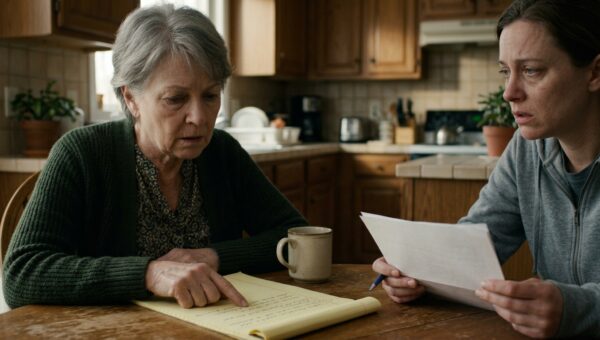
I walked out of that courthouse into the sharp afternoon air and drove straight to the office of Sarah’s cousin, Richard Vance. Richard is an old-school real estate attorney who has practiced in this county for nearly forty years. He keeps his office in a converted sea captain’s house smelling of old paper and pipe tobacco. Richard listened without interrupting while I laid the deeds and the municipal notices across his desk. He didn’t offer false comfort or cheap sympathy. He adjusted his spectacles, pulled a yellow legal pad toward him, and wrote down the exact figure of four hundred seventeen thousand dollars.
He told me the transfer looked airtight on the surface, but then he paused, tapping his pen against the blotter. He asked me a single question about how I originally acquired the land back in nineteen-ninety-two when my late father-in-law helped me clear the title to build the shop. I told him we inherited it jointly with Sarah, and that the original property grant had been tied to an old family parcel that spanned both sides of the tidal creek.
Richard leaned back in his leather chair, a slow, grim smile touching the corners of his mouth. He told me that corporate lawyers from Boston rarely check the deep municipal archives for historic encumbrances. He asked me if I remembered the old cedar lockbox Sarah kept in the attic of the workshop, the one containing her father’s personal papers and the original land grant records from the nineteenth century. I told him it was still sitting right under the floorboards in the loft where we hid valuables during coastal storms.
PART 3
I went back to the workshop as the sun dipped low over the harbor, turning the water the color of hammered pewter. The building was quiet, smelling of pine sawdust and old iron. I climbed the wooden ladder to the loft, pulled up the loose floorboard near the brick chimney, and reached into the dark cavity. My fingers brushed against the cold metal corners of the vintage cedar lockbox. It was heavy, sealed with a small brass key that had hung on a nail behind my workbench for decades.
I carried it down to the workbench, blew the dust off the lid, and turned the key. Inside lay yellowed parchment, probate records from Sarah’s family, and a folded parchment deed bearing a wax seal. Richard had told me exactly what to look for, and there it was on page three of the historical covenant. A prior lifetime usufruct agreement and unrecorded historical covenant signed by Sarah’s father and co-signed by the town elders back in nineteen-forty-one. It explicitly stated that any transfer, sale, or commercial re-subdivision of the property required the unanimous written consent of all surviving blood heirs named in the original trust, and that any unilateral conveyance by a single party rendered the entire title null and void, reverting full control back to the direct lineage holder on the premises.
Julian had skipped three generations of title history in his rush to cash out. He thought he owned a clean asset ready for commercial redevelopment, but his entire legal foundation was built on sand.
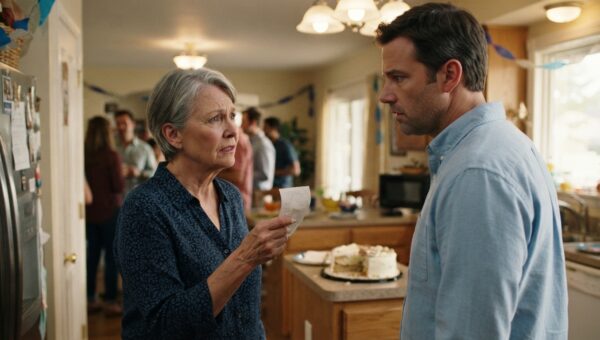
Two days later, Julian pulled up to the workshop in his black sedan. He wasn’t wearing his suit jacket this time; his sleeves were rolled up, and he looked agitated, tapping his phone against his palm as he stepped out onto the gravel. He walked through the sliding double doors where I was hand-planing a length of hard maple.
He didn’t bother with pleasantries. He told me the commercial closing was set for Friday, and that the buyers were bringing surveyors in the morning to mark out the footprint for the new retail plaza. He told me I needed to start clearing my tools out of the eastern bay by tonight. His voice had that sharp, corporate edge, cold and entirely detached from the place where he had learned to whittle his first cedar duck whistle.
I stopped working, laid the plane down on the bench, and wiped my hands on my shop apron. I didn’t yell. I didn’t wave my arms. I reached behind the joist, pulled out the manila envelope Richard Vance had prepared, and tossed it onto the workbench right between us.
Julian looked down at the documents, frowning. He picked up the certified copy of the historical covenant and the formal legal caveat I had filed that morning with the county deeds office. I watched his eyes track across the lines where Richard had highlighted the ownership defect in bright yellow ink. I saw the exact moment the color drained from his face as he realized that the four hundred seventeen thousand dollar sale he had promised his investors was sitting on a title so clouded no bank in the state would touch it.
He looked up at me, his mouth opening slightly before he found his voice. He asked me what this was supposed to be, his tone dropping from corporate certainty to something thin and panicked. I told him it was the rest of the story, the part he forgot to read before he traded his family’s history for a line of credit in Boston. I told him the commercial sale was dead in the water, his buyers had already been notified by the county recorder’s office of an active title dispute, and his investors were going to want answers about why he tried to sell land he didn’t legally control on his own.
Julian started to argue, his voice rising, talking about market pressure, liabilities, and debt ratios, using all those slick words that sounded so important in boardrooms. I cut him off with three simple words.
“Get out, Julian.”
He stood there for a long moment, staring at me as if I were a stranger who had somehow stolen his life. Then he turned, walked out to his sedan, and drove away without looking back.
ENDING
The gravel driveway has been quiet ever since that afternoon. A week after our confrontation, I received a certified letter from Julian’s corporate partners in Boston withdrawing from the purchase agreement and demanding an immediate audit of the project funds he had mismanaged. His tech firm is restructuring under court supervision now, and Julian has gone quiet, buried under the financial wreckage of his own arrogance.
The municipal zoning board formally dismissed the demolition permit once Richard filed the final registry validation. The workshop still smells of cedar and pine shavings every morning when the fog rolls off the harbor. I spent yesterday afternoon tuning the fence on my old table saw, squaring up a piece of cherry wood for a customer who appreciates the slow, honest weight of things made by hand. The deeds are locked back in the cedar box under the floorboards where they belong, safe from anyone who thinks heritage is just another asset on a balance sheet. I picked up my hand planer, brushed a curl of wood off the iron sole, and went back to work.