Brenda paid ninety dollars a visit for three days a week, and I hated the sound of her key turning in the deadbolt. It was a brass key that always caught on the warped weather stripping of the back door, giving me a solid three-second warning to wipe down the counter and shove the cold bowl of vegetable broth into the back of the refrigerator before she stepped inside.
For eight months, that was my entire routine. I would stand by the stove with a wooden spoon, pretending to stir something hearty while my throat felt like a dry pine knot wedged halfway down my neck.
My son, David, worked seventy hours a week down at the county roads department, running the grader until his eyes went bloodshot and his shoulders slumped so low he looked like he was carrying an invisible sack of seed salt. Brenda managed the books for the grain elevator while keeping our family’s two girls shuttled to track practice and piano lessons across three different zip codes. They did not need me falling apart. They did not need a grocery bill that included expensive medical purees or hospital transport vans that charged forty-five dollars just to back down the gravel drive.
So I kept my mouth shut. Literally. When David brought home a sack of groceries with pot roast and fresh crusty rolls from the bakery, I would slice them thin, plate them nicely for him when he stayed for supper on Sundays, and simply move mine around with a fork until the gravy went cold.
I told him my stomach had grown smaller with age. I told him I just lost my taste for heavy meats. He looked at me with those tired, kind eyes that he inherited from his father and he believed me, because children always want to believe their parents are invincible until the very second they prove they are not.
That Tuesday started out like any other. The sun came up grey over the bottomlands, and I was standing by the kitchen sink scrubbing a coffee mug that didn’t need scrubbing just to keep my hands busy. Brenda had called the agency two weeks prior after finding me sitting in the dark because I lacked the breath to reach for the floor lamp. The agency sent Etta. Etta was a tall woman with silver hair cropped close to her skull and eyes that missed nothing. She didn’t wear a crisp white nurse uniform that rustled when she walked.
She wore sensible canvas slip-ons and a dark green cardigan that smelled faintly of peppermint and laundry soap.
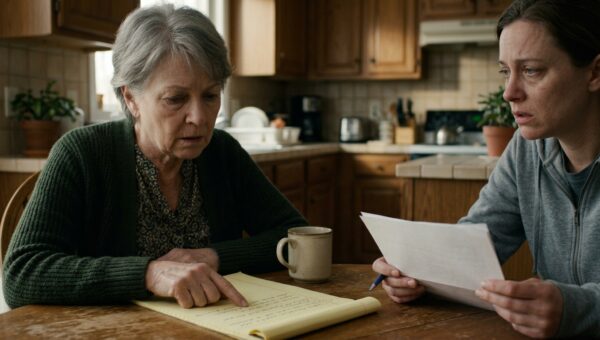
Etta didn’t try to make small talk during her first three visits. She checked my blood pressure, wrote down the numbers on a yellow legal pad, and took her leave. But on her fourth visit, she brought a small clipboard and a yellow plastic ball for my hand exercises that I shoved into the junk drawer the moment she turned her back. I had my usual bowl of watered-down chicken broth sitting on the oilcloth table cover. I knew the drill. I had to let her see me take three spoonfuls before she would sign off on her paperwork and check her watch.
I picked up the spoon. My hand gave a little twitch, just a small tremor of pure exhaustion. I lifted the warm, yellowish water toward my mouth, my chest tightening with that familiar, terrifying squeeze.
I tipped the spoon, let a few drops slide past my lips, and then tried to swallow.
My throat locked tight. The liquid sat there in the back of my mouth like a hot marble, refusing to go down, threatening to spill over into my windpipe and choke the life right out of me. I sat there with my eyes squeezed shut, my jaw trembling, waiting for the spasm to pass so I could spit it back into the spoon and pretend I had just swallowed wrong.
Etta didn’t say a word. She just set down her blue ballpoint pen with a sharp click against the wood.
“Ma’am, how long have you been hiding that you can’t swallow?” she asked.
Her voice wasn’t loud. It didn’t have any judgment in it, just a flat, heavy certainty that cut straight through the wall I had spent eight months building. I opened my eyes and looked at her. Her face was calm, weathered by years of seeing things people tried desperately to hide from the world.
“I just have a bit of a summer cold,” I managed to rasp out, my voice sounding like dry leaves being dragged across asphalt. “It’s nothing. My throat is just dry.”
Etta reached across the table and took my hand. Her fingers were warm and dry, and she didn’t let go, even when I tried to pull back out of sheer pride.
“This isn’t picky eating,” she said, her thumb pressing softly against the back of my wrist where my pulse was racing like a trapped bird. “Something is closing, and the longer we wait, the harder it’s going to be to fix.”
The weight of eight months of hiding, of drinking broth in the dark, of listening to David talk about his truck payments while I starved to death one spoonful at a time, came crashing down on my chest. I couldn’t breathe. I couldn’t keep up the lie. The sheer relief of not having to pretend anymore made my knees feel weak beneath the table.
Etta didn’t wait for my permission. She reached into the pocket of her green cardigan, pulled out her black mobile phone, and punched in three quick numbers with her thumb while keeping her other hand locked around mine. She waited for two rings, then spoke with that steady, no-nonsense tone that nurses use when they are done asking polite questions.
“David? This is Etta, your mother’s home care aide. You need to leave work right now and come home.”
I shook my head frantically, my eyes burning with hot, sudden tears. “Don’t. Don’t worry him. He’s got a crew out on County Road Twelve.”
Etta ignored me completely, holding the phone steady against her ear. “She hasn’t swallowed a solid meal in eight months. Her esophagus is obstructed. We are going to the emergency room, and I need you in this kitchen in twenty minutes.”
She listened for a second, her jaw tightening, and then she handed the receiver straight across the oilcloth to me.
“Talk to your son,” she said quietly. “Tell him the truth.”
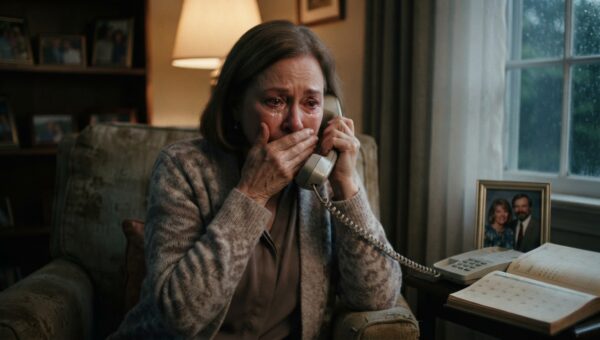
My hand was shaking so badly I almost dropped the plastic phone against my teacup. I brought it up to my ear, my heart hammering against my ribs like a fist against a door.
“Mom?” David’s voice came through the speaker, breathless and sharp, background noise of roaring diesel engines and gravel crunching under tires already bleeding through the connection. “Mom, what is Etta talking about? Are you okay?”
I opened my mouth, but for a second nothing came out. The secret was out in the open air, and it tasted like dust.
“I can’t swallow, David,” I whispered, the words finally tearing past the knot in my throat. “I haven’t been able to eat since the first snow. I’m so sorry. I didn’t want to be a burden.”
There was a long, terrible silence on the other end of the line. I could hear him breathing, ragged and fast, processing eight months of lies in three seconds flat.
“You’re not a burden,” David said, his voice cracking right down the middle in a way I hadn’t heard since he scraped his knee down to the bone behind the old barn when he was seven. “I’m turning the truck around right now. Don’t move. Do you hear me? Don’t move an inch.”
The line went dead with a sharp click.
Etta gently took the phone from my unresisting fingers and laid it back down on the table beside the cold bowl of broth. She stood up, smoothing down her green cardigan, and walked over to the counter to grab my light jacket off the wooden peg by the back door.
“He’ll be here in fifteen minutes,” she said, her voice softening just a fraction. “And when he gets here, we are going to walk out that door together.”
The trip to the county hospital was a blur of fluorescent lights and smelling of antiseptic floor wax that I had smelled too many times in my life. Dr. Vance, a young man with wire-rimmed glasses who looked entirely too young to be cutting into anyone, took one look down my throat with a lighted scope and confirmed what Etta already knew. It wasn’t cancer, thank God, but a severe, localized scar-tissue stricture that had narrowed my esophagus down to the thickness of a pinprick over nearly a year, likely caused by chronic acid reflux I had ignored with peppermint Tums for decades.
By the following afternoon, after a brief outpatient procedure down in surgery that cleared the blockage with a tiny balloon, I was sitting up in a crisp white hospital bed with an IV drip in the back of my hand. The room was quiet, save for the hum of the wall unit pushing air through the vents.
David was sitting in the vinyl armchair beside the bed, his chin resting in his big, grease-stained hands, staring down at his work boots like he had never seen them before. Brenda stood by the window, her arms crossed over her chest, looking out at the gravel parking lot where the late afternoon sun was hitting the hoods of the cars.
“Ninety dollars a visit,” David muttered into his palms, his voice rough. “That’s what it took for someone to notice my own mother was starving to death three feet away from my refrigerator.”
“Don’t you dare blame yourself, David Miller,” Brenda said, turning sharply from the window. Her eyes were red around the rims, but her voice was steady as a plumb line. “She hid it like a professional. You were working seventy hours a week keeping us afloat after the tractor loan went up. We were all blind because we wanted to be.”
I looked between the two of them, the heavy, suffocating weight that had pressed down on my chest for eight months finally lifting away, leaving behind an ache that felt clean and real. I had spent my whole life believing that love meant protecting your children from your own decay, as if hiding a wound would somehow make it heal faster. All it had done was nearly cost me the very people I was trying to save.
“I was scared,” I said, my voice sounding clearer than it had in a year. “I thought if I admitted I couldn’t eat, you’d put me in that brick home off the highway, and I’d never see my own kitchen again.”
Brenda walked over to the side of the bed, her boots clicking softly against the linoleum. She didn’t say anything fancy. She just reached down and pulled the hospital blanket up over my shoulders, tucking it in neatly beneath my chin with hands that were steady and sure.
“You’re not going anywhere except back to your own kitchen,” Brenda said softly, leaning down to give my shoulder a quick, firm squeeze. “And Etta is staying on. Five days a week now. And we’re paying for it, so you can stop worrying about the arithmetic.”
Two weeks later, the kitchen was warm with the smell of slow-simmering root vegetables and real beef broth that didn’t taste like tin or regret. The afternoon sun cut across the oilcloth table in a wide, golden beam, catching the edge of a clean ceramic mug filled with vegetable soup that I could actually swallow without my throat seizing in terror.
Etta’s empty blue ballpoint pen still rested neatly beside a paper napkin on the counter where she had left it before heading out the back door to her car. I looked at it while I took my first slow, careful sip of the broth, feeling the warmth travel all the way down to my ribs without a single hitch.
The silence in the house wasn’t heavy anymore. It was just quiet, and for the first time in a very long time, that was enough.