The kettle on the back burner was whistling a thin, reedy note that I couldn’t ignore anymore, but I kept my hands planted flat on the linoleum counter anyway. Outside the kitchen window, the Arizona sun was dropping fast behind the neighbors’ tile roof, painting the sky a bruised purple that usually meant the wind was about to kick up off the desert.
Inside the house, though, the air was already thick enough to chew. Eleven-year-old Toby was banging a plastic drum set we had foolishly bought him for his birthday, and the twin girls were chasing each other around the coffee table with a box of Crayola crayons spilling in their wake.
It was Saturday evening. It had been Saturday evening for about three weeks straight, if you asked my nervous system.
Brenda had dropped them off at 7:45 that morning, exactly as she did every single day except Sunday, because Brenda had a nail appointment or a yoga class or simply needed her space after spending all of Friday night scrolling through her phone. Mark had kissed the top of my head when he came out of the home office at noon, muttered something about needing to check the oil in the truck, and then vanished into the garage for two solid hours while I scrubbed dried macaroni off the kitchen floor.
By 5:00 PM, I had folded four loads of laundry, helped Toby build a crooked volcano out of papier-mâché, and wiped down the bathroom counters twice because five-year-olds treat toothpaste like weaponized art.
My feet felt like they were made of lead. Every time I tried to sit down with a glass of ice water, one of the girls was tugging on my apron strings asking for juice or crying because a crayon broke.
Mark finally ambled back inside around dinnertime, smelling faintly of motor oil and stale cigarette smoke, and asked if I could stay in on Sunday to watch them while he went to help his brother clear out a storage unit across town. That was the exact second the wire inside my chest finally snapped. I didn’t yell, and I didn’t cry, but my voice dropped into that low, flat register that usually meant trouble.
“I’m not babysitting on my days off,” I said.
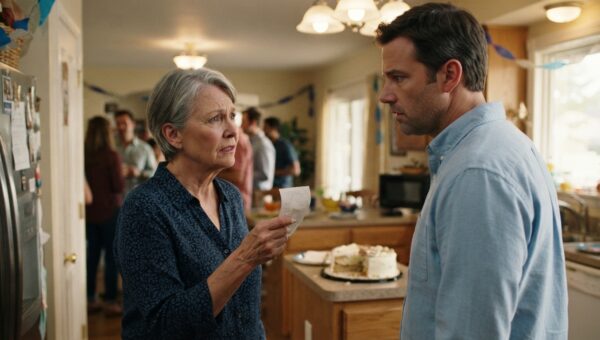
Mark stopped dead in his tracks beside the kitchen island, a jar of peanut butter half-open in his hand.
He stared at me like I had spoken to him in Swahili, his eyebrows drawing together in that heavy, irritated V he always got when things didn’t run on his preferred schedule.
“They’re not guests, Clara,” he said, his voice gratingly reasonable in that way that made my teeth itch. “They’re just kids. You’re already here anyway. What else do you have going on that’s so important?”
“My life, Mark,” I said, turning back to the sink and turning the faucet on full blast to drown out the drum set. “I have my own life. I am off on the weekends.”
He didn’t answer. He just set the peanut butter jar down hard enough to rattle the salt shaker, muttered something under his breath about selfishness, and walked back out to the garage without another word. I figured he was just sulking the way he always did when a boundary was set, so I finished making three separate bowls of macaroni, fed the troops, and told myself the air would clear by morning.
When my phone buzzed three hours later with a text from my sister asking if I wanted to grab coffee downtown, I jumped at the excuse to get out of the noise. I left a note on the counter, grabbed my keys, and drove twenty minutes down to the diner on Fourth Street just to sit in a vinyl booth where nobody was asking me to wipe a nose or find a missing sock.
The coffee was terrible and lukewarm, but the silence was worth every penny. By the time I pulled back into our driveway around 9:00 PM, the front porch light was off, which was unusual because Mark always left it burning for me out of some old-fashioned habit he picked up from his father.
I pushed the front door open, reached for the wall switch, and stopped dead.
My two large blue suitcases, the ones I used for visiting my mother in Flagstaff, were sitting right in the middle of the living room rug. They were zipped shut, tagged with my old airline ribbons, and lined up with military precision right where anyone walking through the front door would trip over them.
Mark was sitting in his recliner by the darkened fireplace, not watching television, just staring straight ahead with his hands folded over his stomach. He didn’t even look up when the door clicked shut behind me.
“You left the house without telling me where you were going,” he said, his voice entirely too calm, like a schoolteacher about to discipline a slow student. “I figured you needed some extra time to sort your priorities out.”
I didn’t move. My hand was still resting on the brass doorknob, and my fingers felt suddenly ice cold against the metal. I looked from the suitcases up to his face, taking in the smug, unyielding set of his jaw. He really thought he had orchestrated a masterpiece. He had packed my bags while I was getting coffee, treating four years of marriage like a hotel reservation he could cancel whenever the service got spotty.
“Whose clothes are in those bags, Mark?” I asked, my voice terrifyingly steady even to my own ears.
He finally stood up, smoothing the front of his flannel shirt with slow, deliberate palms. He walked over toward the edge of the rug, towering over the luggage like a landlord inspecting a tenant’s late rent.
“Mine,” he said flatly. “Well, yours. The house is mine, Clara. You know that as well as I do. My name is on the deed, my mortgage payment comes out of my account every single month, and my children will always come before whatever little hobbies or coffee dates you’ve suddenly decided are more important than this family.”
He paused, letting the weight of the moment sink into the room, waiting for the waterworks to start. He expected me to drop my keys, fall apart on the linoleum, and beg him to let me stay.
“So here is how it’s going to work,” he continued, crossing his arms over his chest with a sickening little smile. “Either you take care of them on my terms, starting tomorrow morning at six sharp, or you zip those bags up right now and walk out that door. I’m not going to have someone living under my roof who thinks she can just clock out of being a mother.”
He threw that word around like it was a badge he could pin on me whenever it suited his convenience. A mother. To three kids whose own mother lived four miles away and only called them when she needed a weekend off from her boyfriend’s lake house.
I looked down at the suitcases, then looked him straight in the eyes. The exhaustion that had been dragging me down all evening suddenly evaporated, replaced by a cold, crystalline clarity that felt almost like floating.
“You think you hold all the cards here, don’t you?” I asked softly.
Mark laughed, a short, dry bark of amusement. “Clara, be serious. It’s nine o’clock at night. Where are you going to go? Who is going to take you in at this hour with two bags of clothes and zero savings of your own?”
That was his mistake. He assumed that because I kept our grocery receipts in a neat little tin and let him handle the big bank statements, I was entirely ignorant of the paperwork that actually mattered in this household. He had spent four years treating me like an unpaid employee who didn’t read the fine print.
I didn’t cry. I didn’t raise my voice. I simply reached into the deep pocket of my wool coat, pulled out a thick manila envelope that had been sitting in the glove box of my Buick since Tuesday, and tossed it onto the coffee table right beside his boots.
Mark frowned, his hand dropping from his chest. “What is that?”
“Open it,” I said, walking past the suitcases without touching them and settling into the armchair opposite him. “Go ahead. Look at the letterhead.”
He hesitated for a second, his smugness flickering just enough for doubt to creep into his eyes. He reached down, picked up the envelope, and slid out the folded document inside. I watched his eyes track across the top lines, moving from the county seal down to the legal description of the property.
I saw the exact second the color drained out of his face. His mouth parted slightly, and his fingers began to tremble against the heavy paper.
“This… this is impossible,” he whispered, staring down at the page like it might bite him. “I pay the mortgage. My paycheck covers the bank note every month.”
“Your paycheck covers the bank note,” I agreed, my voice as calm as a winter morning. “And my inheritance from Uncle Ray covered the entire down payment, the closing costs, and the special warranty deed that was recorded in both of our names with survivorship rights, except for one little detail you conveniently forgot when you refinanced two years ago to buy your truck.”
Mark’s chest rose and fell in a sudden, ragged breath. He looked up from the paper, his eyes wide and wild. “You signed that refinance.”
“I signed a home equity line of credit for your truck repairs, Mark,” I said, leaning back and resting my hands on the armrests. “I never signed away my fifty percent stake in the primary title. And under state law, since the original purchase funds came entirely from my family estate, the primary equity belongs to the person whose name was on the deed before you ever set foot on this porch.”
The living room fell so quiet I could hear the refrigerator humming in the kitchen down the hall. Toby’s drum set had finally stopped, leaving a heavy, ringing silence in the air that felt louder than any noise.
Mark dropped the paper onto the coffee table as if it had burned his fingers. His chest was heaving now, the smooth, arrogant composure he had worn all evening cracking right down the middle like dry clay.
“You planned this,” he breathed, his voice shaking with sudden, unadulterated panic. “You knew I was going to, “
“I didn’t plan for you to be a fool, Mark,” I interrupted, my tone dropping to a hard whisper. “You did that all on your own. You thought you could treat me like hired help because you were too lazy to tell your ex-wife ‘no’ when she dumped her kids here six days a week.”
I stood up slowly, smoothing down the front of my sweater, and walked over to the two blue suitcases. I unzipped the top one, picked up Mark’s favorite fleece jacket that he had apparently packed by mistake in his haste, and dropped it onto the floor at his feet.
“You have twenty minutes to pack your own bags, Mark,” I said, looking him dead in the eye. “Because as of right now, I am revoking your authority to issue ultimatums in my house.”
He opened his mouth to speak, to yell, to threaten some legal action he couldn’t afford, but no words came out. His shoulders slumped forward, and the absolute terror of a man who realized he had just blown up his entire life for the sake of looking tough finally settled over him.
“And don’t bother calling Brenda to take the kids tonight,” I added, turning toward the kitchen to finally pour that glass of ice water. “You’re going to explain to her why you need her to come pick them up right now, because starting tomorrow morning, you are going to be a full-time father without an assistant.”
The front door slammed shut twenty-two minutes later, followed by the roaring engine of his truck tearing down the gravel driveway into the dark.
I sat alone on the porch swing a half-hour later with my coffee cup warming my hands, listening to the desert wind rustling the palm fronds overhead. The suitcases were back in the bedroom closet, tucked away on the top shelf where they belonged. Inside the house, the kids were fast asleep in the spare bedrooms, and for the first time in four years, the quiet didn’t feel like a trap. It felt like mine.