I got a lot of things wrong during those fifty-six years, but letting my father make my world small was the biggest mistake of my life.
It was March of 1969 when the Buick pulled up behind the gravel church lot and my father told me to get in the back without looking at the neighbors. Fairhaven was just a big brick house with iron window latches and nuns who didn’t talk much unless they were handing you a clipboard or telling you to fold the linens.
I was seventeen and my stomach was heavy, and by the time the snow turned into that greasy spring slush, they handed me a bundle wrapped in a hospital blanket and took it right back out the side door before I could count her fingers. My father had the papers folded in his breast pocket before the car engine even cooled down. He told me I was coming home alone and that was the end of it.
The house on Pine Street stayed quiet after that. Elwood moved in three years later, a steady man who worked the grain elevator and kept our checkbook balanced to the penny, but I never told him about Fairhaven. I figured some doors are locked from the outside for a reason, and if you rattle the knob too hard, the whole frame just gives way. Elwood was good to me, but he lived with a ghost he didn’t even know had a name.
I spent decades scrubbing grease off the kitchen floor and canning green beans and watching the seasons turn from the porch swing, and every time March rolled around I would look at my hands and wonder how something so small could just vanish into thin air.
Last month I drove down to the township library to drop off the quarterly donation for the historical society bake sale. The foyer always smells like old newspaper print and damp wool when the weather turns, and people pin all sorts of things to the corkboard by the water fountain. Yard sales, lost calico cats, tractors for parts. I was turning to walk out when a typed index card caught my eye right near the corner. It wasn’t written in marker like the rest. It was neat, done on an old Smith Corona typewriter with a ribbon that needed changing.
The words didn’t make sense at first because my brain refused to line them up.
Fairhaven home, spring of 1969. Looking for birth mother. Only clue is a homemade flannel bib with a crooked letter M stitched in blue thread.
The corkboard started to tilt sideways. I had to reach out and grab the wood trim around the water fountain because my knees got weak all at once. Fifty-six years is a long time to keep a secret locked in a box, but seeing those words on a white card made it feel like somebody had reached into my chest and turned the key. I stood there for a long time just staring at the indentation of the capital M on the paper.
I didn’t call right away. I walked back out to my Buick and sat in the driver’s seat with my hands pressed flat against the steering wheel until the trembling stopped. My heart felt like it was hammering against my ribs, and for an hour I just sat there watching the kids walk home from the elementary school across the street. Part of me wanted to tear the card down and throw it in the roadside ditch.
Part of me wanted to drive straight to the county clerk and dig through the steel drawers where the old files were kept under lock and key.
By Tuesday afternoon I couldn’t look at my kitchen counters without seeing that index card.
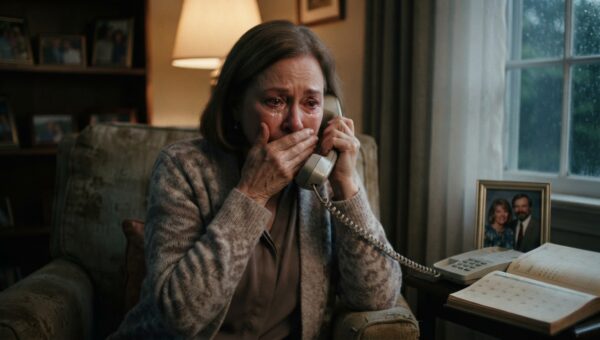
I picked up the black rotary phone in the hallway and dialed the number written at the bottom of the slip. My thumb was shaking so hard I dropped the receiver twice before it settled against my ear. It rang four times, long and hollow, and then a woman’s voice answered on the other end. She didn’t say hello. She just said her name.
“Martha?” I said, and my voice sounded like dry paper.
Nobody said anything for a second and honestly that felt worse than the silence I had lived with since nineteen sixty-nine.
“Is this…?” she started, and then she stopped. I could hear her breathing all the way from over in Grand Rapids, four hours north.
“I saw the board at the library,” I told her. “I made that bib.”
She let out a sound that wasn’t quite a sob, just a sharp intake of air like she had been running uphill in the cold. “I waited my whole life for someone to pick up that phone,” she whispered.
We didn’t talk about my father. We didn’t talk about the nuns or the gray walls at Fairhaven or the way the snow looked on the cornfields that March. We just talked about Saturday. She told me she would drive down in her blue sedan and be on my porch by eleven o’clock if the weather held.
By Saturday morning the kitchen was spotless. I had the coffee pot going and two blue willow mugs sitting on the counter, but I couldn’t sit down. I kept walking to the front window to check the gravel drive. Every time a car went by out on the county road, my stomach did a slow, heavy drop. Elwood had been gone two years now, and the house had grown entirely too quiet around noon, but today the quiet felt different. It felt like something was coming down the road that could not be stopped.
At eleven-fifteen an old blue car turned into the drive and crunched over the limestone gravel.
I opened the front door before she even had her hand off the steering wheel. Martha stepped out of the car wearing a yellow cardigan that reminded me of the ones my sister used to knit back when we were girls. She stood at the bottom of the porch steps for a second, looking up at me through the screen door like she was trying to read a sign written in a language she had almost forgotten.
I pushed the screen open and walked down one step.
She reached into the large leather bag over her shoulder and pulled out something folded square, wrapped carefully in tissue paper that had yellowed around the edges. She didn’t say a word. She just walked up the stairs, stopped right in front of me, and turned back the corner of the cloth.
There it was. The flannel square I had cut from an old work shirt of my brother’s, stitched with heavy blue embroidery floss that kept bunching up because I didn’t know how to anchor the knots properly. The letter M was lopsided, the right leg leaning hard toward the left like it was tired of standing up straight.
“You kept it,” I whispered.
“My adoptive parents gave it to me when I turned twenty-one,” Martha said, and her voice broke right in the middle of the sentence. “They told me it was the only thing that came with me from the start.”
I reached out and touched the crooked blue stitches with the tip of my thumb, feeling the rough knots underneath just the way I had felt them on a cold March morning fifty-six years ago before my father took the bundle out of my arms. The fifty-six years didn’t vanish, exactly. They were still there in the lines around my eyes and the gray in her hair, sitting between us like an old piece of furniture we had finally stopped bumping into in the dark.
We stood together there in the afternoon sun on the back porch, holding the old yellowed square of cloth between us as a light breeze caught the edge of the crooked letter M. Martha reached out and took my hand, and for the first time since I was seventeen years old, my fingers didn’t shake.