The ginger cat was meowing at the empty ceramic bowl by the refrigerator when I let myself in with the spare brass key. Nathan and Chloe had flown out to Denver for a long weekend, leaving me in charge of the mail and the feeding schedule. The house smelled faintly of roasted garlic and cedar from the candle they always left burning in the kitchen.
I scooped the canned fish into the dish, wiped my hands on a paper towel, and went to check the front hallway where the mail carrier usually drops the circulars and utility bills.
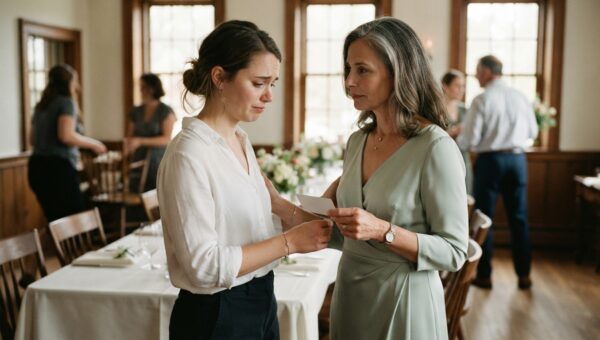
There was a neat pile of envelopes sitting on the oak console table, mostly advertisements and glossy catalogs for outdoor gear. But when I reached out to tidy them, my fingers brushed against something stiff wedged far back behind the ceramic base of the large fern. I pulled it free, thinking a stray bill had slipped out of sight. It was a thick, cream-colored envelope, slightly yellowed around the edges, with dust clinging to the back flap. I wouldn’t normally touch someone else’s personal correspondence, but the front of the envelope stopped me cold.
My name was written right there across the center in sharp, jagged handwriting I hadn’t seen in three decades. It was penned by Arthur, the man who walked out of our lives thirty years ago without a forwarding address or a note of explanation.
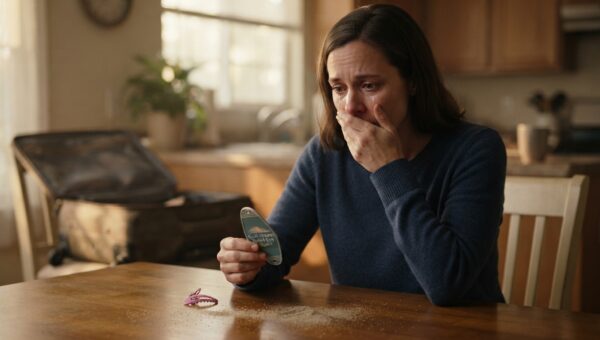
I turned the envelope over and saw the postmark date stamped nearly six weeks ago. My chest tightened immediately, that old familiar knot of panic rising right behind my collarbone. I sat down on the wooden bench by the front door because my legs suddenly felt heavy as lead.
I tore the flap open with a thumb that wouldn’t stop shaking and pulled out a single sheet of lined paper. The ink was faded in spots, penned by someone whose hand was clearly losing its strength. It was short, direct, and completely devoid of the old warmth I remembered from a lifetime ago. He wrote that the doctors at the clinic in Racine had given him less than three months. He said he was tired of running and wanted to look me in the eye just once before the end. At the very bottom of the page, beneath his signature, he had scrawled a telephone number and one sentence that made the hallway spin around me.
“Your son knows why I left.”
I didn’t think twice. My fingers punched the numbers into my cell phone with a fierce, burning urgency that had been frozen inside me since 1994. The phone rang twice, three times, four times, and then a familiar voice answered against the background roar of announcements and rolling luggage wheels. Nathan picked up on the first ring, sounding breathless and distracted as he hurried through the Minneapolis terminal for his connecting flight.
“Mom?” Nathan said, his voice cutting through the static of the airport PA system. “I’m boarding in five minutes, is everything okay with the cat?”
“Nathan,” I said, my voice shaking so badly I barely recognized it. “I’m in your hallway. I found the letter you hid behind the fern. Arthur is dying, Nathan. He sent this six weeks ago.”
There was a terrible, suffocating silence on the other end of the line, broken only by the tinny chime of a gate change announcement.
“Mom, please don’t call that number until I explain,” Nathan said, his voice dropping into a frantic, pleading whisper. “Please.
Just wait until I get home tonight. I’m taking the late flight back. Do not call him.”
The line clicked dead before I could answer.
I spent the next seven hours pacing the length of Nathan and Chloe’s hardwood floors, the creased letter clutched in my right hand like physical evidence of a crime. The sun dipped below the horizon, painting the sky a bruised purple over the dairy farms across the county road. Every time a car slowed down outside, I stopped by the window, my mind racing through thirty years of ghost stories and unanswered questions. How could Nathan know? He was only ten years old when his father packed a single canvas bag, walked out the front door, and never came back.
When the front door finally clicked open at 11:42 that night, Nathan walked in looking ten years older than he had when he left for the airport. He dropped his heavy leather suitcase by the shoe rack, his shoulders slumped under the weight of a jacket damp from the evening mist. He looked at me sitting at the kitchen table beneath the hanging brass lamp, and the last remnants of his defensive posture simply crumbled away. He didn’t even take off his coat.
“You read it,” Nathan said quietly, walking over to pull out the chair opposite me. He didn’t look angry; he looked exhausted, the way a person looks after carrying a heavy stone up a mountain for years.
“He says you know why he left, Nathan,” I said, sliding the cream-colored paper across the laminate surface between us. “Thirty years I spent wondering what I did wrong, what kind of man walks away from his own family without a backward glance. And you’ve known?”
Nathan stared down at the faded ink for a long time before he reached out and touched the edge of the paper. “I didn’t know for thirty years, Mom. Not the whole truth. Not until four years ago.”
I pulled my hands back into my lap, bracing myself against the table. “Start at the beginning. Tell me.”
“It happened on a Tuesday night,” Nathan began, his voice barely above a murmur as he stared past me toward the dark window. “Right before he left. I was ten, but I was a light sleeper. I heard shouting from the den. Not arguing like you and him usually did, this was different. It was terrified. Arthur was talking to a man named Marcus Vance. You remember Vance, he was the junior partner at the firm downtown.”
I nodded slowly, the name dragging up old, unpleasant memories of legal stationery and hushed telephone calls. “He embezzled funds. Arthur fired him.”
“He didn’t just fire him,” Nathan said, looking up to meet my eyes directly. “Vance got mixed up with people who didn’t use courts to settle accounts. When Arthur caught him draining the firm’s escrow accounts, Vance didn’t just walk away. He threatened us. He told Arthur that if he went to the police or tried to clean up the mess publicly, his family wouldn’t live to see the end of the week. They followed me home from school that Tuesday afternoon, Mom. Arthur found a polaroid of me getting off the bus sitting right on the front seat of his truck.”
The kitchen seemed to grow very cold. The old grandfather clock in the hallway ticked off the seconds with heavy, deliberate strokes.
“So he just… disappeared?” I whispered, the word tasting like ash in my mouth.
“He had to make it look real,” Nathan said, his voice cracking slightly. “Vance told him he had to vanish completely, leave no trail, cut every tie, and never contact either of us again, or the threat would become permanent. Arthur spent thirty years living in a cramped apartment two states away, working odd construction jobs under the table, just so Vance and his people wouldn’t look too closely at where we were. He protected us by becoming the bad guy in your memory.”
I sat there in the quiet kitchen, the thirty years of bitterness I had cultivated like a rare, poisonous plant suddenly turning to dust in my hands. I thought of every birthday, every graduation, every holiday where I sat alone trying to explain his absence to a confused little boy who grew up missing a ghost.
“And how did you find out?” I asked, my voice barely audible.
“Four years ago,” Nathan said, leaning forward to rest his elbows on the table. “A retired detective from the old precinct tracked me down at my office in Madison. Vance died in prison back in 2011, and the case files were finally unsealed. The detective had a box of Arthur’s old letters, letters he wrote to us every single year and never dared to mail, because he was still terrified someone might trace them. The detective gave them to me. I went and found him, Mom. He’s living in a small room above a hardware store in Racine. He looks like a skeleton. He didn’t ask for anything. He just wanted to know if we were safe.”
Nathan reached into his jacket pocket and pulled out a thick, worn leather folder filled with yellowed legal documents, police reports, and a stack of unmailed envelopes addressed in that same jagged handwriting. He laid them gently on the table between us.
“When this new letter arrived six weeks ago,” Nathan continued, his voice thick with emotion, “I didn’t know what to do. I panicked. I didn’t want to blow our lives up again, not when we finally have peace. That’s why I hid it behind the fern. I’m sorry, Mom.”
I reached out and touched the corner of the leather folder, my fingers tracing the worn stitching along the edge. The anger I had carried for half a lifetime was gone, replaced by a heavy, aching sorrow for the man who spent three decades in exile just to keep us breathing.
“We’re going to Racine,” I said quietly.
Nathan looked up, surprise flickering across his face. “Are you sure?”
“I waited thirty years for an explanation,” I said, standing up from the table and smoothing down the front of my cardigan. “I’m not going to let him die thinking I hated him for doing the only thing a terrified father could do.”
We drove down to Racine two days later, the morning sun cutting through a thin October mist that clung to the edges of the interstate. When we finally found the small brick building beside the hardware store, my heart was hammering against my ribs like a trapped bird. We climbed the narrow wooden stairs at the back, the smell of turpentine and old dust heavy in the stairwell. Nathan knocked twice on the faded green door marked 4B.
A frail man with sunken cheeks and silver hair pulled back in a loose ponytail opened the door. He wore a flannel shirt that hung loosely off his stooped shoulders, but the moment his hollow eyes met mine, I saw the young man I had married thirty-five years ago staring back at us through the veil of time. Arthur didn’t speak. He just reached out a trembling hand, gripped the edge of the doorframe, and let out a long, shuddering breath that sounded like a shutter closing on a very long storm.
We stayed for two hours in that small, quiet room, drinking instant coffee from mismatched ceramic mugs and talking about thirty years of missed seasons. There were no grand apologies, no dramatic speeches, just the quiet sound of a family slowly putting its pieces back together before the light ran out.
When we finally drove back home that evening, the sun was sinking low behind the dairy barns, casting a warm amber glow across the fields. I unlocked the front door, walked down the quiet hallway, and pulled open the small wooden desk drawer in the guest room. I placed Arthur’s old, creased letter inside, right beside a fresh photograph of Nathan and me smiling on the back porch. I closed the drawer softly as the afternoon sunlight faded into dusk.