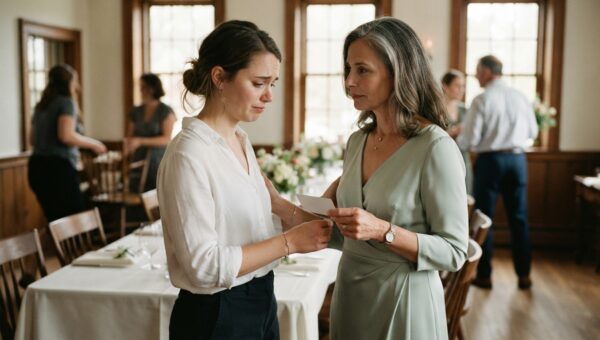
I was pinning a loose hem on my stepson’s wedding trousers when his aunt came into the hotel room and asked me not to dance with him.
“Let the first dance belong to his mother,” Marlene said.
The needle stopped between my fingers.
Ben was downstairs with the photographer. His suit jacket hung from the closet door, and his shoes sat side by side under the window.
I had spent three months helping his fiancée, Tessa, call florists, compare menus, and make a seating chart that somehow fit four divorced parents and two grandmothers at one table.
Marlene watched me set the needle on the dresser.
“I’m sorry,” she said, though her voice did not sound sorry. “I know you’ve been here a long time. But this is one moment we can give Melissa.”
Melissa had been Ben’s mother. She died when he was seven.
I had been in his life since he was nine.
“I don’t think I’m the person who decides that,” I said.
Marlene folded her arms. She was small and neat, with silver hair pinned behind her ears. “You’re his stepmother. You’ve been good to him. I know that. But he only had one mother.”
The words landed exactly where she had aimed them.
For a minute I could hear the banquet room below us: chairs scraping, someone testing a microphone, Tessa’s cousin laughing too loudly.
The wedding was an hour away. I had no lipstick on, and one side of my hair had already come loose.
“I’m not trying to replace Melissa,” I said.
“Then please don’t make him feel he has to choose.”
That was the part that hurt. I had never asked him to.
I met Ben at a school conference on a rainy Tuesday in March. His father, my husband David, had been late because a delivery truck broke down at work. Ben sat beside him in a damp hoodie, drawing a tiny house in the margin of a worksheet. When I asked if he wanted a ride home, he said, “Dad’s car smells like onions.”
It did. David had a sandwich in the glove compartment.
Ben started staying with us every other weekend. Then he began leaving his basketball shoes by the door. A year later, when his father and I married, Ben was the one who reminded David to bring the rings to the ceremony.
He never called me Mom. I never asked him to. He called me Joan, then Jo when he was in a hurry. When he was twelve, he sat on the bathroom floor while I held a bowl as he threw up from the flu. At sixteen, he asked me to read the first college essay he was too embarrassed to show his father. At twenty-three, he called me from a parking lot after his first serious breakup and asked whether I could stay on the phone until he got home.
Those things were ours. They did not need a title.
When Ben was sixteen, he called me from the school parking lot after he failed his first driving test. David was still at work, and Ben had not wanted to tell his father yet. I sat with him in the car while he described missing a stop sign and having the instructor grab the brake.
“You can take it again,” I said.
“I know.”
“You don’t have to be good at it the first time.”
He looked out the window. “You won’t tell Dad I called you first?”
“I won’t tell him unless you ask me to.”
The next week, he asked me to drive him back for the retest. He passed. When he got home, he told David himself. I never treated that call as proof that I had become his mother. It was simply a moment when he trusted me. There had been many others, each one small enough to be private and important enough to remember.
Still, when Tessa asked me to help plan the wedding, I thought it meant she wanted me included. The three of us spent evenings comparing cake samples and laughing over photographs where Ben had a bowl haircut and a missing front tooth. Tessa had never treated me as an awkward extra.
When Tessa first brought up Melissa’s memory at the wedding, she asked whether Ben had kept anything from his mother. I told her about the earrings and suggested she speak with Marlene, who knew Melissa before Ben could remember much. Tessa did. A week later, she sent me a photograph of a small gold charm Marlene had found in a jewelry box. It would be sewn inside Ben’s jacket, against his shirt.
“He should carry her with him,” Tessa said.
I agreed. I had never needed the wedding to belong to me. I only hoped there would be a place for the life Ben and I had built alongside the one he had lost.
She sent me a picture of her dress before she showed her own sister.
I also knew what a wedding could stir up. Melissa’s family had saved her recipes, holiday ornaments, and the little gold earrings Ben wore on a chain under his shirt. Marlene had been his mother’s closest sister. She had driven Ben to piano lessons after Melissa got sick and had stayed with him on the nights David worked late.
I knew why she wanted the day to remember Melissa.
I only wished she had not made remembrance sound like a locked door.
When Marlene left, I finished the hem. My hands were steady by then. I slipped Ben’s jacket onto a hanger and went downstairs to find Tessa.
She was standing alone near the ballroom entrance, holding a clipboard and looking at the place cards.
“Is everything all right?” she asked.
“I’m not sure yet,” I said. “I think Ben may be caught between what people expect from him.”
Tessa’s face changed. She set the clipboard on a chair. “Did Marlene talk to you?”
“She asked me not to dance with him.”
Tessa closed her eyes for a moment. “I was afraid she might.”
“Did Ben ask for a dance?”
“He asked for two songs. One for Aunt Marlene, because it was his mother’s favorite. And one with you, because he says you taught him how to drive with the radio on.” She reached for my hand. “I assumed everyone knew.”
I looked toward the ballroom. “Maybe he told you before he told her.”
“He told me because he didn’t want anybody to feel erased.” Tessa squeezed my fingers. “That doesn’t mean you have to fix it for him. It means we should make sure he gets to choose what his wedding looks like.”
I looked down at the clipboard, then back at her.
“Where is he?”
“Outside with your husband. They’re arguing about his tie.”
I almost smiled. “That sounds familiar.”
I found Ben by the loading entrance. He was leaning against the brick wall, tie loosened, while David tried to straighten it.
“Your father is making that knot worse,” I said.
“It’s a talent,” Ben replied.
David looked up. “She’s right.”
Ben’s smile faded when he saw my face. “What happened?”
I could have softened it. I could have pretended I was only checking on the flowers. Instead, I told him what Marlene had said, as calmly as I could.
He stared at the pavement for a long moment.
“I didn’t ask her to say that,” he said.
“I know.”
“I told her the two-song plan.”
“Maybe she heard the song and not the plan.”
He rubbed his thumb over the edge of his ring. “I wanted to dance with you. I wanted to dance with her. I thought we could do both. I didn’t think it would turn into a vote.”
“It doesn’t have to.”
“I don’t want you to feel like you’re second.”
“I don’t want you to feel like you owe me a dance.”
He looked up. “That’s not what it is.”
“I know that, too.”
He swallowed. “When I was a kid, you used to take me to school early on Fridays because Dad had the morning shift. You’d play that James Taylor song every time. I complained about it for two years.”
“You said it was old people music.”
“It was.” He smiled, then looked away. “But you always let me pick the next song, even when I picked the same one five times.”
“I remember.”
“I want to dance with you because that’s part of my life. I want Aunt Marlene to have her song because that’s part of my life, too.”
I put a hand on his shoulder. His suit was smooth beneath my palm. “Then tell her that.”
“What if she says no?”
“Then you’ll know you offered her something kind. The rest is hers.”
He nodded. He wasn’t a child asking me to solve the problem. He was a grown man trying to get through a wedding without turning love into a contest.
When the guests took their seats, Marlene sat beside David’s mother in the front row. She wore a navy dress and held a folded tissue in one hand. I sat at the next table with Tessa’s aunt and her brother. I tried to listen to the ceremony, but my eyes kept finding Ben.
He and Tessa read their vows slowly. They laughed when the wind lifted the corner of the paper. When they kissed, the guests stood. Marlene clapped with both hands, her eyes wet.
At the reception, the first dance went well. Tessa and Ben moved carefully at first, then relaxed when the room joined in with the chorus. Afterward, the DJ announced that Ben wanted to share two songs with important women in his life.
Marlene looked startled. Ben met her eyes and held out his hand.
“Would you?” he asked.
She glanced once in my direction. I stayed in my chair.
Then she took his hand.
The song was an old Patsy Cline recording. Marlene leaned close to him and whispered something I couldn’t hear. Ben laughed, and she pressed his hand against her cheek. For a few minutes, the dance floor held only the two of them and the memory they shared.
When the song ended, Ben hugged her. She stayed in his arms longer than he expected.
Then he turned toward me.
I stood up before he had to ask twice.
“You still hate this song?” he said when I reached him.
“I have improved with age.”
“I’m not sure that’s true.”
The opening notes of “You’ve Got a Friend” filled the room. He rested his hand lightly on my shoulder. I put mine on his arm. We were both awkward, and neither of us pretended otherwise.
Ben leaned down once and said, “I’m glad we did both.”
“I am, too,” I said.
He looked relieved, not because the dance had solved anything, but because he had been able to make a choice without being asked to rank the people he loved.
Halfway through, I saw Marlene at the edge of the dance floor. She was watching us. Her expression was hard to read. When the song ended, she was the first person to clap.
Later, as the guests moved toward the cake, Marlene found me near the coffee urn.
“I shouldn’t have asked you to step aside,” she said.
“No,” I replied. “You shouldn’t have.”
She let out a breath. “I thought if he danced with you, people would forget Melissa.”
“I don’t think a person disappears because someone else matters, too.”
Marlene looked down at the tissue in her hand. “I miss her every time there’s a family picture.”
“So do I, in my own way. Ben tells stories about her. I listen.”
“I didn’t know that.”
“You could ask him. He has a lot of stories.”
She looked toward the dance floor. Ben was showing Tessa’s grandfather how to use the photo booth. “He was so little when she died.”
“He was.”
“I wanted to keep her close.”
“I understand.”
She reached out and touched my elbow, barely more than a tap. It wasn’t an apology for everything. It was an opening.
At the end of the night, Tessa’s family packed leftover cake into plastic containers. David carried Ben’s suit jacket over his arm. Marlene and I ended up beside each other at the coat check.
“Do you think he’ll keep those earrings on?” she asked.
“I think he’ll forget they’re under his shirt until he changes.”
She laughed. “That sounds like Ben.”
Outside, the air was cool and smelled of rain. Ben came down the steps with Tessa, still holding her hand. He hugged his father, then Marlene, then me.
“Thank you for coming,” he said.
“I was in the sewing room before you were,” I told him. “I think I qualify.”
He leaned back. “I know you do.”
I drove home with David. The wedding flowers were wrapped in paper on the back seat. He reached over at a red light and took my hand.
“You handled that well,” he said.
“I did what I could.”
“You did more than that.”
I kept my eyes on the road. “The dance wasn’t a prize, David.”
“I know.”
“It was just a dance.”
He squeezed my hand. “And it mattered.”
In the weeks after the wedding, Ben sent us a video from the reception. The camera shook during my song, and I was laughing at something he said. Marlene had filmed the first dance with her phone. She sent the clip to the family group chat and wrote, “Melissa would have loved seeing him so happy.”
I read the message twice. I thought of the two songs and the way Ben had looked when both women said yes. I hoped Marlene had felt that her sister was remembered without needing the dance to belong to only one person.
Then I replied, “She would have.”
I did not add anything else. I did not have to.
A month later, Ben called to ask whether I still had the old driving playlist. Tessa had found a car they wanted to buy, and he said she needed to hear the song he used to complain about.
When they came over, Marlene came with them. She brought a tin of her sister’s lemon cookies. We sat around the kitchen table while Ben told the story about the school bus, the rainy Fridays, and the music I played too loudly.
Marlene corrected one detail. I corrected another. Tessa laughed at both of us.
Nobody had to decide who counted more.
Before they left, Ben kissed my cheek and took the playlist. Marlene hugged me at the door. The hug was brief, but she held on long enough for me to notice.
I watched their car turn at the corner. Then I went back inside and found David in the kitchen, still eating cookies.
“Those are good,” he said.
“They’re Melissa’s recipe.”
“I know.”
I sat beside him and took one from the tin. For the first time, the name did not feel like something I had to make room for. It was already there, in the stories, in the music, and in the people who had loved Ben before I did.
There was room for all of it.