PART 1
My mother called me the first week of November to ask if I would host Thanksgiving.
She said her knees were too swollen to stand over a roasting pan, and Dad’s back had been acting up since he cleared the gutters. I had a four-bedroom house with an open dining area, a double oven, and two spare folding tables in the garage. I told her of course I would do it.
Three days before the holiday, my mother called back.
“Valerie is bringing a few folks from her firm and her neighborhood,” Mom said, keeping her tone light, like she was talking about the weather. “Twelve people. Her house is being repainted, so it just makes more sense for everyone to gather at your place.”
Twelve extra adults meant sixteen pounds of extra turkey, two more pans of dressing, another gallon of cider, and three more pies. I spent $418 at the grocery store on Tuesday evening after work, loading heavy bags into my trunk in the freezing drizzle. I stayed up until one in the morning chopping celery, peeling yellow potatoes, and washing every linen napkin I owned.
Valerie arrived at noon on Thursday in an oversized black SUV. She did not bring a salad. She did not bring a bottle of wine or a box of bakery rolls.
She brought twelve guests who smelled like expensive perfume, took over my living room couch, and left wet coats piled on my front entryway bench.
Valerie walked straight into my dining room, took off her leather driving gloves, and looked around the walls.
“You’re still using that laminate side table?” she asked, loud enough for her friends by the fireplace to hear. “The lighting in here makes the trim look so yellow. It feels like an apartment from twenty years ago.”
I swallowed the burn in my throat, smiled at her guests, and pointed them toward the punch bowl in the kitchen.
Dinner was loud, crowded, and exhausting. I spent three hours carrying heavy platters back and forth from the stove, refilling water glasses, and clearing grease-smeared plates while Valerie sat at the center of the longest table holding court about her marketing bonuses.
Around four o’clock, right before dessert, I went into the walk-in pantry to get the extra dessert plates.
I heard hushed, angry voices on the other side of the thin wooden door.
“She has the room, Arthur,” my mother was hissing. “Stop making a scene.”
“It’s not right, Martha,” Dad answered, his voice low and tight with strain. “She spent half her paycheck feeding these strangers, and Valerie treats her like hired help.
You promised me we would tell both girls the truth about the estate accounts this year.”
“We will not ruin Valerie’s holiday,” Mom snapped back. “Valerie is the one who represents this family in the county. Claire has always been simple. Claire does not need the burden.”
I stood between the wire shelves with three porcelain saucers in my hands, unable to breathe.
When I stepped out of the pantry, my twelve-year-old niece, Maya, was standing near the doorway. Her eyes were wide, her face was completely white, and her hands were tucked into her cardigan pockets. She had heard every single word through the wood.
I set the plates down, pulled Maya into the quiet guest room down the hall, and sat with her on the edge of the bed for ten minutes. I rubbed her back while she caught her breath, telling her that grandparents get tired and say things they do not mean when holidays get hectic.
When we walked back out, the pumpkin pie was already sliced on the buffet.
My father stood up at the head of the table with his cider glass raised. He cleared his throat twice.
“Before we cut the pie,” Dad announced, looking down the long row of chairs, “I want to offer a toast to the daughter who keeps this family together. The one who carries our name forward, works hard every day, and never lets us down.”
Every head at the table turned toward Valerie.
Her friends began clapping and raising their wine glasses. Valerie smiled her practiced, smooth smile, touching her pearl necklace as if the words were her natural birthright.
Nobody looked toward the kitchen door where I stood holding an apron and an oven mitt. I had spent four days scrubbing floorboards and cooking forty pounds of food with my own money.
Valerie never noticed that the four children at the corner table had stopped eating their pie. Maya and her cousins were staring at the adults with stiff, troubled faces, watching the forced smiles instead of the dessert.
As I walked past Maya’s chair to pick up the empty punch pitcher, she reached out quickly.
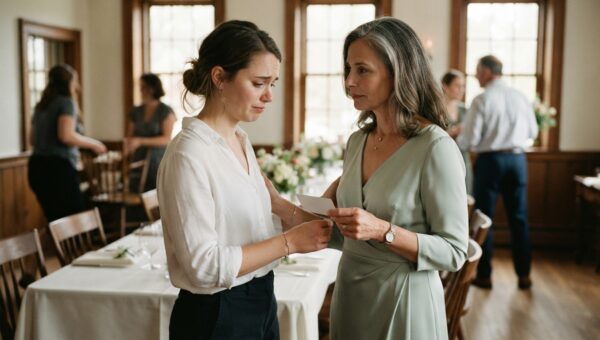
She caught my wrist, pressed a crumpled white paper napkin into the palm of my hand, and looked away.
I walked into the laundry room, closed the door, and smoothed the napkin flat on the dryer. Written on the paper in dark ink was a four-digit gate code, a unit number, and the address of a storage facility on Route 9.
PART 2
Beneath the storage unit number, Maya had scribbled four words in her neat middle-school printing: *Mom’s green tin trunk.*
I tucked the napkin into my jeans pocket and stayed in the kitchen until the last guest left at eight o’clock.
My mother gave me a quick peck on the cheek as she walked out to Dad’s car, complaining that the turkey gravy could have used a pinch more sage. Valerie didn’t even say goodbye. She hurried out to her SUV with three of her neighborhood friends, laughing loudly in the driveway while Dad carried her leftover boxes to the trunk.
I spent until midnight running the dishwasher three times, bagging five loads of trash, and wiping down the dining table. Every time I looked at the dark wood, my father’s voice echoed in my ears: *The daughter who keeps this family together.*
For forty years, Valerie had been the shining star of the household. She was the one who received private tutoring, the one whose framed certificates covered the hallway wall, and the one my parents held up as proof of good breeding. I was the ordinary second child. My father used to shake his head when I showed him my drawings, telling me that practical girls focused on secretarial work instead of daydreaming. When Valerie went off to the state university with full family support, I was told there was only enough tuition money for one daughter, so I took a night job at a medical billing company and paid my own way through community college.
I had spent my whole life believing Valerie was simply smarter, more capable, and more deserving.
On Friday morning at nine o’clock, I drove to the storage facility on Route 9.
The complex was a row of drab metal buildings behind a chain-link fence. I punched the four-digit code from the napkin into the key pad, and the gate rolled open. Unit 114 was located halfway down the second row.
I pulled the rolling metal door upward with a sharp rattle.
The unit was packed with Valerie’s discarded patio sets, old office chairs, and boxes from her divorce three years ago. Sitting right in the center, resting on a wooden crate, was an old olive-green footlocker with brass latches that had belonged to my grandfather.
The brass clasp was unlocked.
I opened the lid. The locker smelled of mothballs and old cardboard.
Inside was a stack of yellowed manila folders tied with twine. The top folder was marked *School Records: 1988–1994*.
I sat down on a plastic storage bin and opened the first file.
Inside were my original childhood report cards from elementary and middle school. Not copies. The actual, embossed quarterly records from Westfall Public Schools.
I stared at the grades on the paper. Straight A’s in reading, science, and history. Teacher evaluations describing an exceptionally bright, attentive student who showed leadership in group studies.
Beneath the report cards were four folded letters on blue-lined notebook paper, addressed to Principal Miller at the junior high school. They were dated between 1991 and 1993, written in Valerie’s unmistakable, round cursive with the looping capital letters.
I read the first line of the top letter, and my throat went completely dry.
*Dear Mr. Miller,* Valerie had written when she was fifteen years old. *My parents asked me to write this because my sister Claire is showing severe cognitive distress at home. She cannot retain textbook lessons, and her behavior around other students is becoming unstable. We beg you not to place her in the advanced placement track next semester, as the pressure will cause a nervous breakdown.*
PART 3
I sat in that cold metal unit for forty minutes, reading every single page.
Valerie had not written those letters alone. Tucked right behind her notes were two formal letters signed by my mother, using the family’s official stationery, requesting that the school board remove me from the accelerated academic program and transfer me to general business tracks.
My mother had written: *Claire is fragile and prone to extreme emotional fatigue. Her older sister Valerie is our primary academic candidate, and we wish all honors resources to be concentrated on Valerie’s college preparation.*
The pieces of my entire life began to shift into a terrible, clear line.
In seventh grade, my homeroom teacher, Mrs. Gable, had called me to her desk with tears in her eyes and told me I was being reassigned to the basic study hall. When I ran home crying and asked my parents why, my mother told me that the school tests showed I was struggling, that I wasn’t built for high pressure, and that Valerie had to study twice as hard just to carry the family name for both of us.
They had hidden my real grades in a footlocker. They had deliberately pulled me out of advanced classes so that Valerie would remain the undisputed academic pride of the county. Valerie had spent her adolescence securing her own pedestal by convincing the administration that her little sister was mentally defective.
And my parents had gone along with it because they were terrified of having two daughters compete for the same small pool of family pride and money.
At the bottom of the trunk lay an envelope from my grandfather’s estate attorney, dated May 1996.
It was a copy of my grandfather’s original will. He had left forty thousand dollars in a restricted educational trust for each granddaughter. But there was an amendment attached. My mother had filed a legal petition as my guardian, claiming that due to my special learning limitations, my educational share should be redirected into a general family fund to support Valerie’s four-year degree at the private university in Richmond.
My entire college fund had been given to Valerie. My parents had told me my grandfather left nothing for the grandchildren because his nursing home bills had cleared out the estate.
I didn’t yell. I didn’t throw the papers.
I took the manila folder, placed it inside my leather tote bag, pulled the metal door of the storage unit down until the latch clicked, and drove straight to my parents’ house on Elm Street.
Their sedan was in the driveway. It was eleven-thirty on a gray Friday morning.
I walked up the front steps without knocking and turned the brass doorknob.
My mother was sitting at the kitchen table drinking black tea, while Dad was slicing an apple with a paring knife.
“Claire?” Mom asked, blinking at me over her glasses. “What are you doing here so early? Did someone leave a dish at your house?”
I walked into the kitchen, set the manila folder right on the center of the table between the tea mug and the apple peels, and stepped back.
“I visited Valerie’s storage unit on Route 9,” I said.
My father’s knife stopped moving against the apple core.
My mother looked down at the faded cardboard folder, saw the blue lines of Valerie’s high school handwriting sticking out from the top, and her face went completely rigid.
“Where did you get that?” my mother whispered.
“Maya gave me the key code,” I told her. “She heard you and Dad arguing behind my pantry door yesterday afternoon while I was serving dinner to twelve of Valerie’s friends.”
Dad dropped the knife onto the cutting board. He covered his face with both hands, his shoulders dropping until his forehead nearly touched the table.
“Martha,” Dad groaned into his palms. “I told you. I told you forty years ago this would find us.”
“Claire, listen to me,” my mother started, her voice shaking as she reached toward the folder. “You don’t understand how things were back then. Your father’s shop was failing, and Valerie had a real future in regional business. We couldn’t afford two daughters at that level. We had to make sure one of you got out.”
“You didn’t make sure one of us got out,” I said, keeping my voice so calm it felt like ice in my mouth. “You stole my grades. You told my teachers I was unstable. You let Valerie lie to the principal, and then you stole my grandfather’s trust fund so she could live in a sorority house while I was working graveyard shifts at the clinic.”
“We gave you a good home!” Mom yelled, her face turning dark red. “You had clothes! You had food! Valerie needed that support to make something of herself!”
“And what did she make?” I asked. “A woman who shows up to Thanksgiving with twelve freeloaders, insults my house, and lets Dad toast her for keeping the family together while you two hide the truth like thieves in a pantry?”
ENDING
Neither of them had an answer for me. The silence in that kitchen was forty years old, built out of lies, favoritism, and cowardice.
My father looked up from his hands, tears running down into the gray stubble on his cheeks. “Claire, what do you want us to do? Tell me what to do.”
“There is nothing for you to do, Dad,” I said. “You made your choice in 1991, and you toasted it yesterday afternoon.”
I reached down, picked up the manila folder from the table, and tucked it back under my arm.
I walked out the front door, got into my car, and drove home.
Valerie called me at three o’clock that afternoon. She was screaming into the phone, demanding to know why I had broken into her private storage locker and accusing me of turning Maya against her.
“Maya didn’t turn against you, Valerie,” I told her quietly. “Maya just has ears. She heard what you are, and she didn’t want to carry your garbage anymore.”
I hung up the phone and blocked her number.
I called an attorney in town on Monday morning. Because forty years had passed since the probate fraud, pursuing legal restitution for the stolen educational trust was barred by the statute of limitations. But I didn’t care about the money anymore. What I needed was my dignity back, and no court order could give me that.
I scanned every single report card, every letter to the principal, and my grandfather’s original trust document into clean digital files. I made three identical thumb drives and kept the originals in a fireproof lockbox in my bedroom.
When my parents called two weeks later asking if I would be coming to Christmas dinner, I sent them one short text: *I will not be sitting at your table again.*
I spent Christmas Day in my own home with the fireplace going and soft music playing on the stereo.
Around one in the afternoon, the doorbell rang.
I opened the door. Maya was standing on the porch wearing a thick wool coat, holding a small plastic container wrapped in tin foil. Behind her at the curb was her father, Valerie’s ex-husband, who gave me a polite nod from the front seat of his truck.
“I brought you some gingerbread cookies, Aunt Claire,” Maya said, looking up at me with clear, honest eyes.
“Come on in, sweetie,” I told her, opening the storm door wide.
We sat at my laminate side table, the one Valerie had called cheap, and ate cookies with hot cocoa while the winter sun came through the window.
The dining room didn’t look yellow to me at all. It looked warm, clean, and completely mine.