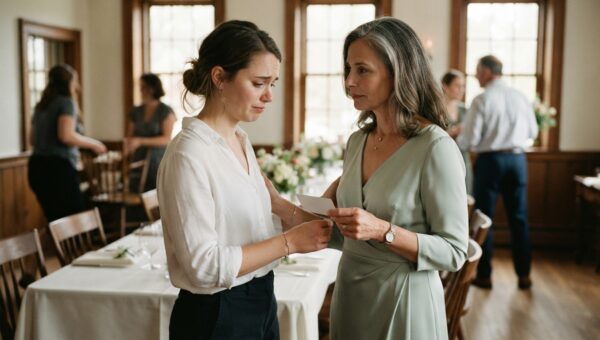
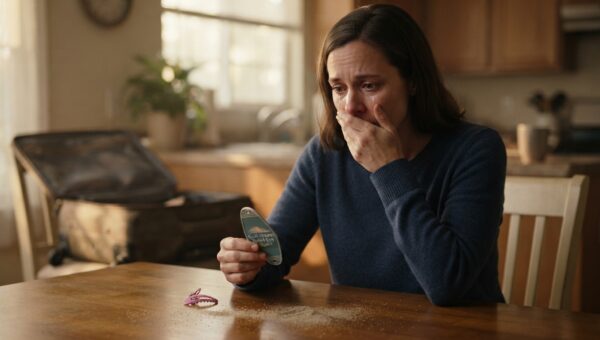
The linoleum floor behind the counter of Miller’s Diner still had that stubborn scuff mark near the mop sink where Dad dropped his heavy iron skillet back in ninety-eight. I looked down at it while Arthur Vance, our family lawyer, folded his metal-rimmed reading glasses and slid them into his breast pocket with a dry click. Arthur’s office always smelled like stale mints and damp wool, even in July. Clara sat across from me in her cream-colored linen blazer, her posture stiff and victorious, holding a fresh leather folder against her lap like a shield. She had every reason to look pleased. The house on Maple Street was hers now, along with the bulk of Dad’s savings account, sitting pretty at around $184,000 according to the probate ledger.
I didn’t care about the house. I cared about the three years of silence that came before the funeral. Dad had stopped talking to me the week I told him I wasn’t going to hand Clara my wife Elena’s pink slip. He had stood right where that scuff mark was by the mop sink, his face turning the color of an overripe plum, telling me that blood was thicker than water and my wife was just an outsider meddling in family ledgers. He said he had built this diner with his own hands and he knew how to run it. Then he walked out, climbed into his faded blue Ford pickup, and didn’t speak a single word to me until the day he drew his last breath at St. Jude’s.
Arthur cleared his throat, breaking the heavy quiet in the office. He picked up a thick, leather-bound volume with grease stains darkening the corners and pushed it across the mahogany desk toward me. It looked heavy, wrapped in a faded red ribbon that had frayed at the knot.
“Your father left specific instructions regarding this item, Raymond,” Arthur said, his voice dropping into that solemn professional register lawyers use when they are about to deliver bad news disguised as sentiment. “The real estate and liquid assets go to Clara, as outlined in the primary codicil. But this specific property is yours. He said you would know what to do with it.”
Clara let out a short, sharp laugh that sounded like dry leaves scraping across concrete. She didn’t even bother to hide her contempt as she stood up and smoothed down her skirt. “A recipe book, Ray? Honestly. Dad knew you liked to play chef on weekends, but I think he just wanted to make sure you got the leftovers while the actual estate stayed where it belonged.”
I picked up the book. The leather was stiff and cold against my palms, smelling faintly of old flour and cigarette smoke from the days when Dad used to sit in the corner booth with his Pall Malls. I didn’t answer Clara. I just tucked the book under my arm, thanked Arthur in a flat voice, and walked out into the bright afternoon glare without looking back at my sister.
Elena was waiting in the sedan down the block, the engine idling with a faint tick in the valve lifters. When I climbed into the passenger seat and laid the heavy volume on my knees, she turned down the radio. She didn’t ask about the house or the money because she already knew how Clara had operated behind the scenes for years. She just looked at the frayed red ribbon.
“Is that it?” Elena asked, her dark eyes steady and kind.
“That’s it,” I said. “A cookbook from our first year in business.”
We drove back to the diner in silence. The lunch rush was long over, and the dining room was quiet except for the low hum of the refrigeration units behind the pie case. We sat at our usual corner table near the jukebox, the one with the slight wobble in the left leg that Dad had never gotten around to shimming. I untied the frayed ribbon. It fell apart in my fingers like dry moss.
I opened the front cover. The pages were thick cardstock, covered in Dad’s bold, sloping handwriting detailing measurements for sourdough starter and beef stew roux. I flipped through the middle sections, my thumb catching on grease spots and scribbled notes about supplier prices from nineteen-ninety. Nothing out of the ordinary. Just fifty years of daily labor bound between stiff cowhide.
Then I reached the back. The final page was glued down to the inner lining of the back cover, but a thick section of the cardboard backing felt loose. I worked my fingernail beneath the edge, and the false bottom gave way with a muffled tear. A folded piece of yellowed legal paper slid out and landed softly on the checkered tablecloth.
It wasn’t a recipe. It was a typed document with blue ink signatures at the bottom, dated eleven years ago, right around the time the diner was struggling to stay afloat after the highway expansion diverted traffic away from our doors.
I picked it up, my thumb trembling slightly against the crisp fold. Elena leaned in close, her shoulder brushing mine as her eyes scanned the header. The room seemed to go dead silent, the hum of the fridge fading into nothing.
“Read this part,” Elena whispered, her finger tapping a paragraph near the middle.
I read the legal phrasing out loud, the words feeling clumsy and heavy on my tongue. It was a corporate restructuring agreement drafted by an outside firm in Grand Rapids. It detailed a complete transfer of property rights and majority shares of Miller’s Diner away from our father and into a private LLC entirely controlled by Clara. There was a provision for a buyout clause that would have left Dad with a monthly stipend and zero operational authority over the building he had spent his youth constructing.
My brain stalled out for a second. I stared at the signature at the bottom. It was Clara’s handwriting, neat and deliberate, signed on a Tuesday in October eleven years ago. Right beside it was a second signature, crossed out with a violent slash of red ink that tore slightly through the paper.
Below the signatures, Dad had written a short note in his familiar, heavy hand, dated just three days after the contract was drawn up. His ink was darker there, pressed down so hard the pen had nearly punched through the fiber.
I read his note out time and again, the words finally sinking into the marrow of my bones. He wrote that Clara had presented the papers while he was recovering from his first hip surgery, claiming it was standard liability protection for the family. He wrote that he caught the clause transferring the deed only because his old friend from the bank tipped him off about a title search. He hadn’t called the police or dragged her into court because he was too proud to air family laundry in public, but he had put a permanent stop to it that very afternoon.
Elena reached out and touched the corner of the yellowed paper. She didn’t cry or shout. She just looked at the date and then up at me, her expression clearing like a fog lifting off the lake.
“He never hated me,” Elena said softly, the words dropping into the quiet space between us like stones in a deep well. “He was trying to stop your sister from doing the exact same thing to the business all over again.”
The pieces clicked together with the force of a falling beam. Three years ago, when Dad got sick the second time and Elena stepped in to balance the failing ledgers, she found thousands of dollars missing from the operating account. She found suspicious withdrawals made out to a consulting firm that didn’t exist anywhere except on paper under Clara’s married name. When Clara realized Elena was auditing the books and tightening the controls, she panicked. She went straight to Dad, exploiting his old-fashioned pride and his failing health, whispering in his ear that Elena was trying to edge the family out of the diner.
Dad had been trapped in a terrible corner. If he investigated Clara openly, the family would fracture into pieces and the local gossip mill would tear our reputation apart. But if he didn’t do something, Clara would manipulate him into signing away the rest of the property just like she had tried to do a decade before. So he came up with a brutal, solitary strategy. He demanded I fire Elena. He knew I wouldn’t do it because I knew my wife’s integrity better than anyone. By staging a bitter public estrangement and cutting me out, he made Clara believe she had won total control over his affections and his future estate, keeping her isolated from the diner’s actual daily operations while he quietly locked the original proof away in the one place Clara would never think to look.
“He played a very long game,” I said, my throat tightening up until I could barely force the air past my collar.
Before Elena could answer, the front bell of the diner chimed, its brass clapper striking the iron ring with a sharp, cheerful sound that felt entirely wrong for the moment. The heavy glass door pushed open, and Clara walked in. She was still wearing her linen blazer, her car keys dangling from her right hand, her expression bright with the smug confidence of someone who had just inherited a house and a bank account without breaking a sweat.
“Well,” Clara said, her heels clicking briskly against the linoleum as she walked toward our table. “I hope you’re done mourning over your little book. I need to talk to you about the commercial lease transfer for the diner. Now that I have the primary estate control, I think we need to bring in a real management firm to handle the property taxes. Dad agreed with me on most things, you know.”
She stopped about three feet from our table. Her eyes drifted down to the yellowed legal document lying open between our coffee cups. She saw the heading. She saw her own signature scrawled across the bottom in neat, unmistakable ink.
The color didn’t drain from her face in some dramatic fashion; she just stopped moving. Her shoulders went rigid, and the smile on her mouth vanished so fast it looked like it had never been there at all. She reached out one hand and gripped the back of an empty chair to steady herself, her fingers turning white against the wood.
“Where did you find that?” Clara asked, her voice dropping an octave, losing all its polished boardroom sharpness.
I didn’t stand up. I just looked at her across the table, seeing past the expensive blazer and the smug posture down to the frightened little girl who had tried to steal her father’s life’s work eleven years ago and thought she had gotten away with it.
“Dad left it in the recipe book, Clara,” I said quietly. “He knew about the takeover attempt from twenty-fourteen. And he knew exactly why you wanted Elena out of the kitchen three years ago.”
Clara stared at the paper for a long, frozen second. She opened her mouth to say something, to spin another lie about misunderstandings or bad legal advice, but the words wouldn’t come. The silence in the diner was absolute, heavier even than the quiet in Arthur’s office.
She didn’t argue. She didn’t yell. She just let go of the chair, turned on her heel with a sharp rustle of linen, and walked out the door without looking back, letting the brass bell ring once behind her as the door clicked shut.
We sat there together in the corner booth for a long time as the afternoon light slanted low across the checkered floorboards. The weathered leather recipe book rested securely beside the cash register on the counter where I placed it later, held open by a heavy brass weight to its first page, serving as both a foundation and a shield.