The red LED numbers on the microwave downstairs always glowed a hard 2:07 when the house settled into that dead part of the night where the floorboards stopped creaking. Last night, they blinked at me through the dark while the phone on the nightstand screamed. It did not ring out. It buzzed twice, sharp and broken, and then the line went dead.
I sat straight up in the dark. My heart did that heavy, thumping thing against my ribs. I did not need to check the clock again.
Two weeks ago, Clara had stood in this exact bedroom while the rain drummed against the windowpane. She had not come to my house alone in four years, not since Mark convinced her that moving thirty miles out to the edge of the county was better for their privacy. He drove her everywhere. He answered when people asked her what she thought about politics or church or dinner. I had bitten a hole clean through my own tongue keeping my mouth shut because I was terrified of giving them an excuse to cut me off entirely.
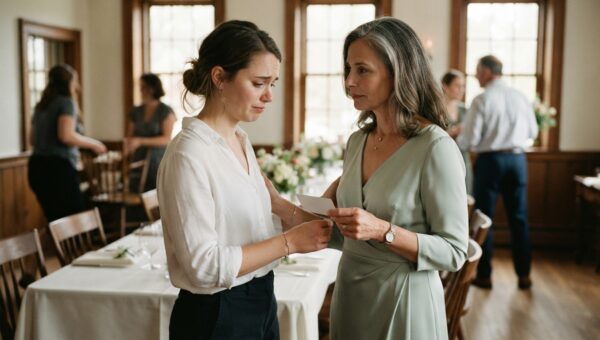
When she walked through my front door that afternoon last month, her coat was buttoned crooked and her eyes looked like bruised glass. She did not ask how I was doing.
She walked straight past me into the small den where I keep my old laser printer humming away in the corner.
She did not say a word while the machine whirred and spat out paper. Forty sheets. I counted the rhythm of the rollers in my head because I was scared to interrupt her breathing. When the last page slid out, she gathered them up with shaking fingers and stuffed them into a yellow manila envelope. She licked the flap until the taste of cheap glue was on her tongue, pressed it down hard, and looked me dead in the eye.
“If I call you and hang up twice, take this to the police,” she had whispered.
I reached out to touch her sleeve, but she pulled back like she had been burned. “Clara, honey, what is this?” I asked.
“Don’t ask,” she had begged me. “Just don’t ask yet.”
And I did not ask. For fourteen long days, that yellow envelope sat buried underneath my tax folders in the bottom drawer of the mahogany desk.
I lived with my stomach in a knot. Every time the landline rang during the day, I jumped. I checked the locks three times before I went to bed. I even drove past their brick house on a Tuesday afternoon just to see if their blue sedan was parked in the driveway, hating myself for spying like a nervous old hen.
Then last night, the phone rang. Two short buzzes. And silence.
I threw the quilt back, my bare feet hitting the cold hardwood floor with a sharp slap. My head was ringing. I did not turn on the hall light. I groped my way down the steps in the dark, my hand sliding along the banister until I reached the study.
The desk drawer groaned when I pulled it open. My fingers found the heavy yellow envelope immediately. I tore the paper flap right off, not even caring that I ripped the cardboard.
I pulled out the stack of papers and carried them over to the kitchen island where the overhead light was bright.
The first page was a bank statement from an account I did not even know existed. It had Mark’s name on it, but the address was a P.O. box in town, and the balance was sitting at zero because the transfer logs showed eighty-four thousand dollars had been swept out into a brokerage firm three days prior.
I flipped the page. There were photocopies of checks with Clara’s signature scrawled across the bottom in a jerky, forced hand that looked nothing like her neat cursive. Below those were printed text message logs between Mark and some unknown number, detailing how he had locked her out of her own inheritance account by claiming she was medically unfit to manage her own affairs. Page after page followed. It was a complete forensic diary of six years of small, deliberate erasures. He had taken her car title, her birth certificate, her grandmother’s diamond brooch, and every single paycheck she had earned from the dental clinic before he forced her to quit.
At the bottom of page thirty-eight, there was a handwritten note in Clara’s actual handwriting, scrawled in the margin so hard the ink had punched through the paper. “If anything happens to me, he did it. He said I have nowhere else to go.”
I didn’t cry. There was no room for tears. My chest felt hollowed out, like someone had scooped out my ribs with a cold spoon.
I grabbed my car keys off the hook by the back door, shoved the stack of papers into my canvas tote bag, and walked out to my old sedan. The engine turned over on the second try, coughing up a cloud of white exhaust in the chilly air.
The drive down to the county precinct took twelve minutes. The streets were pitch black, the streetlights buzzing in the damp air. Nobody was out except for a stray cat darting across the asphalt near the hardware store.
When I pushed open the glass doors of the police station, the young desk sergeant looked up from his computer with a heavy, bored sigh. He had a styrofoam cup of coffee sitting next to his elbow and his tie was loosened around his neck.
“Can I help you, ma’am?” he asked, glancing at the clock on the wall which read 2:34.
I walked right up to the high wooden counter, dropped the canvas bag down with a heavy thud, and pulled the yellow envelope out.
“My daughter lives at forty-two willow creek lane,” I said, my voice sounding stranger to my own ears than it did to his. “Her husband is Mark Geller. She called me twice and hung up ten minutes ago, exactly like she told me she would. And this is the proof that he is going to kill her.”
The sergeant’s boredom vanished in a heartbeat. He stood up so fast his chair screeched against the linoleum. “What’s your name, ma’am?”
“Martha,” I said. “Martha Miller. And you need to send someone right now.”
It took twenty minutes for the dispatcher to coordinate two patrol cars and a sergeant. They let me ride in the front seat of the lead cruiser because I refused to stay behind at the station. The blue lights cut through the dark empty lanes of the subdivision, flashing against the brick walls of the sleeping houses as we took the corner onto Willow Creek Lane too fast.
Mark’s blue sedan was parked right in the middle of the driveway, blocking the garage.
The cruiser cut its headlights before we pulled into the gravel. Two officers stepped out instantly, their boots crunching on the stones. I tumbled out behind them, my tote bag clutched against my chest like a shield.
Before the officers could even reach the porch steps, the front door swung open.
Mark stood there in his gray fleece pajama pants and a rumpled white t-shirt. He looked annoyed, rubbing his hand over his jaw like he had just been woken up from a deep sleep. His hair was messy on one side, but his eyes were sharp and cold.
“What is the meaning of this?” Mark demanded, his voice dropping into that smooth, reasonable tone he always used when he wanted to make everyone else look crazy. “Do you have any idea what time it is? Clara is asleep upstairs. You people are waking up the whole neighborhood.”
“Shut up, Mark,” I said, my voice cutting through the night air before the officers could speak.
“Mr. Geller, step back from the doorway,” the lead officer said, placing his hand right on the holster at his hip. “We’ve received a report of an active domestic welfare concern and a financial fraud dossier naming you.”
Mark’s face didn’t go pale. It just tightened. He tried to laugh, but it came out flat. “A dossier? Martha, have you been drinking? What are you talking about? Clara!” he shouted, turning his head back toward the dark hallway behind him. “Your mother is out here making a scene again.”
“She’s not coming, Mark,” I said, stepping past the officer onto the porch. “She’s not answering to you anymore.”
From down the dark hallway, a muffled sound reached us. A dull thud, like someone dropping a heavy book against the baseboards. Then a bright click as the overhead light flickered on in the kitchen at the back of the house.
The second officer moved past Mark without waiting for permission, his flashlight beam slicing down the corridor. “Police department! Anyone in the house, make yourself known!”
“She’s in the back office!” I yelled. “The door is locked from the outside!”
Mark lunged sideways to block the hallway, but the first officer caught him by the shoulder and spun him hard against the wooden doorframe, the sound of his breath rushing out in a sharp grunt. “Don’t move an inch, sir. Keep your hands where I can see them.”
I didn’t wait for them. I ran down the dark hallway myself, my sneakers squeaking against the polished tile floor. The door to the small back study was shut tight. I hit it with the flat of my hand.
“Clara?” I called out, my voice cracking right down the middle. “Clara, honey, it’s Mom!”
From behind the wood, a small, choked voice answered. “Mom?”
“Step away from the door, ma’am,” the second officer said gently, sliding a heavy metal pry bar into the wooden frame with a sharp crack.
The latch gave way with a loud splinter of pine. The door swung wide open, hitting the wall behind it with a bang.
Clara was sitting right there on the floor against the bookshelf. Her knees were pulled up to her chin, and her arms were wrapped tightly around her legs. Her face was tear-streaked and swollen, and her right cheek was bruised a dull, angry purple where someone had hit her hard. The laptop on the small desk in front of her was still open, the screen glowing with a half-finished message she had been trying to send before he caught her.
She looked up at me, her eyes wide and terrified, until she saw the canvas bag in my hand and the police officers standing behind me in the doorway.
“You got my call,” she whispered, her voice barely a breath.
I dropped the bag, fell down onto my knees right there on the rug, and pulled her into my arms so hard I knocked the wind out of both of us. She buried her face in my shoulder, her whole body shaking like a leaf in a gale-force wind. I held her tight, rocking back and forth on the floor while the distant wail of a second police cruiser grew louder outside.
Out in the hallway, Mark was shouting something about his rights and his lawyer, his voice rising in panic as the steel cuffs clicked around his wrists.
I didn’t listen to him. I just stroked Clara’s hair, feeling the heavy, solid weight of her in my arms after six long years of standing outside a locked door.
“It’s over, honey,” I whispered against her ear, my own tears finally hot on my cheek. “We’ve got the forty pages. He can’t touch you anymore.”
Two hours later, after the statements were taken and the detectives had hauled Mark away in the back of an unmarked cruiser with his corporate ledger tucked under their arm, the house was finally quiet again.
Back at my own kitchen table, the sun was just starting to crest over the horizon, painting the sky a pale, cold gray. Clara sat in the wooden chair by the window, wrapped in my heavy wool blanket with a mug of hot tea between her hands. The room smelled of old coffee and morning damp.
I walked over to the corner of the study where my old laser printer sat humming softly in the quiet. I reached out, pressed the power button, and watched the small green light flicker to life. Then I pulled a fresh, clean sheet of white paper from the tray, rolled it flat across the glass, and slid a new blank document onto the screen for her to fill out in her own name.