The kettle was whistling on the back burner of my stove when the soft, hesitating rap rattled the screen door. Tuesday afternoons in my house are usually dead quiet, save for the hum of the refrigerator and the grandfather clock in the hall that loses four minutes every week. I wiped my hands on my apron, figuring it was just the mail carrier dropping off a flat rate box or the neighbor kid asking if our lawnmower was free to borrow again.
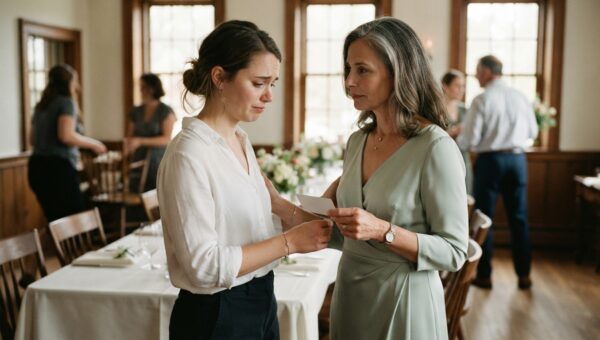
When I pushed the inner door open, the afternoon glare made me squint. A woman stood on the top step, maybe thirty-two or thirty-three years old, holding the strap of a heavy leather bag with both hands like she was steadying herself against a high wind. Her eyes were red around the rims, and she had that particular look of someone who had practiced what she was going to say in the car three times over and forgotten every single word the second the wood groaned beneath her shoe.
She didn’t say hello. She just reached into her bag, pulled out a small, square piece of stiff white paper, and held it out between us.
It was a hospital Polaroid from the summer of 1994. The borders had turned that creamy, buttery yellow that cheap instant film gets after three decades in a drawer. In the picture, a girl with wide, terrified eyes and hair pulled back in a messy clip was standing over an open plastic isolette, her scrub sleeves rolled up past her elbows to reveal forearms so thin they looked like peeled willow switches.
Cupped in her two hands was a baby who looked less like a human infant and more like a pink sparrow pulled out of a gutter after a spring storm.
The woman on my porch looked down at the photograph in her hand, then looked up, her gaze locking onto the wrinkles around my eyes and the way my mouth sets when I am tired.
“You sang ‘You Are My Sunshine’ until your voice gave out so I wouldn’t die in the dark,” she whispered. Her voice cracked right on the middle word, thin and sharp as dry kindling. “My mother told me every day of my life. I’ve been looking for you for five years to thank you for holding me when my mother couldn’t.”
I didn’t step back. I didn’t ask her who she was, because the second she said those words, the smell of industrial floor wax and recycled oxygen rushed back into my head so hard I almost lost my footing on the linoleum.
“Clara,” I said. It wasn’t a question. The name just fell out of my mouth like I had set it down on the counter five minutes ago and only now remembered where it was.
She let out a wet, shaky breath that sounded like a laugh trying to climb out of a well. “Clara,” she agreed, nodding once. “Can I come in? My legs feel like they are made of salt right now.”
I hooked the screen door open with my elbow and pulled her across the threshold before she had a chance to change her mind.
Back in July of 1994, I was twenty-two years old and five weeks out of nursing school with a diploma that still smelled like the print shop. They put me on the night shift in the neonatal intensive care unit at St. Jude Memorial because nobody else wanted the hours, and because the head nurse, a woman named Mrs. Gable who chewed wintergreen gum like she was trying to break her own teeth, figured the new girl wouldn’t complain when the monitors started screaming at three in the morning.
I was terrified of everything. Every beep was a heart attack, every green line on the screen was a secret code I hadn’t memorized yet, and every baby in those plastic boxes felt like a piece of spun glass I was going to drop on the tile.
Around midnight on a Tuesday, the double doors at the end of the hall blew open and the ER transport team came in sideways. They had a woman on a gurney who was twenty-six weeks pregnant and bleeding through her hospital gown so fast the orderly was slipping in it. Her name was Helen, and her chart said she was thirty-eight years old, and she had spent seven years trying to get pregnant before the placenta gave out halfway through a thunderstorm in the county seat.
“Take the baby,” the doctor yelled over the noise, his hands already red to the wrists. “Get that kid out before she crashes.”
They wheeled Helen down toward surgery while the surgical resident stayed behind to pry the infant out of a uterus that had already started to shut down. When they brought the little bundle over to my station, it didn’t cry. It couldn’t. Its lungs were little more than wet tissue paper, and its skin was that translucent, jelly-like purple that means the blood is sitting too close to the surface.
Two pounds, four ounces. You could have laid her out on a paperback book and still had room for her feet.
Mrs. Gable shoved a chart into my hands and pointed at bed four. “Keep her warm and keep her oxygen at forty percent,” she barked, her clogs clicking down the linoleum as she ran after Helen’s gurney. “Don’t let those sats drop below eighty or we are done for.”
I stood there alone in the quiet hum of the NICU with a child who weighed less than a bag of flour.
By three in the morning, Helen was still on the table two floors up, and the word came down the internal phone that they couldn’t get the bleeding to stop. The resident came back down once, washed his hands at the sink without looking at me, and said, “Her kidneys are starting to fail. If she goes, the baby’s going to feel it. Keep her calm. If she starts thrashing in that box, her lungs will pop like grapes.”
I knew what that meant in theory. In practice, it meant a twenty-two-year-old kid with grease on her scrubs and grease in her hair was standing in a freezing room trying to keep a phantom safe.
I didn’t call for help because nobody had time to come. I reached my hands through the rubber-gasketed ports of the isolette, slid my palms under that tiny, bird-boned back, and lifted her just an inch off the mattress so her chest wouldn’t compress against the hard plastic. Her skin felt like warm oil. Her heart was beating so fast against my thumb it felt like a trapped bee.
“Hey,” I whispered to the dark corner of the room. “Hey, little peanut. You’re okay.”
She didn’t move. Her tiny mouth was open like she was trying to catch a drop of rain.
I don’t know why that particular song came out of my mouth first. My mother used to sing it to me when we drove the old truck down to the river to watch the barges, back before my father left and the house on Elm Street went to the bank. It wasn’t a hymn and it wasn’t a lullaby designed for hospitals. It was just an old, sad tune about sunshine and grey skies.
“You are my sunshine,” I whispered into the plastic hood. “My only sunshine…”
I sang it once through. Then I sang it again.
By the fifth time, my voice was shaking because my arms had gone completely numb from the elbows down, but I couldn’t pull them out because every time I lowered her back onto the mattress, the little red digits on the saturation monitor started to slide downward like a mercury drop in January. So I stayed there. I kept my hands locked inside those rubber sleeves, leaning my weight against the metal frame of the bed, and sang the same four verses over and over into the hum of the ventilator.
“Please don’t take my sunshine away…”
By six o’clock, my throat felt like it had been rubbed with sandpaper. Mrs. Gable came back in with a paper cup of lukewarm coffee, stopped three feet from my station, and stared at me.
“You’re still holding her,” she said.
“She drops if I let go,” I croaked. My voice was gone, just a dry rasp like leaves scraping across concrete.
“Helen made it,” Mrs. Gable said quietly, setting the coffee down on the chart desk without looking at me. “They got the packing in place about twenty minutes ago. She’s in recovery. You can let the kid down now.”
I lowered Clara back onto the pad, and my arms didn’t want to come out of the ports. When I finally pulled them free, the rubber cuffs had left red, purple-bruised rings around my forearms that stayed there for three days.
I never saw Helen and I never saw the baby again after they went home four weeks later. In those days, nurses didn’t follow up; you shipped one batch of broken things out the double doors and the next shift rolled a new set in before the sheets were even cold.
Now Clara was sitting at my kitchen table, her fingers wrapped around a heavy stoneware mug of chamomile tea I’d made without asking. The Polaroid lay between us on the yellow Formica, right beside the sugar bowl.
“She kept this in her Bible,” Clara said, her thumb tracing the corner of the faded white border. “Even after the divorce, even after we moved three times, even when she got sick last winter and couldn’t remember what year it was. Whenever things got bad, whenever the rent went up or the car died on the interstate, she’d pull this out and put it on the kitchen table.”
I sat across from her, my hands folded in my lap. “How is your mother, Clara?”
Clara looked up, her eyes steady and dark, very much like the woman on the gurney thirty-two years ago. “She died in November. Just before the first freeze. When we were going through her things, we found three notebooks full of dates and names. She had written down your first name from the name tag on your scrubs, Marjorie, and the year, and the hospital. She spent twenty years trying to find a nurse named Marjorie in three different states before she got too tired to keep writing.”
“I changed my last name when I married,” I said softly, feeling almost guilty for having lived an ordinary life while they were carrying that piece of paper around like a map. “And I left St. Jude in ninety-eight after my dad got sick. I went into public health down in Joplin. You wouldn’t have found me under the old registry.”
“I didn’t use the registry,” Clara said, a tiny, ghost of a smile touching the corner of her mouth. “I used the state archives. I found the night-shift log for July fourteenth, 1994. There was only one nurse whose shift overlapped with Helen’s admission and signed the six-hour vitals sheet for bed four without a break.”
She reached across the table and touched my wrist. Her skin was warm, strong, and steady. There was no trace of the bird-boned fragility left in those fingers.
“When I was little,” Clara said, her voice dropping down to something like a secret, “whenever I couldn’t sleep, my mother would sit on the edge of my bed and hum that song. She didn’t sing the words very often. Just hummed them. She told me once that a girl with tired eyes and blue scrubs sang it into the dark so hard that God didn’t have a choice but to let me stay.”
I looked down at the table, at the little circle of condensation spreading out from the bottom of her mug. For thirty years, I had wondered where all those babies went. You pour yourself into them when they’re half-formed and purple, and then the doors swing and they vanish into the traffic on Highway 65, and you spend the rest of your life wondering if you were just a ghost they passed in a hallway.
“I wasn’t a hero, Clara,” I whispered, and my voice sounded old even to me. “I was just scared. I was twenty-two and I didn’t want to lose my first patient on my third week.”
“My mother said heroes are just scared people who refuse to let go,” Clara said. She picked up the Polaroid, slid it back into her bag, and closed the brass clasp with a small, definitive click that echoed in the quiet kitchen. “She told me that every time I felt like giving up.”
We sat there for a long time while the sun dropped behind the neighbor’s cedar fence, turning the kitchen window into a square of dull amber glass. We didn’t talk about hospitals or sickness or the thirty-two years in between. We just drank the tea until it went cold, two strangers who had spent six hours together in a room with no windows while the world outside was storming.
When she finally stood up to leave, I walked her out to her car parked by the hedge. The evening air smelled like wet dust and cut clover, the way Missouri summers always smell right before the dark settles in.
She opened the driver’s side door of her little sedan, then stopped and turned back around. Before I could say goodbye, she leaned in and wrapped her arms around my neck, holding on with a strength that felt entirely out of proportion to her size. I put my arms around her back, feeling the solid, heavy rhythm of her ribs against mine, and for a second the thirty-two years between us just folded up like an old map.
“Are you going to come back?” I asked, hating the smallness in my own voice.
Clara pulled back, her hand lingering on my shoulder. “Every Tuesday,” she said. “If that’s all right with you. I brought some pictures of Mom’s garden. I think you’d like them.”
She got into the car, started the engine, and backed down the gravel drive without turning her headlights on until she hit the paved road. I stood on the porch until the red taillights winked out behind the bend by the creek, the crickets starting up their steady, metallic roar in the high weeds along the ditch.
Inside, on the mantelpiece above the cold gas fireplace, right beside the brass clock that loses four minutes a week, I set the framed copy of the 1994 Polaroid she had slipped onto the kitchen table while I was looking for the tea strainer. The afternoon light caught the edge of the glass, making the little paper baby look like she was floating in something warm and golden instead of cold and dark.