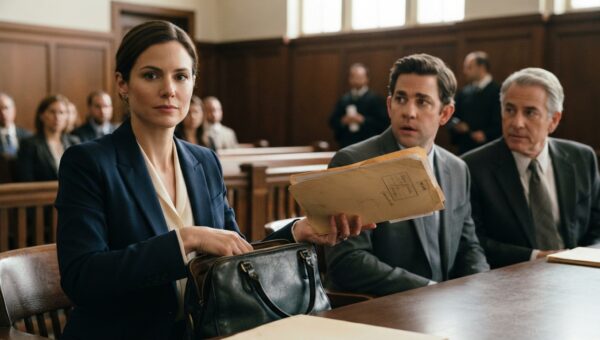
The restaurant on the river road had red velvet booths that smelled faintly of old wax and wood smoke, a place where people from the valley went when they wanted to pretend things were better than they were. Arthur chose it because he liked the low ceilings and the way the waiters brought out heavy silver trays without asking. He had been reminding anyone who would listen for three weeks that we were twenty-five years past the afternoon we stood outside the county courthouse in the rain.
Marjorie sat across from me with her hands folded over her napkin, her thumb tracing the smooth edge of her silver wedding band. She had not touched her water glass since we sat down. Across the table, Arthur carved his prime rib with the deliberate, heavy movements of a man who believed the world owed him a chair at the head of it.
For twenty-five years, Arthur had made it his second job to let me know I didn’t measure up to the ledger he kept in his head. He was the kind of man who measured a person by the title on their tax return and the make of their truck, and when his younger sister Marjorie married an ordinary lathe operator from the paper mill, he took it as a personal insult to the family name.
Every Thanksgiving, every Easter, every summer cookout by the creek, Arthur found a way to slide a needle under my skin.
I usually let it slide off my back because Marjorie asked me to. She knew what her brother was, but she also knew what it cost to break completely with the only blood she had left after their mother passed.
“Twenty-five years,” Arthur said, lifting his glass of amber scotch so the candlelight caught the rim. He didn’t look at me when he said it. He looked right at Marjorie, his smile tight and practiced like a politician working a small-town diner. “I still remember the day you packed your bags. We all thought you’d aim a little higher than the shop floor, but I suppose a girl learns to settle for the first fellow who has the nerve to ask.”
The table went very quiet. My fork clicked against my china plate, the sound entirely too loud in the small private room where our cousins and in-laws had gathered to celebrate something they secretly thought wouldn’t last five years.
I felt the old heat rise behind my ears, the familiar weight of twenty-five years of swallowed words pressing down on my chest. I opened my mouth to say something smooth, something that would deflect the barb and keep the peace for Marjorie’s sake, but I never got the chance.
Marjorie stood up so fast her chair legs scraped a harsh line across the hardwood floor.
She didn’t raise her voice. She didn’t shake. She simply reached into the large leather tote bag sitting by her feet on the floor and pulled out something small, gray, and heavy, with black plastic buttons worn smooth at the edges. It was an old pocket cassette recorder from the nineteen-nineties, the kind with a built-in condenser mic that picked up every breath in a room.
Arthur stopped smiling, though his hand stayed frozen halfway to his mouth with the scotch glass. “What’s that supposed to be?” he asked, his voice dropping an octave as he tried to reclaim his usual authority.
Marjorie didn’t answer him right away. She walked the three steps around the corner of the heavy oak table, her heels clicking a steady rhythm against the floorboards, and placed the little machine squarely beside his water glass, right on top of his linen napkin.
“I found this while cleaning out the back corner of Dad’s garage last month,” Marjorie said, her voice entirely flat and level. “Right behind the old outboard motor where he kept his lockbox.”
Arthur stared at the plastic casing as if it might bite him. “Dad’s old junk. Throw it out. The man had a habit of keeping every receipt he ever touched.”
“It’s not a receipt,” Marjorie said. She reached down with one finger and clicked the silver play button down until it locked with a solid, mechanical thud. “It’s Dad talking to you in the workshop. The night before our wedding. I heard it once, right after we cleared out the house. You haven’t.”
The little speaker gave a low, electrical hiss, the sound of magnetic tape dragging across a metal head after sitting in a damp cedar box for a quarter of a century. Then the room filled with the unmistakable, gravelly rumble of old man Arthur senior clearing his throat.
“Sit down, Arthur,” the recorded voice said, sounding tired and raspy through the tinny speaker. “And shut that side door so the neighbors don’t hear you shouting through the screen.”
Arthur’s face lost whatever color the scotch had put into it. He tried to reach out and knock the recorder off the table, but my hand was already flat on the mahogany beside it, my fingers curled around the edge. He jerked his hand back as if he’d touched a hot stove burner.
“You can’t marry her off to that nobody,” the recorded voice of the old man filled the restaurant alcove, loud enough that even our cousins at the far end stopped chewing. “She’s got her mother’s share of the timber tract coming to her, and if she moves into town with him, who’s going to run the books for the co-op? Who’s going to look after the property when my legs give out?”
“She belongs here,” the younger voice of Arthur on the tape snapped back, sharp and desperate in a way none of us had ever heard him sound in public. “She doesn’t know anything about the real world. That mill hand is just after the acreage. Cut her out of the will, Dad. Tell her if she walks out that door tomorrow, she gets nothing. Make her stay.”
The tape hissed softly as the old man let out a long, slow sigh that sounded like dry leaves scraping across concrete.
“She’s marrying him because he looks at her like she’s a person instead of an unpaid clerk,” the father’s voice answered, steady and unyielding. “And as for the land, I’m splitting it even. You’re scared she’ll leave you behind, Arthur. You’ve lived off her labor for ten years since your mother died, and you think you own her just like you own the tractor shed. Well, she’s leaving tomorrow morning, and if you ever try to make her feel small for choosing an honest man, I’ll see to it the court hears every word of how you tried to rob your own sister.”
A heavy, suffocating silence settled over the table. Nobody moved. My cousin Susan dropped her cloth napkin into her lap and stared straight down at her water glass.
The tape clicked at the end of the short loop, the motor winding down with a dull mechanical whine before the play button popped back up with a sharp click.
Arthur sat there with his mouth half-open, looking smaller in his expensive suit than he ever had in faded denim. His hands were shaking slightly where he rested them on the white tablecloth, his fingers curling into tight, useless fists against the linen.
“You knew,” Arthur whispered, his voice cracking on the second word. He looked up at his sister, his eyes darting around the table as he realized every cousin and uncle at the dinner had heard the exact measure of his greed. “Marjorie, you, “
“I knew for twenty-five years,” Marjorie said, her voice cold as winter well water. She didn’t look down at him. She looked straight across the room toward the exit sign glowing softly by the heavy oak doors. “And I let you sit at our table every year because I thought maybe time would soften whatever turned you into such a small, bitter man. But it didn’t.”
She turned and looked at me, the hard lines around her eyes softening just enough for me to see the woman I married in the rain outside the courthouse a quarter of a century ago.
“Let’s go,” she said quietly.
I stood up, pulling my jacket off the back of my chair and sliding my arm through the sleeve. I didn’t look at Arthur, and I didn’t say goodbye to the cousins who were suddenly finding the patterns in their dinner plates deeply fascinating. There was nothing left to explain, and no apology in the world could patch up twenty-five years of hollow insults built on a foundation of cowardice.
We walked out of the private room together, our footsteps muffled by the thick red carpet of the hallway. The night air outside was crisp and smelled faintly of wood smoke drifting down from the ridge behind the mill.
The vintage cassette player stayed right where Marjorie left it, sitting quietly beside Arthur’s untouched water glass on the white linen cloth, its tape fully rewound, while we climbed into the truck and drove out into the dark with our hands locked tightly across the console.