The dust motes in Marcus’s living room were dancing in the mid-morning light when I pulled open the top drawer of his oak desk and found the blue envelope. It had been sitting there under a stack of old utility bills and receipt books, tucked away like something he meant to burn or mail on a Tuesday that never came.
His apartment still smelled like him. Cold black coffee from the pot on the counter, stale cedar shavings, and that faint hint of motor oil he never quite washed out from working the late shifts down at the rail yards. Five days earlier, the coroner had called me at 6:45 in the morning to tell me my thirty-two-year-old son’s heart had simply stopped beating while he slept. Just like that. No warning, no sickness, no grand farewell. Just a silent exit that left me standing in his kitchen holding a cold landline phone while my knees went weak.
Now I was the one boxing up his boots, sorting through his flannel shirts, and trying to figure out how a life could be packed down into twelve cardboard U-Haul boxes from the hardware store.
I pulled the envelope out. My thumb caught on the corner of the thick cardstock paper, and I stopped breathing for a second. The name written across the front in his sharp, slanted handwriting wasn’t mine. It was Chloe’s. My daughter’s married name. The last name she had taken five years ago on a hot September Saturday in a church three miles away from here. A day Marcus hadn’t even shown up for.
“It’s just a work crisis, Mom,” he had told me on the phone that morning five years ago, his voice sounding entirely too calm while church bells were ringing down the street. “Tell Chloe I’m sorry. I just can’t make it.”
Chloe had never forgiven him. Not for the empty seat at the family table, not for the missing photos in the album, and certainly not for the way he hadn’t even called her afterward to explain himself properly. She had blocked his number before the reception dinner was even served, cutting him out of her life with the clean, sharp edge of a meat cleaver. I had spent five years standing right in the middle of that war zone, trying to keep the peace between two stubborn kids who had inherited their father’s granite jaw and my own stubborn pride.
“He just didn’t care enough to show up, Mom,” Chloe had told me over tea just last year, her eyes hard and bright behind her coffee cup. “My own brother couldn’t be bothered to put on a tie for four hours. I’m done wasting my breath on him.”
And I had let her believe it. Because Marcus had never corrected her. He had just taken her anger, absorbed the cold shoulder every holiday, and kept his distance without ever offering a single excuse beyond that one brief, flat phone call about work.
My hands were shaking slightly as I turned the blue envelope over. The flap wasn’t even sealed. It was tucked shut, old-fashioned style.
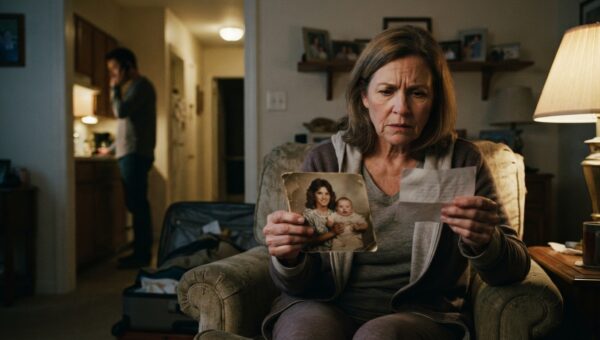
I pulled out the contents. Three things fell onto the cluttered wooden desk with a dry, rustling sound.
The first was a boarding pass for a flight leaving Wichita Municipal at 6:15 AM on the exact morning of Chloe’s wedding, destination Denver, with a tight connection to her destination city. He hadn’t bought a cheap ticket either. He had paid for the early seat. He meant to be there.
The second item was a crumpled, crinkled white paper wristband from St. Jude’s Emergency Room, timestamped 8:42 AM on that same Saturday. The name printed in faded dot-matrix ink beside the barcode was Marcus Vance.
The third item was four folded sheets of lined yellow legal paper, covered edge to edge in his hurried, messy ink.
I didn’t open the letter right then. I just sat down hard on the edge of his unmade mattress, staring at the little white hospital band until my eyes blurred. My chest felt tight, the way it always did when I realized how little we ever really know about the people living right under our noses.
I didn’t call Chloe to chat. I dialed her number at 11:14 AM because my voice wouldn’t have worked five minutes earlier.
“Mom? Is everything okay with the boxes?” her voice came through the speaker, brisk and slightly impatient, the sound of a woman juggling work emails and a toddler’s snack schedule.
“You need to come over here,” I said. My voice sounded thin, like dry paper.
“I can’t right now, Julian has a client meeting at noon, and I promised, “
“Chloe. Drop whatever you’re doing and get in your car,” I told her, and there was something in my tone that must have cut right through her excuses because the background noise on her end stopped dead. “I found something in Marcus’s desk. It’s about your wedding.”
“I don’t care about Marcus or my wedding, Mom. We’ve talked about this a hundred times.”
“No,” I said, and my hand tightened around the phone until my knuckles turned white. “You haven’t. You’ve talked about what you think happened. Now get over here, or I’ll bring these papers to your front porch and read them through your mail slot.”
The line went quiet for three long seconds. Then she let out a sharp, ragged breath. “Fine. Twenty minutes.”
The wait was the longest twenty minutes of my life. I walked back and forth across his narrow living room floor, stepping around stacks of old car magazines and a spare set of winter tires, my fingers clutching the blue envelope against my apron like a shield. I kept looking at his boots by the front door, half expecting him to walk in through the kitchen with a grease-stained hoodie and ask me what all the fuss was about.
When her silver sedan crunched over the gravel in the alleyway outside, I was standing right by the screen door.
Chloe didn’t bother knocking. She pushed the door open with her hip, her face flushed from the autumn wind, her car keys dangling from her fingers like a weapon. She looked so much like her father in that moment, chin lifted, eyes narrowed for a fight she had already rehearsed in her head on the drive over.
“This better be good, Mom,” she snapped, stepping into the small kitchen and letting the screen door slam behind her with a dry rattle. “Because I left three loads of laundry sitting in the, “
I didn’t say a word. I just walked over to the Formica kitchen table, laid the plane ticket down first, then placed the crumpled white emergency room wristband right beside it.
Chloe stopped talking mid-sentence. Her eyes dropped to the table. She took two slow steps forward, her boots clicking softly against the linoleum.
“What is that?” she whispered, her voice losing its sharp edge all at once. “Where did you get those?”
“I found them in his bottom drawer,” I said plainly. “Under the receipts.”
She reached out, her fingers trembling slightly as she touched the edge of the boarding pass. She turned it over, looking at the date stamp. September 14th. Five years ago. The exact morning she walked down the aisle toward Julian under a clear blue sky while her brother supposedly sat at a desk three hundred miles away filing paperwork.
“He bought a ticket,” Chloe murmured, her brow furrowing deep as she looked up at me. “He… he was coming. Why didn’t he get on the plane?”
“Look at the wristband, Chloe.”
She picked up the white paper band, holding it close to her glasses. She read the timestamp out loud, her voice barely louder than a breath. “Eight-forty-two in the morning. St. Jude’s.”
“That’s twenty minutes after your ceremony started,” I said, and my throat felt like it was full of sand. “He wasn’t at work. He was in an ER gown with a concussion and two cracked ribs.”
Chloe dropped the wristband back onto the table as if it had burned her skin. She took half a step backward, shaking her head, her chest rising and falling fast under her wool jacket. “No. No, that doesn’t make sense. He told you it was a work crisis. He told you his boss needed him on-site for an emergency system upgrade.”
“He lied to me,” I said quietly. “Just like he lied to you.”
“Why?” Her voice broke on the word, small and terrified, the sound of a little girl losing her footing on thin ice. “Why would he lie about that? If he was hurt, why didn’t he call me? Why didn’t you tell me?”
“Because I didn’t know either,” I said, my own anger flaring up to meet her confusion. “I believed him because Marcus never lied to me about work in his entire life. When he said it was urgent, I believed him.”
I picked up the four folded sheets of yellow legal paper and held them out toward her. The edges were slightly yellowed with age, the ink dark and heavy where his pen had pressed down hard enough to tear through the grain.
“Read it,” I told her, my voice dropping to a harsh whisper. “He wrote it that same week, I think. But he never mailed it.”
Chloe stared at the paper in my hand for a long time. Her breathing sounded loud in the small, silent kitchen. Finally, with jerky, uncoordinated movements, she reached out and took the letter from my fingers. She unfolded the sheets, her eyes scanning down the page until they hit the top line.
She stood there by the kitchen table under the hum of the old refrigerator, and as she read those first words aloud, the last five years of our family’s life simply dissolved into nothing.
“I need you to know now why I told Mom it was work,” Chloe read, her voice shaking so badly she had to stop and swallow hard before she could finish the sentence, “and why the man who brought me to the hospital was…”
She paused. Her eyes went wide, the color draining entirely from her face until she looked almost translucent in the gray kitchen light.
“Who?” I asked, though I didn’t yet know the name myself. “Who brought him in, Chloe?”
She didn’t answer. She just kept reading, her lips moving silently across the lines, her hands beginning to shake so violently the yellow paper fluttered like a bird caught in a draft. A small, ragged sob broke out of her throat, sharp and ugly, the sound of a daughter realizing too late that the person she hated the most was the only one who had stood between her and a disaster she never even knew existed.
“Read it out loud,” I told her, stepping closer and putting my hand on her shoulder, feeling the hard, tense knot of muscle beneath her coat. “Read the rest of it, Chloe.”
She looked up at me, her eyes brimming with heavy, hot tears that spilled over her glasses and ran down her cheeks unchecked. “He didn’t miss my wedding because he didn’t care, Mom,” she whispered, her voice cracking right down the middle. “He missed it because Julian’s old associates found him at the airport parking garage.”
The kitchen seemed to tilt slightly on its axis. I caught the edge of the counter with my palm to steady myself. “What are you talking about?”
“Julian never told me everything about his old debt before we got married,” Chloe choked out, her fingers digging into the yellow paper until her knuckles turned blue. “He thought it was over. He thought those men were out of state. But they followed him here. They went after Marcus at 5:00 AM in the short-term parking lot to get to Julian through him.”
She stopped, drawing in a long, shuddering gasp of air that sounded like a sob.
“Marcus fought them off in the stairwell,” she read on, her voice dropping to a raw, broken murmur as she quoted from the letter in her hand. “He said… he said if he let them delay him or if he called the police right then, the word would get back to Julian before the ceremony started, and I would spend my wedding day terrified, or worse, calling off the vows I had dreamed about for years.”
The rest of the letter tumbled out of her mouth in broken fragments between her tears. The man who dragged Marcus to the emergency room entrance wasn’t a stranger; he was the loan shark’s primary enforcer, dropping an unconscious Marcus at the sliding glass doors with a bruised warning meant for Julian’s ears. Marcus had woken up in cubicle four with an IV in his arm and a police officer asking questions he refused to answer because answering them meant telling his sister her new husband was built on a foundation of sand and violence.
So he chose the silence. He chose her hatred. He chose to let her believe he was just a cold, indifferent brother who couldn’t be bothered to show up for her big day, just so she could walk down that aisle with her head held high and a smile on her face that nobody had spoiled.
“He protected me,” Chloe whispered, her knees finally giving out beneath her as she sank down onto one of Marcus’s mismatched wooden kitchen chairs, clutching the yellow paper to her chest like a prayer book. “He protected my whole wedding day, and I spent five years telling everyone he was a monster.”
She didn’t try to look strong anymore. She leaned her forehead against the sticky laminate of the kitchen table and cried the kind of heavy, tearing grief that only comes when you realize you’ve spent half a decade hating a ghost who died trying to keep you safe.
I didn’t say anything to comfort her right away. I just walked over to the stove, pulled down two mugs, and poured us both some of the lukewarm coffee Marcus had left behind that morning. I set one cup down in front of her, and then I sat down in the chair across from her, pulling her hand away from the paper just enough to hold it between my own old, calloused palms.
Her skin was ice cold. Just like Marcus’s hands used to get whenever he was worried about something he couldn’t fix.
We sat there in that quiet apartment for a long time as the afternoon light slowly shifted across the linoleum floor, moving from the sink toward the back door. We didn’t talk about Julian. We didn’t talk about the debt or the men in the parking garage or the wedding photos hanging on her living room wall that suddenly looked like they belonged to a stranger’s life.
We just talked about Marcus. We remembered the way he used to fix the latch on our screen door with a pocketknife and a piece of scrap wire. We remembered the way he laughed when the toaster shorted out during breakfast three winters ago. We talked about his quiet ways, his stubborn loyalty, and the heavy, invisible armor he wore every single day without ever asking for a single “thank you” in return.
The anger was gone out of her now. What was left in its place was something much harder to carry, but at least it was real.
Later that evening, after the sun had dipped below the fence line and cast long, dark shadows across the alley, Chloe and I walked back into the living room together.
On the low wooden coffee table beside the stack of old magazines, I placed a small, square wooden box I had found in Marcus’s closet. Inside it, we laid the plane ticket, the crumpled St. Jude’s wristband, and the four yellow pages of his unmailed letter, folding them neatly so the ink was protected from the light.
Chloe struck a wooden match against the box and held the flame to a small white candle sitting on a saucer beside the wooden box. The flame flickered once, caught the wick, and steadied into a bright, yellow point of light that pushed back the corners of the gathering dusk.
We stood there side by side in the quiet room, our shoulders touching, watching the smoke rise up toward the ceiling until the flame burned straight and true.