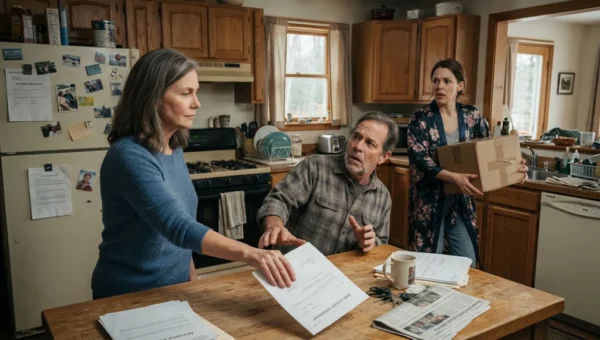
PART 1
When I retired from thirty years of clerking at the county water district, my son, Brian, asked me to stay with his family just until the house was ready.
I had sold my small split-level in Salem two weeks after my sixty-second birthday. My plan was simple: buy a quiet two-bedroom cottage in a five-five-and-older community closer to the coast, where my sister lived.
The developer was finishing the drywall and the back patio, and Brian insisted I shouldn’t waste money on an extended-stay motel for eight or ten weeks.
His wife, Sarah, sat at their kitchen island with a mug of green tea and smiled when he brought it up. We agreed on clear ground rules. I would handle school pickup for seven-year-old Lucas and ten-year-old Emma at three in the afternoon, give them an after-school snack, and help Emma with her fourth-grade fractions until Brian or Sarah got home around five-thirty.
I was happy to do it. Being useful to your children is a good feeling when your working life suddenly stops.
What I was not prepared for was becoming the default babysitter every single evening.
By the end of my first month in their guest room, five-thirty came and went without anyone pulling into the garage. Brian would text around six to say he was stuck on a client estimate in Beaverton.
Sarah would call at six-twenty from the gym or say she had to stay late at the dental office to finish billing records. Dinner fell entirely on me. Bath time fell on me. Packing lunches for the next morning fell on me.
On weekends, they suddenly had dinner parties, weekend golf scrambles, or errands that took six hours. If I mentioned meeting an old coworker for coffee on a Saturday morning, Brian would look wounded, run a hand through his hair, and ask if I really wanted Lucas to miss his regional soccer match because neither parent could take him.
I ended up staying home. I cooked casseroles, folded tiny socks, and fell asleep on the guest bed by nine-thirty with an aching lower back.
Twice, the builder called to say my coastal cottage was nearing inspection, and twice I pushed back my move date by three weeks because Brian swore their family routine would completely fall apart without me.
After three full months of this, on a rainy Thursday in November, I reached my limit.
I waited until Lucas was in bed and Emma was reading in her room.
Brian was in the basement on his computer, and Sarah was wiping down the granite countertops in the kitchen.
“Sarah,” I said, leaning against the pantry door. “We need to talk about the schedule. I love the kids, but I’m sixty-two years old and I’m exhausted. Starting next week, I need one night a week for myself. Just one evening where I don’t cook, I don’t run baths, and I can go to a book group or sit in a diner with a newspaper.”
Sarah didn’t argue. She didn’t roll her eyes or make a sharp comment. She just set down her sponge, dried her hands slowly on a linen towel, and gave me a long, steady nod.
She reached into the ceramic bowl by the microwave, pulled out the spare key to her crossover, and held it out to me.
“You should go,” she said.
Her voice was quiet, almost flat. I thought she was being sarcastic, the kind of passive-aggressive coldness people use when they feel insulted by a simple boundary.
“I don’t need to storm out tonight, Sarah,” I said, keeping my hands at my sides. “I just meant starting next week.”
“Go now, Ruth,” she said, pressing the remote fob into my palm. “Take the car. Go get your coffee.”
I took the key because her eyes were dead serious. I walked out through the mudroom into the garage, unlocked the crossover, and pulled open the heavy driver door.
Lying flat across the passenger seat was a thick manila folder.
Across the front, in Brian’s distinct, sharp architect print, was my name: *RUTH – FUTURE TIMELINE & CARE.*
Inside were printed monthly calendars, bank withdrawal receipts, and a folded yellow legal pad covered in my son’s handwriting.
I had already postponed my move twice to make room for his family. But as I read the top line of that legal pad under the dome light, I realized Brian had been making permanent plans for my life without telling either of us.
PART 2
The yellow legal pad began with three underlined words: *Phase Three: Transition.*
My fingers went stiff against the paper. The dome light hummed above my head while rain tapped steadily against the windshield.
Brian had laid out a sixteen-month schedule, dated from the week I sold my house in Salem through the following spring. Column one listed their household expenses: mortgage, private tutoring for Emma, club soccer dues, and a five-hundred-dollar monthly car lease for a third vehicle.
Column two was labeled: *Mom’s Contribution (Savings on Childcare).*
He had calculated the exact cost of hiring a full-time after-school nanny and evening sitter in their neighborhood: $2,850 a month. Directly beside that figure, he had written: *Net savings to our account: $34,200/year.*
Underneath that table was the section that made my stomach turn over.
*Cottage Status:* Brian had written. *Builder contact: Greg Miller. Keep pushing closing date. Give Greg reasons: title complications, pending estate clearance, Mom’s knee rehab. Goal: delay possession until June, then convince Mom to surrender earnest deposit ($15,000) or assign purchase rights to buyer pool.*
He hadn’t just taken advantage of my willingness to help with the grandchildren. He had been actively interfering with the construction company building my retirement cottage.
Two weeks earlier, the builder, Greg Miller, had called my cell phone sounding confused. Greg had asked why my family office had requested a sixty-day extension on the electrical sign-off. When I asked Brian about it that night, Brian had patted my shoulder and told me general contractors always blamed supply delays on clerical issues. He had lied right to my face.
Behind the legal pad were printed emails between Brian and a regional property management firm in Lincoln City. Brian had been negotiating to list my coastal cottage as a short-term vacation rental the moment construction finished, listing himself as the primary managing agent and retaining a twenty percent property management fee.
And at the very bottom of the folder was a printed pre-admission intake packet for an assisted-living facility twelve minutes from Brian’s house.
The facility was called Shady Pines Manor. It was a single-story brick complex next to the state highway. The intake form had my Social Security number, my date of birth, and my pension details filled out in Brian’s handwriting.
He had marked the application: *Anticipated occupancy: Fall. Level One Assisted Care.*
Level One. For an active sixty-two-year-old woman who had run a half-marathon three years ago, drove her own car, and had just retired from three decades of managing county water rights.
He was planning to stall my coastal move, take over the cottage as an investment rental for his own pocket, keep me in his guest room as an unpaid servant until the kids entered middle school, and then park me in an assisted-care facility down the road so I wouldn’t be his problem when I grew old.
The garage door behind me creaked.
In the rearview mirror, I saw Sarah standing on the concrete floor in her slippers, her arms wrapped around her cardigan. She walked over to the passenger side, opened the door, and looked at the open folder in my lap.
She didn’t look surprised. She looked exhausted, the skin beneath her eyes dark and hollow.
“He left it on his desk yesterday afternoon,” Sarah said. Her voice was low, barely carrying over the rain outside. “He told me he was handling your closing documents so you wouldn’t get stressed by the paperwork.”
“Did you know about this, Sarah?” I asked.
Sarah climbed into the passenger seat, pulled the door shut, and shook her head.
“I knew he wanted us to save money on after-school care,” she said, looking down at her hands. “When you moved in, Brian told me you were lonely after selling the house. He said you begged him to stay because you didn’t want to live alone by the water. He said having the kids around kept you from being depressed.”
A cold, bitter laugh caught in my throat. “He told you I begged him?”
“Every single time I suggested we take the kids for the weekend so you could rest, he got furious with me,” Sarah said, a tear slipping down her cheek. “He told me I was making you feel unwanted. He told me that if we hired a sitter, it would break your heart because taking care of Emma and Lucas was the only thing giving you purpose.”
I turned the page on the legal pad.
There was a note Brian had jotted down on the margin of the Shady Pines application from three days ago: *Talk to Dr. Vance about Mom’s mild memory lapses. Need medical notation for file.*
My memory was fine. I balanced my checkbook to the penny, remembered every family birthday, and had never missed a single medication dose in my life. Brian was actively building a paper trail to make his own mother appear incompetent so he could seize control of my assets.
“Where is his computer?” I asked Sarah.
“In the basement office,” she whispered. “He’s down there right now, on a conference call with his golf league.”
PART 3
I didn’t take Sarah’s car out for coffee.
I picked up the manila folder, got out of the crossover, and walked back into the house through the mudroom. Sarah followed two paces behind me, her jaw set tight, her slippers scuffing against the hardwood floor.
We went down the carpeted stairs to the finished basement.
The basement door was slightly ajar. Through the crack, I could hear Brian laughing into his headset, boasting about his handicap and talking about booking a weekend trip to Bandon Dunes in the spring.
I pushed the door open.
Brian looked up from his dual monitors, his smile fading as he saw me standing there with the folder clutched against my ribs. Sarah stepped into the doorway behind me, crossing her arms.
“Hey, Mom,” Brian said, sliding one headphone off his ear. “I’m on a quick call with Mark. Did you need something from the freezer?”
I walked straight up to his mahogany desk and dropped the manila folder squarely across his keyboard.
The papers fanned out across the desk, scattering his notes and covering his wireless mouse. The top sheet was the Shady Pines intake packet, with his bold print visible under the desk lamp.
Brian stared down at the pages. The easy, confident look he wore every day vanished in an instant. His neck flushed a deep, mottled red, and he quickly clicked the mute button on his headset before ripping it off his head.
“Where did you get this?” he demanded, looking past me to glare at his wife. “Sarah, were you going through my private desk drawers?”
“You left it right on top of your laptop yesterday while I was putting away your clean laundry, Brian,” Sarah said, her voice shaking with quiet fury. “Don’t you dare try to turn this into my fault.”
“It’s just notes!” Brian snapped, standing up from his leather chair and holding his hands out toward me. “Mom, listen to me. You’re taking this completely out of context. You don’t understand how real estate planning works.”
“Explain it to me, Brian,” I said. My voice was deadly quiet. “Explain to me why you called Greg Miller and told him my coastal cottage had title complications.”
Brian swallowed, his eyes darting toward the basement stairs like he was looking for an escape hatch.
“The housing market is unstable right now,” he stammered, pulling at his collar. “The builder was rushing the finishes. I was just trying to protect your investment. If we delayed the closing, we could negotiate a better rate, or turn it into a rental that brings in passive cash flow every month.”
“Cash flow for whom?” I asked, pointing a finger at his yellow legal pad. “You wrote down that you were going to take a twenty percent management fee. You calculated that my free labor saved your household thirty-four thousand dollars a year. You postponed my closing so you didn’t have to pay for a nanny, and you were planning to use my property to pay for your golf trips.”
“I have two kids to put through college, Mom!” Brian yelled, his face turning an ugly, defensive crimson. “Sarah works part-time! My firm is cutting commission splits! You have a full state pension, social security, and hundreds of thousands of dollars sitting in cash from the Salem house! What are you going to do with all that money at sixty-two? Sit in a cottage by yourself and look at gulls?”
The words hung in the cold basement air like poison.
Sarah let out a sharp, ragged breath from the doorway. “Brian, stop. Just stop talking.”
“No, Sarah, she needs to hear it!” Brian shouted, completely losing his composure. “She’s our family! What is the point of having a grandmother if she won’t help her own son? Other grandmothers would give anything to live with their grandkids! I was trying to keep us all together!”
“You were trying to put me in a state-line assisted living home,” I said, pointing directly to the application with my Social Security number. “You were planning to tell my doctor that I had memory lapses so you could take over my financial power of attorney.”
Brian froze. His mouth opened, but no words came out.
For thirty-four years, I had defended this boy. When he got caught cheating on a high school physics exam, I blamed the teacher for being unfair. When his first business partnership failed because he couldn’t keep his accounting straight, I loaned him eight thousand dollars from my emergency savings and never asked for a dime back. I had spent his entire life making excuses for his selfishness because I thought love meant smoothing down every rough edge he created.
Looking at him across that desk, I saw the truth. He didn’t see a mother who loved him. He saw an asset on a balance sheet to be managed, drained, and discarded when the utility ran out.
“Pack my things,” I told him.
“Mom, come on,” Brian whispered, his voice suddenly dropping into a frantic, pleading tone. “It’s nine at night. It’s raining. We can sit down tomorrow and talk through this like adults. I’ll call Greg in the morning and tell him to clear the closing.”
“You won’t call Greg,” I said. “You won’t touch another piece of paper with my name on it for as long as you live.”
I turned my back on him and walked up the basement stairs.
ENDING
I didn’t sleep in the guest room that night.
Sarah helped me carry my two suitcases and my coat out to my five-year-old sedan. Brian stayed in the basement, locking himself in his office while the children slept upstairs.
Before I backed out of the driveway, Sarah stood by my driver-side window in the rain. She reached through the glass and took my hand in hers, her fingers cold and trembling.
“I’m so sorry, Ruth,” she said softly. “I really thought you wanted to be here.”
“I know you did, Sarah,” I replied. “This wasn’t on you. But you need to take a hard look at your bank accounts, because a man who steals from his mother won’t think twice about stealing from his wife.”
She gave me a tight, sorrowful nod and stepped back onto the curb.
I drove six miles down the highway and checked into a clean, quiet motel near the interstate. I sat on the edge of the queen bed, ate a packet of crackers from my purse, and slept for nine straight hours without an alarm.
At eight o’clock on Friday morning, I drove straight to the construction site in Newport.
Greg Miller was in his trailer office, reviewing blueprints with a foreman. When I walked through the door, he looked up, surprised to see me in person.
I didn’t waste time. I explained that my son had no legal authority to speak for me, showed him my original sales contract, and signed the final drywall and utility inspection waivers right there at his desk.
“Your son told me you were having medical setbacks, Ruth,” Greg said, shaking his head with a heavy frown. “He said you were likely going to forfeit the earnest money.”
“My health is perfectly fine, Greg,” I told him. “When can I have the keys?”
“Wednesday,” he said.
I spent the next four days in that motel room, reading books and taking long walks along the beach in my raincoat. The salty ocean air cleared three months of exhaust and tension out of my lungs.
On Wednesday afternoon, I signed the closing papers at the county title office and unlocked the front door of my cottage.
The house was sixty miles from Brian’s neighborhood. It had pale yellow siding, a covered front porch, and large south-facing windows that filled the living room with clean, bright daylight. The walls smelled of fresh white paint and new pine flooring.
Brian tried calling me four times over the next two weeks.
He left voicemails claiming he was under extreme financial stress, that his architectural firm had downsized its associate roster, and that he had only been trying to secure our family’s long-term future. When I didn’t return his calls, he sent a long, self-pitying email accusing me of abandoning my grandchildren over a misunderstanding.
I didn’t reply to the email. Instead, I forwarded the entire manila folder to an estate attorney in Newport and had my will, my medical proxy, and my beneficiary designations completely restructured. Every dollar of my pension and property was transferred into an irrevocable trust naming Emma and Lucas as sole beneficiaries, managed entirely by an independent bank trustee, with an explicit clause legally barring Brian from ever serving as an administrator or touching the funds.
Sarah filed for legal separation five months later.
When she hired a forensic accountant during the divorce proceedings, she found that Brian had hidden thirty-two thousand dollars in an offshore online trading account while claiming their household was broke. Sarah kept the house, put Emma and Lucas in the neighborhood school’s official after-care program, and went back to work full-time.
Yesterday afternoon was the second Sunday of October.
The autumn sun was warm against my back as I stood at my new butcher block island, slicing fresh apples into a ceramic pie dish. Through the front window, I could hear the rhythmic crash of the surf against the headland two blocks away.
A knock sounded on my front screen door.
Emma and Lucas ran into the foyer, dropping their small backpacks on the cedar bench. Sarah stood on the porch behind them, holding a jug of fresh apple cider from the valley.
“Grandma, look!” Lucas yelled, running across the hardwood to show me a smooth piece of dark driftwood he had picked up from the tide line down by the beach access. “Mom said we can stay until Tuesday!”
I smiled, took the wood from his small hand, and set it on the sunny windowsill right beside my coffee mug.
Brian is living in a rented one-bedroom apartment in Tigard now, working as a junior draftsman for an engineering firm. He sees the children every other weekend under strict court scheduling, and he hasn’t spoken to me since the separation papers were signed.
I don’t hate my son, but I don’t carry his burdens anymore.
When the children ran out to the back patio to look at the gulls circling over the pines, I poured two glasses of cold cider and handed one to Sarah at the table.
My schedule belongs to me now. My keys belong to me. And in this house, nobody makes plans for the future except the woman who paid for the roof over her head.