PART 1
I did warn you, I said quietly. Back in January. I told you that you didn’t understand a single thing about how a cold chain works. You laughed at me.
Twenty minutes earlier, Ashley Hoffman had fired me in front of six executives from our buyer. She was twenty-six, the founder’s niece, fresh out of Stanford with an MBA and a plan to digitally transform everything I had spent eighteen years building.
I was just the forty-seven-year-old who designed the refrigerated network that kept vaccines and biologics stable in Texas heat.
When she slid her restructuring plan across the glass table, I slid my business card back. The room went silent.
Ashley had laughed then too, her silver bracelets clinking against her coffee cup. She told me the company was pivoting to cloud-managed logistics and didn’t need dusty old manual monitors or employees who resisted the modern era. She handed me a severance check for two weeks and told me my keycard access was already revoked.
Now, sitting in my kitchen with a cup of instant coffee that tasted like cardboard, I watched my phone light up for the seventh time in ten minutes. It was Robert, our vice president of operations, calling from his personal cell. I let it ring.
Robert knew as well as I did that the new cloud software Ashley had forced through hadn’t been fully mapped to our legacy server architecture.
Nobody else knew the backup routing codes for the Austin cold-storage facility, because I had written them by hand onto encrypted flash drives stored in a floor safe that only I could unlock. Ashley had dismissed my manual safeguards as paranoid gatekeeping. She had assumed the database would sync automatically once she clicked her little button on the dashboard.
My phone started vibrating again. This time it was a text message from Ashley herself.
The text preview popped up on the lock screen. Please call me. The main storage unit in Austin is throwing a level-four temperature alert and the system won’t let us override it.
I set my coffee mug down on the Formica counter and stared out the window at the neighbor’s overgrown oak tree. Eighteen years. I had given eighteen years of my life to building a fail-safe system that could withstand a complete grid failure during a hundred-and-ten-degree July afternoon.
When my husband passed away, the warehouse had been my second home. When my daughter went off to college, the cold-chain telemetry logs had been my evening reading.
And Ashley had replaced me with a software package bought off a vendor who had never set foot inside a warehouse.
The phone stopped vibrating, then started again immediately. I picked it up, unlocked the screen, and scrolled through the employee directory app that was still active on my personal profile before they wiped my account.
Ashley had panicked. She had thirty million dollars worth of temperature-sensitive pharmaceuticals sitting on those pallets in Austin, and her shiny new dashboard was locked in a hard fault state because the override requires a physical secondary key—a physical key that was currently sitting in the bottom drawer of my old desk, which Ashley had probably already had cleaned out by the janitorial staff.
I went to the pantry, grabbed a box of saltines, and ate three of them dry while I thought about what to do next.
PART 2
By four o’clock, the phone calls had stopped, replaced by a frantic stream of text messages from middle managers I had known for years.
They were scared. They knew what a level-four fault meant for the Austin facility. If the temperature climbed three more degrees, the entire inventory would spoil, and the buyer would sue the company into bankruptcy before the end of the quarter.
My doorbell rang at five-fifteen.
I did not move from my armchair. Through the sheer living room curtain, I saw Robert’s gray sedan parked sideways in my driveway, blocking my old Honda. A minute later, Robert’s face appeared in the windowpane next to the front door, his expression pale and sweating despite the mild air conditioning of his car.
He knocked again, harder this time.
“Martha,” he called out through the wood. “I know you’re in there. Please. Open up.”
I unlocked the deadbolt and pulled the door open three inches, keeping the chain latch firmly in place. Robert looked terrible. His tie was loosened, and his shirt collar was damp with sweat.
“She’s gone,” Robert blurted out, gripping the edge of the doorframe. “Ashley took her car and drove back to Dallas an hour ago when the alarms started blaring. She realized she couldn’t fix it. The board is calling my phone every two minutes. The Austin site manager says the internal temps are hitting forty-two degrees.”
“That’s unfortunate,” I said, my voice level. “Sounds like a software glitch.”
“It’s not a glitch, Martha, and you know it,” Robert said, his voice cracking slightly. “It’s the manual override lockout. The system requires your hard token to clear a level-four fault. Nobody else has the physical pairing sequence. The documentation was in your desk, but Ashley told the cleaners to toss everything in your cube this morning. It’s gone.”
“She threw my reference logs into the trash?” I asked.
“She thought they were obsolete,” Robert whispered, looking down at the porch mat. “She didn’t listen to me. She didn’t listen to any of us. Martha, if those vials spoil, we lose the entire state contract. The company goes under. People are going to lose their jobs. My job. Your old team’s jobs.”
I looked at him for a long moment. Robert had signed off on my termination letter that morning without a single word of protest. He had stood right behind Ashley while she handed me two weeks of severance and a cardboard box.
“You should have spoken up when she brought that dashboard in, Robert,” I said quietly. “You knew the architecture.”
“I tried,” he said, and for the first time, I believed him. “She threatened to replace me too. She said I was stuck in the past.”
I unlatched the chain and pushed the door wide open. “Come inside. Let’s look at the numbers.”
PART 3
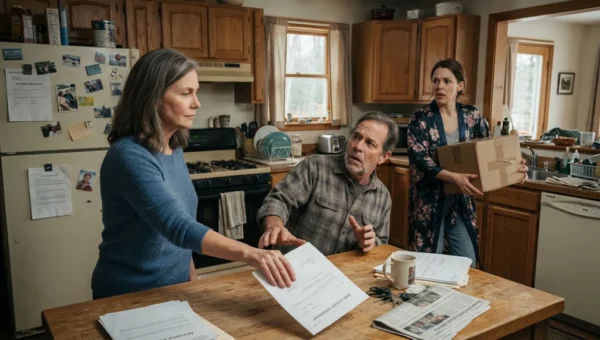
We sat at my small kitchen table with his laptop open between us. The remote diagnostic feed was flashing red across the screen. The Austin warehouse was cooking itself from the inside out because the automated cooling cycles had locked themselves out after detecting an unverified user intrusion—which had been Ashley trying to bypass the security firewall with her admin credentials.
“Can you reset it from here?” Robert asked, watching my hands hover over the trackpad.
“Not without the secondary seed,” I said. “The seed is hardcoded into the flash drive in my safe. The safe is in my den.”
I stood up and walked into the back room, unlocking the heavy metal box sitting on the bottom shelf of my bookcase. Inside sat the black aluminum drive that had protected our network for over a decade. When I brought it back to the kitchen, Robert looked at it like it was a holy relic.
“Plug it in,” he breathed.
“Not yet,” I said, setting the drive beside my coffee cup. “We need to talk about terms first.”
Robert blinked, pulling his head back. “Terms? Martha, the company is about to—”
“The company isn’t about to do anything if I don’t plug this in,” I interrupted. “And I am not doing it as a favor to Ashley Hoffman, and I am not doing it for free as an independent contractor after being fired this morning like a thief.”
“What do you want?” Robert asked, his voice dropping to a cautious whisper.
“Three things,” I said, ticking them off on my fingers. “First, my termination record is expunged and replaced with a formal medical retirement, with full pension vesting intact as of today. Second, Ashley is removed from operational control of the logistics division effective immediately, with oversight returning to the senior committee. Third, my consulting contract is rewritten through the end of the year at double my previous rate, with direct reporting to the board rather than the executive suite.”
Robert stared at me, his mouth slightly open. “You can’t negotiate employment terms like this. That’s… that’s corporate extortion.”
“Call it what you like,” I said, sliding the laptop an inch away from him. “You have about twenty minutes before the temperature in sector four reaches forty-five degrees and the product degrades past the point of legal liability. Call the board chairman right now and put him on speaker.”
Robert reached for his phone with trembling fingers.
Ten minutes later, the chairman of the board—a man who hadn’t visited the Texas facility in three years—was listening to my voice through the tiny speaker on Robert’s phone, agreeing to every single condition without a moment of hesitation. He sounded panicked, exhausted, and profoundly defeated.
I plugged the black flash drive into Robert’s laptop, entered my six-digit secondary key, and pressed enter.
Within forty seconds, the red flashing warnings on the screen shifted to steady yellow, then cool blue. The cooling compressors in Austin kicked back on with a heavy, distant hum that we could almost imagine hearing through the fiber-optic lines. The internal temperatures began to drop.
ENDING
By nine o’clock that night, the house was quiet again.
Robert had left an hour ago, carrying the signed contract addendum that the chairman had emailed over for my signature. My job was restored on my own terms, my pension was secure, and Ashley Hoffman was currently on a red-eye flight back to California to explain to her uncle why the logistics division was no longer hers to break.
I walked back into the den, picked up the black flash drive from the desk, and slid it back into the bottom of the safe.
Then I turned off the desk lamp, walked into the kitchen, and picked up my cold coffee cup to take it to the sink. The kitchen was dark except for the amber glow of the microwave clock, steady and quiet against the wall. I rinsed the cup under the tap, dried my hands on the hand towel, and went to bed.