PART 1
Dayton, Ohio, in December always smelled of woodsmoke and wet asphalt. The brick ranch house on Maplewood Drive where my parents, Arthur and Eleanor, lived for thirty-two years was supposed to be a place of holiday warmth. Instead, my husband Ethan, our five-year-old daughter Lily, and I walked into a pressure cooker that had been heating up for years.
Dinner started tense. My sister Lauren, three years younger, sat across from us with her husband Greg. Lauren never left Dayton. She worked part-time at the county records office and lived ten minutes from our parents, while Ethan and I lived two hours away in Columbus where Ethan worked as a certified public accountant. For as long as I could remember, I carried the quiet guilt of moving away, even though I called every Sunday and drove home for every major holiday.
Then Lauren leaned across the holiday table, her eyes sharp and cold over her wine glass. “Must be nice to show up empty-handed and still expect Mom and Dad to rescue you.”
I stared at her, my fork halfway to my mouth. “I never asked to be rescued, Lauren. Ethan and I pay our own mortgage, we pay for Lily’s preschool, and we brought a homemade pie and the good wine.”
My mother, Eleanor, suddenly slammed her crystal water glass down so hard the stem snapped in her palm. Water pooled across the embroidered holiday table runner, soaking the linen. “You’re a leech!” she screamed, her face mottled red with a rage that seemed entirely out of proportion. She pointed a trembling, manicured finger straight at five-year-old Lily, who shrank back into Ethan’s shoulder. “And that child is nothing but another burden!”
The dining room went dead silent. You could hear the old gas furnace clicking on in the basement.
Ethan immediately stood up, his chair scraping loudly against the hardwood floor. He took my hand, his grip warm, steady, and protective. “Let’s go,” he said quietly. We packed our coats, scooped up Lily from her chair, and walked out the front door without saying another word.
The drive back to Columbus was quiet, save for Lily falling asleep in her car seat.
I felt hollowed out, my chest aching with a deep, stinging pain. But the next morning, just as the sun was clearing the frost off the car windshield, my phone buzzed violently on the nightstand.
It was my father. His voice was shaking so badly I could barely understand his words.
“Sweetheart… you need to come back,” Dad whispered. “It’s about the house.”
I sat straight up in bed, staring at the gray winter light filtering through the blinds. “What about the house, Dad?”
Dad drew a ragged breath on the other end of the line. “Your mother never told you what she did with it.” And what he revealed next changed everything.
PART 2
I told Ethan to stay with Lily in Columbus while I drove back to Dayton alone. The two-hour trip felt twice as long with my foot heavy on the gas pedal and my mind racing through every possible financial catastrophe.
Did Mom take out a second mortgage? Did she run up credit card debt in our names?
When I pulled into the driveway on Maplewood Drive, my father was waiting on the front porch. He looked smaller than he had the night before, his plaid flannel shirt hanging loose on his stooped shoulders. Eleanor was apparently upstairs or out shopping with Lauren, which gave us a rare moment of privacy.
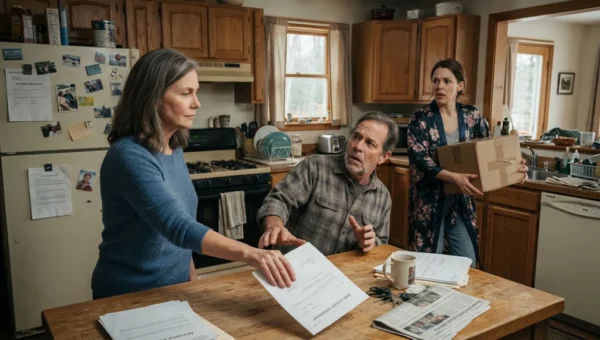
Dad ushered me straight into the kitchen before I could even take off my winter boots. He poured two cups of lukewarm coffee from the pot, his hands trembling as he set the ceramic mugs on the formica table.
“She didn’t just borrow against it, Sarah,” Dad said, staring down into his black coffee. “She signed over the deed.”
I stared at him, my coffee mug halfway to my lips. “What do you mean, signed over the deed? The house is yours and Mom’s. You bought it together.”
“In nineteen-ninety-four, yes,” Dad said quietly. “But two years ago, after your uncle passed and your mother started talking about estate planning, she had me sign some papers at the kitchen table. She told me it was just a transfer into a family revocable trust to protect the property from nursing home liens. I trusted her. I didn’t read every single line of the fine print.”
“And where does the deed live now, Dad?” My voice felt brittle like glass.
“It’s in Lauren’s name,” Dad whispered, a tear tracing the wrinkles near his eye. “Sole owner. Your mother deeded the entire house to Lauren for ten dollars last spring. And that is not the half of it. Lauren and Greg took out a home equity line of credit for seventy-five thousand dollars against the house last month to pay off Greg’s commercial equipment debts. Your mother approved every single signature.”
The kitchen felt like it was spinning off its axis. Seventy-five thousand dollars of debt slapped onto the house I grew up in, the house my father built a back deck for with his own hands, the house my mother always promised would be split equally between Lauren and me when they were gone.
“Why?” I asked, my voice barely a breath. “Why would Mom do that?”
“Because Lauren convinced her you were financially independent in Columbus,” Dad said, his shoulders shaking. “Lauren told your mother that you and Ethan looked down on us because we stayed in Dayton. She told Eleanor that you didn’t need an inheritance, that you were living high on the hog while Lauren was struggling. And your mother let her bitterness do the rest.”
I stood up from the table, my chair making the same sharp scraping sound as Ethan’s had the night before. I knew where the physical copies of the property transfer documents had to be. My father kept a heavy metal filing cabinet in the small den behind the living room, and unlike my mother, he still kept paper records of every tax assessment and insurance policy.
PART 3
I walked into the den, my father trailing behind me murmuring that we should just talk to Lauren first. I didn’t care about talking to Lauren right now. I cared about the paper trail. I pulled the key ring off the hook by the backdoor, found the small brass key for the filing cabinet drawer marked “Taxes and Property,” and slid it into the lock.
Inside was a manila folder labeled “Maplewood Deed and Title.” I pulled it out and flipped open the tab. There it was. A quitclaim deed filed with the Montgomery County recorder eighteen months ago, transferring one hundred percent of the property interest from Arthur and Eleanor Miller to Lauren Miller-Hayes. Attached to it was a bank statement from the local credit union showing a seventy-five thousand dollar draw dated November fourteenth, with twenty thousand dollars immediately wired to an equipment leasing company in Greg’s business name.
The door behind me swung open. It wasn’t my father. It was Lauren. She had apparently just walked in through the front door, her car keys jangling in her hand.
“What do you think you’re doing?” Lauren snapped, dropping her grocery bags onto the sofa. “Snooping through our parents’ private files? You have some nerve showing your face here after the way you and your husband stormed out yesterday.”
I turned around, holding the manila folder in my hands. The paper felt heavy, real, and undeniable.
“Our parents’ private files?” I said, my voice dangerously calm. “Lauren, this is Dad’s house. Or it was, until you and Mom stole it out from under him with a fraudulent quitclaim deed and seventy-five thousand dollars in equity loans for Greg’s failing landscaping company.”
Lauren’s face flushed a deep, ugly crimson. She didn’t look shocked; she looked caught. “Mom wanted me to have it! You abandoned this family when you moved to Columbus. You think you’re better than us because your husband wears a tie to work. Mom gave me the house fair and square.”
“For ten dollars?” I stepped toward her, holding up the paperwork. “That’s not an inheritance, Lauren. That’s elder manipulation. And Dad didn’t even know he was signing away his ownership.”
At that moment, my mother walked into the den from the hallway, leaning heavily on her wooden cane. She took one look at the folder in my hand and her expression hardened into pure venom.
“Put that down, Sarah,” my mother hissed. “You’ve caused enough trouble in this family. Lauren takes care of us. Lauren is here every week. You show up once a year with your fancy city clothes and expect everything to wait for you. The house is Lauren’s, and not a court in Ohio is going to change it.”
I looked at my mother, then at my sister, and finally past them to my father, who stood in the doorway looking defeated and broken. I realized then that shouting wouldn’t fix thirty years of favoritism and hidden resentment. But evidence was a different story.
ENDING
I didn’t yell. I didn’t cry. I simply pulled my phone from my coat pocket, opened the camera app, and took clean, high-resolution photographs of every single page in the manila folder, including the county filing stamps and the bank wire transfer receipts.
“You’re right, Mom,” I said quietly, slipping the original documents back into the drawer and locking it. “A local court might take months to unravel a quitclaim deed. But the Montgomery County Prosecutor’s Elder Fraud Division takes financial exploitation of senior citizens very seriously, especially when a cognitive impairment assessment shows Dad was medicated for surgery when he signed those papers.”
Lauren’s bravado vanished instantly, her mouth opening and closing like a fish. My mother’s cane clattered against the hardwood floor as she took a half-step backward.
“You wouldn’t,” my mother whispered, her voice cracking. “You wouldn’t drag your own family into court.”
“You called my five-year-old daughter a burden yesterday,” I replied, walking past them toward the front door. “And you stole my father’s home to fund Greg’s lawnmowers. I’m not dragging my family anywhere. You did that all by yourselves.”
I drove back to Columbus with the digital copies securely on my phone and in my email cloud. Two weeks later, Ethan and I sat with a real estate attorney and a protective services caseworker. By February, the quitclaim deed was challenged on grounds of undue influence and lack of informed consent, forcing Lauren and Greg into a court-ordered asset freeze and a mandatory property reversion to my parents’ original joint trust.
My father moved into a quiet apartment near us in Columbus by the spring, choosing peace over Dayton. My mother and Lauren are currently trying to figure out how to pay back seventy-five thousand dollars on a part-time county salary. I haven’t spoken to either of them since. Last night, while unpacking some boxes in our garage, I found the small winter coat Lily wore on Christmas Day. I hung it in the closet, closed the door, and finally let the silence settle around me.