PART 1
My prescription heart pills cost $312 a month, and my widow’s Social Security check is exactly $1,540.
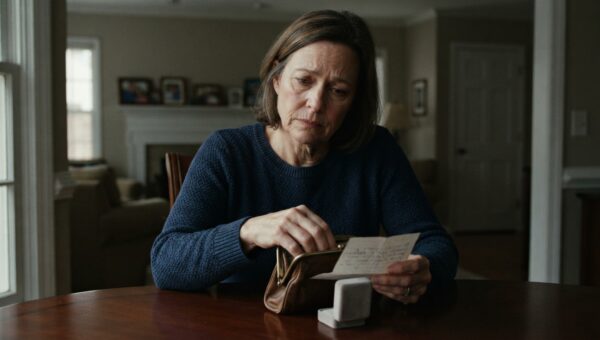
After rent on my mobile home, the gas meter, and groceries, three hundred and twelve dollars was money that simply wasn’t there. So around February, I bought a two-dollar plastic pill splitter from the grocery store pharmacy. I started cutting the little white tablets in half.
When the pharmacy copay jumped another twenty dollars in May, I cut the halves into quarters with an old paring knife and hid the crumbs in an empty tea tin.
Whenever Dr. Miller asked how the new dosage was working, I smoothed down my skirt, looked him in the eye, and told him I felt fine.
I was sixty-eight years old, and I had worked thirty-one years as a bookkeeper for a farm supply coop. I didn’t want charity, and I didn’t want my daughter Laura worrying. Laura had three kids of her own, a husband whose siding business was slow, and a mortgage on a split-level outside town. When the utility company sent a shutoff warning in July, I sold my mother’s silver-rimmed china dishes to an antique booth for a hundred and eighty dollars.
After that, whenever Laura called to ask how I was holding up, I let the phone ring until the machine picked up. It was easier not to answer than to practice sounding cheerful.
Then last Tuesday, Laura asked if my eight-year-old grandson, Toby, could stay the night while she and her husband drove into the city for a supplier meeting.
Toby is a quiet boy who counts everything. He counts the floor tiles in the grocery aisles, he counts the fence posts along the state route, and he keeps his toy trucks arranged by number on my braided rug.
While I was heating up a can of chicken noodle soup on the stove, Toby pulled a wooden chair up to the kitchen counter. He liked setting out my dinner napkin and salt shaker. But instead of the napkins, his hands went to the amber prescription bottles lined up beside the microwave.
He lined the bottles up by height, unscrewed the childproof cap on the blood pressure medication, and tipped the contents onto a clean paper towel.
He started touching each piece with his small pointer finger, counting out loud under his breath.
“Grandma,” Toby said, his forehead wrinkling. “The label says thirty days. There’s supposed to be sixty pills in here.”
I turned from the stove with the wooden spoon in my hand.
“Put those back in the bottle, honey,” I said, trying to keep my voice light. “That’s grown-up medicine.”
Toby didn’t scoop them back. He tapped a little pile of chalky white fragments.
“Grandma, there’s supposed to be sixty. There’s a hundred forty.”
He looked at the jagged halves and quarters, then looked right up at my face.
My chest had been tight for seven days straight, a dull, heavy ache behind my ribs that I had been calling stubborn heartburn and washing down with baking soda water. I opened my mouth to explain why the pieces were small, to tell him that numbers don’t always match the label, and the words got stuck in my throat.
The kitchen didn’t spin. It just tilted sideways, fast and hard, and the yellow linoleum floor came right up to meet me.
PART 2
The next thing I knew, a cold draft was blowing across my face from the screen door, and Toby’s small hands were pressing a kitchen dish towel against my cheek.
He was crying, but he wasn’t screaming. He had my flip phone in his lap with 911 already on the screen, his little thumb hovering over the green call button.
“Grandma,” he sobbed, his voice shaking against my collar. “You didn’t answer me. Your eyes were open, but you didn’t answer.”
I reached up, my arm feeling like it was made of wet sand, and touched his wrist. “Don’t press it yet, Toby. Help Grandma sit up against the cabinets.”
He braced his skinny shoulder against my ribs and helped me pull my back against the lower cupboard. The floor was hard and cold. On the counter above us, the burner was still clicking under the soup pot, and the paper towel was still covered in those chalky white quarters.
I sat there on the linoleum with my grandson, listening to the clock over the sink. I realized how close I had come to dying right in front of an eight-year-old child because I was too proud to tell my daughter I had thirty-eight dollars left in my checking account.
“Push the green button, Toby,” I whispered.
The ambulance arrived nine minutes later. The volunteer paramedics knew me from church; one of them was my late husband’s cousin’s boy, Mark. He took one look at my gray lips, strapped a blood pressure cuff onto my arm, and his eyebrows pulled down tight.
“Eileen, your top number is two hundred and ten,” Mark said, his voice flat with worry. “Your pulse is thready. When did you take your metoprolol?”
“Around six this morning,” I murmured.
Mark glanced up at the counter where Toby had laid out the bottle and the fragments. He picked up one of the jagged quarters between his latex-gloved fingers.
“You took a quarter of a twenty-five milligram dose?” he asked.
I didn’t answer. I couldn’t look at him.
They loaded me onto the gurney, wrapped me in a scratchy gray blanket, and carried me down my three wooden porch steps. Toby rode in the front cab with the driver, clutching his backpack and my purse against his knees.
By the time we reached the regional hospital twenty miles away, the emergency room doctor had an intravenous line running into my left wrist and nitroglycerin paste taped to my chest. The pressure behind my breastbone began to loosen, but the shame stayed lodged right in my throat.
At nine o’clock that evening, the curtain around my cubicle rattled open.
Laura rushed in. Her hair was pulled back in a messy clip, her winter jacket was unzipped, and her face was blotchy from crying. Her husband, Dan, was standing right behind her in the doorway, holding Toby by the hand.
“Mom,” Laura gasped, dropping into the vinyl visitor’s chair and grabbing my free hand. “The doctor said you had a hypertensive crisis. He said your blood vessels were ready to blow. He said you haven’t been taking your maintenance dose for months.”
She reached into her coat pocket, pulled out the clear plastic bag the paramedics had handed her, and dropped it onto the white hospital blanket.
Inside was the amber bottle, the crumbly pills, and the two-dollar plastic splitter from my kitchen drawer.
“Why are these cut into pieces?” Laura asked, her voice cracking. “You told me your Medicare Advantage plan covered your prescriptions. You told me the copay was fifteen dollars.”
PART 3
I looked down at the plastic bag on my legs.
“The fifteen-dollar tier was for the generic beta blocker,” I said, my voice barely louder than the hum of the heart monitor behind my pillow. “Back in January, the manufacturer stopped making that generic. The brand-name substitute went into Tier 3. Three hundred and twelve dollars every thirty days.”
Laura stared at me. “Three hundred and twelve dollars? Mom, your Social Security is only fifteen hundred!”
“Fifteen forty,” I corrected softly. “Rent went up seventy-five dollars in March. Propane went up. I couldn’t ask you, Laura. You and Dan were already behind on the truck payment. I saw the past-due notice on your counter when I watched the kids in April.”
Laura turned to look at Dan. Dan’s face tightened, and he looked down at the linoleum floor, shifting his weight from one work boot to the other.
“Mom,” Laura said, her eyes filling with tears. “You sold Grandma’s silver dishes.”
“They were just plates,” I told her.
“They weren’t just plates! You loved those dishes! And you stopped answering the phone because you didn’t want me to hear you wheezing, didn’t you?”
She buried her face in the edge of the mattress and began to cry with deep, heavy hitches.
Dan stepped into the room, laid a heavy, calloused hand on his wife’s shoulder, and looked straight at me.
“Eileen,” Dan said quietly. “We’re family. You don’t starve your heart to save us a hundred bucks. We would have canceled the cable, we would have picked up scrap runs, we would have done whatever it took. You don’t ever hide something like that from your kids.”
A nurse came in ten minutes later to check my vitals and hang a second bag of fluid. Behind her walked a woman in business slacks carrying a clipboard, a social worker from the hospital’s patient advocacy office named Sarah.
Sarah pulled up a rolling stool and sat down beside my bed.
“Mrs. Gable,” Sarah said kindly, clicking her pen. “The emergency physician flagged your chart for medication non-adherence due to financial hardship. Let’s look at what happened here.”
She opened a binder and pulled up my prescription history on her tablet.
“Your primary care clinic submitted the prescription for the brand-name drug under an unclassified pharmacy code,” Sarah explained. “They didn’t file a formulary exception with your insurer, and they didn’t enroll you in the state’s low-income prescription assistance program, the Extra Help benefit through Social Security.”
I blinked at her. “What is that?”
“If your monthly income is under eighteen hundred dollars, the federal government covers your prescription copays almost entirely,” Sarah said. “Your monthly cost for that heart pill shouldn’t be three hundred and twelve dollars. Under the benchmark subsidy program, your copay is four dollars and sixty cents.”
Laura’s head snapped up from the bed. “Four dollars?”
“Four dollars and sixty cents,” Sarah repeated, turning the tablet so we could both see the state benefit grid. “The clinic just renewed the electronic order every six months without checking why the claim was hitting the coverage gap. Nobody stopped to ask Mrs. Gable if she could actually afford to pick it up from the pharmacy counter.”
I sat there in that hospital bed, looking at that little number on the screen: $4.60.
For seven months, I had been standing over my cutting board with a paring knife, slicing pills into chalk dust, sweating through the nights with an ache in my chest, and selling my mother’s heirlooms to keep the propane on. All because nobody had spent three minutes showing an old woman which box to check on an assistance form.
ENDING
They kept me in the cardiac observation ward for forty-eight hours until my blood pressure stabilized at one-twenty over seventy-eight.
Before I was discharged on Thursday afternoon, Sarah had me sign three simple state subsidy applications. She stamped them, faxed them directly to the state department of health and human services, and handed me an interim voucher card from the hospital’s emergency charity fund to cover my first thirty days of medication at zero cost.
When Dan pulled his pickup into my gravel driveway, Laura carried my small overnight bag up the steps.
She didn’t leave right away. She went straight to my kitchen, took the two-dollar plastic pill splitter from the drawer, and dropped it into the plastic trash can under the sink. Then she took my green spiral-bound household ledger off the secretary desk, sat down at the kitchen table, and opened it to the expense page.
“From now on, Mom,” Laura said, setting her reading glasses on her nose, “we go over this book together on the first of every month. If the gas bill goes up, we look at it. If a copay changes, we call Sarah. No more keeping secrets to protect my feelings.”
I didn’t argue with her. I was too tired, and too relieved, to put up a fight.
Yesterday was Saturday. The afternoon sun was warm through the front window, and Toby was sitting on my braided rug with a box of colored pencils, drawing a picture of an ambulance with big red wheels.
The new bottle of pills sat on the counter beside the microwave. A full sixty round white tablets, whole and unbroken, with the printed receipt stapled to the paper bag showing a total balance due of four dollars and sixty cents.
Toby looked up from his drawing, pointed his pencil at the bottle, and then looked at me.
“Grandma,” he asked, “did you take the one from the top?”
“I took it with my breakfast, Toby,” I told him, smoothing his hair back from his forehead. “A whole one.”
He nodded once, completely satisfied, and went right back to counting the black spokes on his fire truck tires. I sat back in my rocker, felt my heart beating slow and even against my ribs, and listened to the quiet ticking of the kitchen clock.