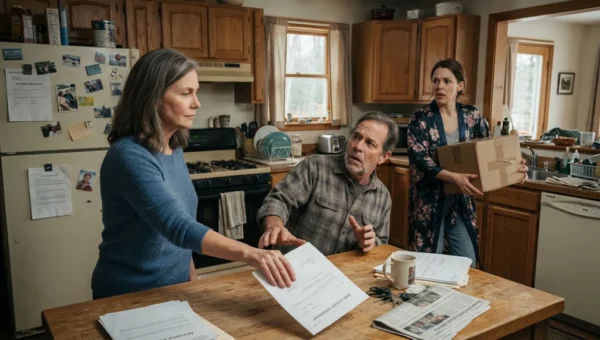
My daughter set the salad bowl on the table and said, “If you invite Daniel to the birthday dinner again, I won’t come.”
Her son, Milo, was in the next room building a tower from couch pillows. Her daughter, Rose, was drawing at the counter. I looked at the bowl because I did not know where else to look.
“I didn’t invite him,” I said.
“You texted him yesterday.”
“He asked if the kids could see him.”
“He sees them every other weekend.”
“I thought it would be nice for their birthday.”
“It’s my birthday, Mom.”
I had forgotten that part. The dinner was for my daughter’s thirty-sixth birthday, not for the children.
Daniel had texted me because Milo wanted to show him a school project. I had answered that he was welcome to stop by Sunday. I had not told my daughter.
“I was trying to make things easier,” I said.
“For who?”
“For the children.”
“No. You were trying to make things the way you wish they were.”
Her voice was low. She was not yelling. That made it harder to pretend she was being unreasonable.
Daniel had been part of our family for twelve years. He and Tess met in college, married young, and had the children before either of them knew what they wanted their thirties to look like. When they separated, I kept inviting him to Sunday dinner because I thought the children needed us all to get along. I did not mean to take sides. I told myself that welcoming Daniel was the same as supporting Tess.
It was not.
“I care about him,” I said.
“I know. You can care about him and still respect that I’m not married to him anymore.”
I folded the napkin in my lap. “I don’t want the children to feel like they have to choose.”
“They don’t. Their father is their father. He has his weekends. They love him. But when you put him at my birthday dinner, I have to sit beside the person I spent a year trying to leave.”
I heard the word trying. “You said you were happier after the divorce.”
“I am.”
“Then why does it still hurt?”
“Because leaving a marriage doesn’t erase what happened in it.”
I began to say that Daniel was a good father. Tess looked at me, and the sentence stopped before it came out. I knew he was a good father. She knew it too. That was not the question.
“I won’t invite him to your birthday,” I said.
“Thank you.”
She took a breath and rubbed her forehead. “I don’t want to keep explaining this. You can see him separately. You can love the kids’ dad. Just don’t keep putting me in the same room with him because you miss what the family used to look like.”
I wanted to deny that I missed it. Instead, I looked at the table. Daniel had built it with my late husband, one winter when the children were still small. At holidays, he used to sit at the far end and carve the turkey while Tess passed plates. Now the chair at the end was empty, and I had been trying to fill it with the same people.
“I hear you,” I said.
Tess put on her coat. She kissed Milo and Rose, then touched my shoulder as she walked past. It was not a cold gesture. It was not an invitation to keep arguing either.
The birthday dinner went ahead the next weekend. I made lasagna and bought a cake with lemon icing, Tess’s favorite when she was a child. Her brother, Paul, came with his wife. The children arrived with Tess and sat at the table between the adults. Daniel was not there.
For the first half hour, I kept looking at the door. I had spent years expecting him to arrive with a bottle of wine and an apology for being late. When the doorbell rang, it was my neighbor returning a casserole dish. She wished Tess happy birthday and left.
Tess noticed me looking. “You can relax, Mom. He’s not coming.”
I flinched. “I wasn’t waiting for him.”
She did not answer. Rose asked for more lemonade. I poured it. The evening moved forward without the missing chair becoming the center of the room.
Later, while Paul loaded plates into the dishwasher, Tess helped me carry the cake to the counter. The children were watching a movie in the living room.
“I’m sorry I made you feel like I was trying to undo your divorce,” I said.
She set the cake knife down. “You’ve been doing it for a while.”
“I thought I was keeping the children’s family together.”
“They have a family. It’s different now.”
“I know.”
“Do you?”
I didn’t answer quickly. I had always understood divorce as a change in the adults’ relationship. I had not understood how much it changed the children’s routines, their sense of home, and the way every holiday had to be negotiated. I had offered Daniel a seat because I wanted the room to look familiar. Tess had to live in the room I was trying to recreate.
“I’m trying to,” I said.
She looked at me, then nodded once. “That’s a start.”
The next morning, I drove to the park where Daniel sometimes brought the kids to practice soccer. I had promised Rose a book, and I could have left it at Tess’s house. Instead, I called Daniel and asked if he had ten minutes to meet me by the benches.
He looked surprised when I handed him the book. “Everything okay?”
“I need to talk to you about the way I’ve been inviting you to family things.”
He lowered the book. “Tess asked you not to?”
“Yes.”
He nodded as if he had expected it. “I shouldn’t have texted you about coming to her birthday.”
“She invited you to see the kids. It wasn’t your job to know what I had promised.”
“I knew she wouldn’t want me there.”
I looked at him. “Then why did you ask?”
He rubbed a hand over his jaw. “Because it’s hard to be outside the family all at once. I know it isn’t the same for her.”
That answer softened me, but it did not change what I needed to do. Daniel was not a villain. He was a man who had been my son-in-law for twelve years and still missed the way we used to gather. So did I. We had both been using the children’s schedules to keep a door open that Tess had closed.
“I care about you,” I said. “But I won’t put you at her birthday or holidays unless she asks. If you want to see the kids, talk to Tess.”
“I do talk to her.”
“Then keep it between the two of you.”
He gave a small, tired smile. “That’s probably fair.”
I told Tess later that I had spoken with him. I did not repeat their conversation. She texted back, “Thank you for respecting what I asked.” It was plain and brief. I read it several times, hoping it would say more, then reminded myself that she had not promised a quick repair.
In the weeks that followed, I stopped being the messenger. When Daniel called to ask whether the kids had left their soccer shoes at my house, I told him to text Tess. When Rose asked whether her dad could come to my house after school, I said she should ask her mother. I did not mean to make the children responsible for the adults’ arrangements. I meant to stop pretending I could arrange everything without speaking to the adults involved.
A few weeks later, Daniel called to ask if I could keep the children after school because his shift had changed. He sounded tired, and I wanted to say yes before I had checked with Tess. Then I remembered the promise I had made. “Please ask their mother first,” I said. “I don’t want to make plans around her.”
He was quiet for a moment. “That’s fair. I’ll text her.”
Tess agreed, and I picked the children up. On the way home, Rose asked whether her parents might live together again someday. I felt the old urge to tell her that adults sometimes changed their minds, that families found ways back. I could see the hope in her face, and I knew a comforting answer might keep it alive for a little while.
“I don’t know what the future will look like,” I said. “Your mom and dad are not planning to get back together right now. They both love you, and you don’t have to fix anything between them.”
She looked out the window. “I know.”
At my house, we made grilled cheese and watched a cartoon. I did not text Daniel to tell him what Rose had asked. That was her conversation to have with her parents when she was ready. When Tess arrived, I told her the pickup had gone smoothly and that Rose had asked a question. Tess asked if Rose seemed upset. I said she seemed thoughtful, then let her talk to her daughter privately.
It was uncomfortable to leave a gap where I used to fill it with advice. It was also the first time I understood that trust sometimes looked like not carrying a message.
The hardest moment came at Thanksgiving. For years, we had eaten at my house at noon, and Daniel had carved the turkey. After the divorce, Tess asked to come at two because she would be at Daniel’s for the morning. I had said yes, but I bought an extra pie and set out his old serving spoon without realizing I was doing it.
Paul found the spoon in the drawer. “Are we expecting Dan?”
“No.”
He looked at the table. “You set out his fork.”
I put it back in the drawer.
Tess arrived with the children at two. She brought rolls and a bowl of cranberry sauce. No one asked where Daniel was. The kids talked about the morning they had spent with him, and I listened without adding that I wished he were there. It was not easy, but I did it.
After dinner, Rose curled up beside me on the couch. “Grandma, can Dad come to your house next time?”
I touched her hair. “That’s something you need to ask Mom and Dad together. I love your dad, but your parents decide when you see him.”
“Mom gets mad if I ask.”
“She may feel sad sometimes, but she won’t be mad at you for loving him.”
Tess was standing at the doorway. I had not known she could hear us. She looked at me, then at Rose.
“You can ask me anything,” Tess said. “We’ll talk about it.”
Rose slid off the couch and went to her mother. Tess held her close. She did not look at me, but when she left that night, she hugged me longer than usual.
In January, Tess invited me to a school play. Daniel would be there because the children were both in the cast. She asked whether I was comfortable sitting with her or whether I wanted a different seat.
“I can sit with you,” I said. “If you want me to.”
“I do. I just don’t want to feel trapped.”
“Then we can sit on the aisle.”
At the auditorium, Daniel arrived after us and sat two rows behind. He waved to the children. I waved back, then turned to Tess. She squeezed my arm when the lights dimmed. The play was a jumble of songs and cardboard scenery. Milo forgot one line and grinned when Rose whispered it to him.
Afterward, Daniel took the children for pizza. Tess and I went home together. We talked about her new supervisor, the leak under my bathroom sink, and whether Rose should start clarinet lessons. We did not talk about whether her marriage might have been saved. I had once considered that a failure of closeness. Now I understood it as her trusting me with the present instead of asking me to rewrite the past.
The next Sunday, Tess called to ask if I wanted to help the children decorate cupcakes. She said Daniel would drop them off and pick them up. I agreed. When he arrived, he stayed on the porch while the children carried their coats inside.
“Thanks for having them,” he said.
“Of course.”
“I hope things are better with you and Tess.”
“They’re improving.”
He nodded. “Good.”
I did not invite him in. He did not ask. We said goodbye without resentment.
The children covered the cupcakes with too much blue frosting. Rose put a chocolate button on each one and called it a winter hat. Tess arrived in time to help them wash their hands. She lingered after they left, wiping frosting from the counter.
“I’m glad you had them,” she said.
“I’m glad too.”
“Do you miss him?”
I could have lied to make her comfortable. “I miss the version of our family when everyone sat at the same table. I don’t miss pretending it was fine when it wasn’t.”
She leaned against the counter. “That’s honest.”
“I should have been honest sooner.”
She put the sponge down. “I’m not asking you to stop caring about him.”
“I know.”
“I’m asking you to care about me enough to let my life be different from the one you pictured.”
“I can do that.”
She studied me for a moment. “I think you’re starting to.”
I did not ask her to say more. I did not ask if she forgave me. We finished cleaning the kitchen, then she carried the cupcake tray to her car. At the door, she turned back.
“Dinner next Sunday?” she asked.
“Just us?”
“Just us.”
I smiled. “I’ll make soup.”
After she left, I put the extra place setting away. The table looked smaller without it, but not empty. I had spent a year trying to keep a family arrangement alive because I was afraid that letting it change meant losing everyone. My daughter had not asked me to stop loving the people she loved. She had asked me to stop using love as an excuse to ignore what she said.
Before they arrived, I put the extra serving spoon back in the drawer. I did not need to hide it or throw it out. It was a useful spoon from a table we had shared for years. But I did not set it in front of an empty chair as if Daniel might appear and restore the old arrangement.
Tess brought a loaf of bread. Rose showed me a new drawing. Milo asked whether I still had the board game he liked. We ate, cleared the dishes, and started a second pot of tea. Nothing about the afternoon required me to mediate. I could just be their grandmother and their mother’s mother, which had always been enough.
The next Sunday, Tess came over with the children. Daniel had them the following weekend. We ate soup and cornbread, and no one had to pretend the old marriage was still sitting at the table.
When Tess left, she kissed my cheek. “See you Wednesday?”
“Yes,” I said. “I’ll be here.”
It was a small promise, and this time I knew exactly who it was for.