The heavy blue ledger was tucked behind three dozen empty glass cylinders on the bottom shelf, right next to a box of green floral tape that had gone gummy back during the Carter administration.
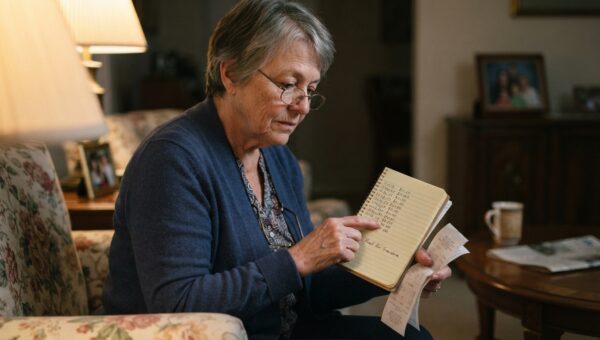
I didn’t need to open it to know what was on page four hundred. I knew every name, every date, and every cheap white ribbon we used when the family couldn’t afford the silver-edged ones.
Arthur Vance had dropped that book off on my counter nineteen years ago this November, back when his hair was still iron gray instead of chalk white. He told me the county morgue handled the paupers, but the families who fell just short of the county line, the ones who had a plot in the red clay behind St. Jude’s but nothing left for a spray of lilies, were his problem.
“They want to bury their people with some dignity, Clara,” he said to me that Tuesday morning. “And you’re the only one in three counties who knows how to wire a basket so it doesn’t sag in the middle.”
That was how it started. No contract, no receipts, and not a single dime exchanged between us.
Nineteen years of stems, wire, oasis foam, and late-night snipping under a single fluorescent tube that flickered every time the compressor kicked on.
I figured it cost me about $11,000 a year in wholesale product and labor, though I never bothered to add it up until the accountant asked me for tax numbers I didn’t have.
Nobody else knew. Not the families, who thought the county or some anonymous church fund was paying for the heavy carnation wreaths. Not my distributor in Wheeling, who just thought I really liked white mums.
Then the water main under Fourth Street blew out at 2:14 on a rainy Thursday night and didn’t stop until six the next morning.
The basement did not just flood; it filled up like a concrete swimming pool, swallowing four decades of antique copper urns, spare delivery tires, and every refrigeration motor I owned.
Insurance adjuster came out on Friday afternoon wearing shiny loafers that didn’t touch the mud and clipboarded the whole mess with a face like he was smelling something dead.
“Sewer event,” he told me before he even unclipped his pen. “Municipal line backup. Your policy specifically excludes subterranean municipal backflow.”
I didn’t yell. At sixty-six, you learn that yelling at men with clipboards is like spitting into a high wind.
“The pipe is city property,” I said, pointing at the buckled floorboards where the linoleum had curled up like bacon.
“Not our definition,” he said, turning around before I could tell him where to put his clipboard.
By Sunday night, I had packed my personal shears into a red plastic milk crate and wiped down the front counter for what I figured was the last time.
The floor smelled like stale river silt and rotted peat moss, that heavy, sour damp that gets into your clothes and stays there for days. I was done. My knees sounded like a bag of dry twigs every time I stood up, and the shop was gone.
Monday morning was supposed to be simple. I had a guy coming from over in Clarksburg with a flatbed truck to haul off the dead coolers for scrap metal at fifty bucks a pop.
I was standing by the front door with the key in my hand, looking out at the gray October fog, when the hearse pulled up to the curb.
It wasn’t one of Arthur’s new Cadillacs. It was his old 1998 Lincoln Town Car hearse, the one with the dull black paint on the fender where he backed into a concrete pillar at the cemetery back in ninety-six.
The engine died with a heavy shudder, and the driver’s door creaked open.
Arthur stepped out, his knees stiff, leaning hard on his blackthorn walking stick. He wasn’t wearing his funeral director’s suit. He had on an old brown flannel shirt and a canvas jacket that had seen better winters than this one.
He didn’t look at the scrap metal truck idling across the street. He just walked up the cracked concrete steps of my shop, pushed the door open, and stepped right over the wet floorboards without wiping his boots.
“You left the back light on,” he said.
I just stood there by the register with my coat on. “The scrap guy is supposed to be here at eight, Arthur. You’re early for a viewing.”
“There ain’t no viewing today,” he said.
He reached inside his canvas jacket and pulled out that heavy blue ledger, the one I had just put away on the bottom shelf behind the glass cylinders. He set it down on the wet counter with a solid thud that sent a little cloud of dried dust floating up into the cold air.
“What is that?” I asked, even though I knew the corner of the cover where the mice had chewed off the blue buckram back in 2008.
“That’s nineteen years of bills you never sent,” Arthur said.
He didn’t look at me when he said it. He looked out the front window where three more cars had just pulled up behind the hearse. Then a pickup truck. Then an old station wagon with a rusted tailgate.
People started getting out. Not mourners in black, but people I hadn’t seen in years, and some I only knew by the names on Arthur’s yellow referral slips.
Martha Gilly was first, carrying a yellow plastic bucket and a push broom. Her husband Joe had died of the black lung back when George Bush was in office, and I’d made a basket of yellow mums for him that nearly broke my back to carry.
“You can’t sell the coolers, Clara,” Martha said, pushing past Arthur like she owned the place. “We need those for the spring bulbs.”
“Martha, the motor’s burned out,” I said, my voice sounding thin even to me. “It’s a sewer event. The man said so.”
“The man don’t know shit about what’s in this town,” Martha said, dropping her bucket with a loud clatter against the base of the counter.
More people came through the door. Tom Henderson from the lumber yard was carrying two sheets of marine plywood and a box of galvanized screws. Sarah Miller, whose mother’s casket had been draped in three dozen of my best sweetheart roses when nobody else would even answer Arthur’s phone calls, walked in with a mop and a gallon of bleach.
“You gave us forty-eight hours of credit on my daddy’s stone, Clara,” Sarah said, her voice shaking just enough that I had to look down at my boots. “You think we didn’t keep count?”
Arthur opened the blue ledger right there on the ruined counter.
The pages were thick with handwriting, some in my own sloppy hand when I was rushing to get an order out before dark, some in Arthur’s neat, sharp cursive.
Near the back, tucked into the binding with a paperclip that had rusted red, was a folded deposit slip from the First National Bank dated three days ago.
The total written in the corner wasn’t the eleven thousand I figured I lost every year. It was nearly eighty-four thousand dollars, collected twenty bucks at a time in plain white envelopes dropped into Arthur’s drop box behind the chapel with notes that just said *For the flowers*.
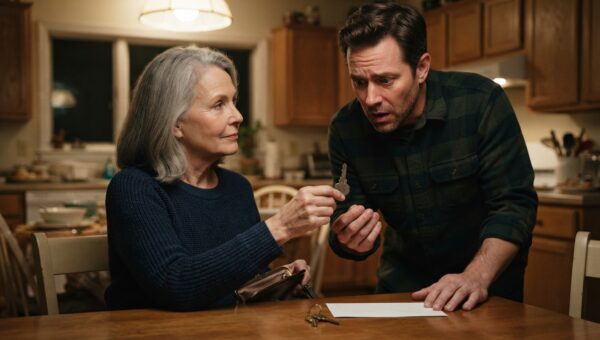
“They tried to pay every time, Clara,” Arthur said quietly, resting his hand on the cover of the book. “I just told ’em you put it on the county account. Kept their pride intact. Same as you did.”
“I didn’t want their money, Arthur,” I said, and my throat felt tight and dry. “That’s not why I did it.”
“I know why you did it,” he said. “And now they want their shop back.”
By ten o’clock, the scrap metal truck had backed away and gone down the street because there wasn’t room for him at the curb anymore.
Tom Henderson had the old floor ripped up by eleven, his skill saw screaming through the water-logged pine while four other men carried the ruined refrigeration units out into the alley one piece at a time.
Sarah was scrubbing the back wall with bleach until the room smelled clean instead of damp.
I sat on an upturned milk crate by the front window with the blue ledger open on my lap, watching the light change on the wet asphalt outside.
Arthur didn’t leave. He sat on an old folding chair across from me, watching the sawdust fly and occasionally yelling at Tom to measure twice before he cut the subfloor.
“You’re too old to be running this place by yourself anyway, Clara,” Arthur said, pulling a peppermint out of his pocket and unwrapping it with a crackle of cellophane.
“I’m sixty-six, Arthur. You’re seventy-two. Don’t start.”
“We’re setting it up as a community trust,” he said, sucking on the peppermint. “The town owns the building now. You just work the counter and tell people which way the ribbons go.”
I looked down at the page where my own handwriting from 2004 was starting to fade around the edges.
A single green stem, left over from a spray I’d been working on before the pipe burst, was lying on the counter beside the ledger. It was fresh, crisp, and didn’t have a single brown spot on the leaves.
I picked it up between my thumb and forefinger, feeling the cool moisture on the skin, and slid it into the empty glass vase Arthur had just set down beside my hand.