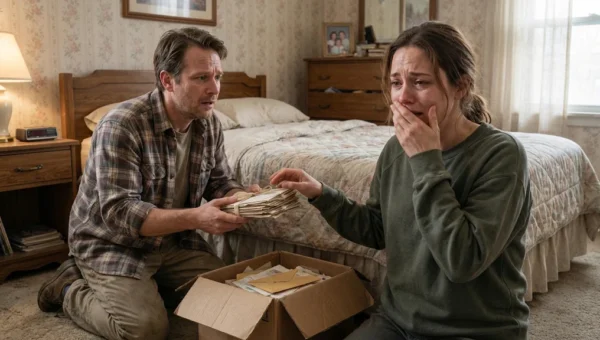
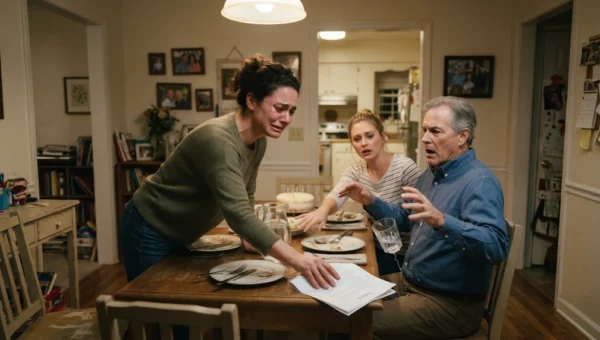
The smell of coffee grounds in Walt’s blue mug is what I remember from the morning Kendra brought a real estate agent to my sister’s house. I had rinsed the mug and set it by the sink, thinking Darlene might want it there when she came downstairs. Walt had been dead eleven days. Kendra didn’t hug her mother. She came through the front door with two suitcases, a woman carrying a folder, and a plan to sell the house.
I was there because I’d been sleeping in the spare room since the funeral. That sounds like I took charge. I didn’t. I was scared to leave Darlene alone at night, and I was also scared of being alone with my own thoughts, so we made a deal that helped both of us. Or so I told myself.
Kendra looked around the living room and called the place a mansion. It wasn’t. It was a large ranch house outside Amarillo, with a long hall, a back porch that needed paint, and a pantry Walt had built with the shelves too high. Darlene and Walt had spent thirty-eight years fixing it up a little at a time. Kendra had grown up there after Darlene raised her alone for most of her childhood.
“We’ve decided we’re going to sell,” Kendra said. “It’s too big for Mom, and I need the money more than she does.”
The agent didn’t say anything. Darlene had one hand wrapped around the chipped blue mug. I’d told my sister to let Kendra handle the practical things. I thought that meant phone calls and bills. I didn’t know it meant this.
I should explain why I was so sure I knew what was best. Darlene had been missing meals and forgetting where she’d put things, though she was still sharp enough to tell me when I was being a pain. At the funeral, Kendra had stood in the church hall with a stack of bills and a face that looked like it hadn’t slept. She said her mother couldn’t manage all the paperwork alone. I said, “Let her help. You don’t need another fight right now.”
I meant it. I also wanted the fighting to stop because I couldn’t stand it. Those are not the same thing, but I acted as if they were.
Kendra had never been an easy daughter. She’d been a hard teenager, then a hard young adult, then a woman who called when she needed something and went quiet when she didn’t. But she had also sat by Walt’s bed during his last week and brought him ice chips when Darlene couldn’t get him to drink. I saw that. I chose to believe it meant she’d be careful with her mother.
There was a reason Kendra needed money. Her small bookkeeping business had lost two clients, and she’d fallen behind on rent for the office. She was raising her own boy, Eli, mostly by herself. None of that made the house hers to sell. I knew that too, somewhere in the back of my mind.
That morning she looked at me, then at her mother. “You said we’d talk about this,” she said.
Darlene set down the mug. “We haven’t talked.”
Kendra opened the folder. The agent took out a few pages and placed them on the table. I saw the listing agreement at the top, but I didn’t know what the rest of it was. I reached for the papers before Darlene did.
That was my first bad choice.
I said we could all sit down and look at the numbers. I said nobody had to decide anything that day. I said it in the calm voice I use when I’m trying to make everybody behave. Kendra’s shoulders dropped a little. The agent sat back. Darlene looked at me, and I read her quiet as agreement.
It wasn’t.
Kendra talked about the upkeep, the taxes, the empty rooms. She said the house was too much for her mother. She said she could find her a nice apartment near the grocery store. She said Walt wouldn’t want the place to turn into a burden. That last part got under my skin, because Walt hated wasting money but he also loved that house. He’d patched the roof twice rather than pay someone else to do it.
I didn’t correct her. I sat there and let the agent ask about the roof and the water heater. I watched Darlene rub the mug’s chipped handle with her thumb. I know that handle. She’d chipped it years ago when she knocked it against the sink, and Walt had put a little strip of tape over the sharp bit so it wouldn’t catch her finger. She kept using it anyway.
When Kendra asked if I’d seen any paperwork about the house, I said I hadn’t. That was mostly true. I’d seen a blue folder in Walt’s desk before the funeral, but I’d assumed it held insurance papers. I hadn’t opened it. I’d been busy telling myself that the family would get through this if we all acted sensible.
Three weeks later, I was back at my own place. Darlene had told me to go home and sleep in my own bed. I left because she asked, and because I was beginning to feel like a guest who’d stayed too long. Kendra stayed at the house. She said she wanted to help her mother sort through Walt’s things.
I was relieved. I’m ashamed of that now, but I was. I wanted somebody younger to take over the hard parts. I kept thinking, let her deal with the bills, let her call the lawyer, let her do something useful. I didn’t ask Darlene what she wanted. I asked what would make the days easier.
That’s a bad way to help somebody.
The first time I heard the word “trust,” Kendra said it over the phone. She asked if I knew whether Walt had put the house in one. I said I didn’t know. She said she’d found papers and was trying to figure out what they meant. Then she asked me not to mention it to her mother until she’d talked to the lawyer.
I said all right. I didn’t want another argument. That was my second bad choice, though I didn’t know what I was choosing yet.
A few days later, Darlene called me while I was at the pharmacy. She said Kendra wanted her to sign something, but she didn’t know what it was. I asked what the paper said. She said it had too many words and Kendra told her the lawyer could explain later. I told her not to sign anything she didn’t understand.
Then I asked if she wanted me to come over. She said no. I let her say no. I should have gone anyway.
The next morning I did go over. Kendra had left for an appointment, and Darlene was at the kitchen table with Walt’s old blue folder open in front of her. She’d put on her reading glasses. There were pages with stamps and signatures, a copy of the deed, and a letter from a lawyer in town.
“I don’t know what I’m looking at,” she said.
I didn’t either. But I recognized Walt’s handwriting on a small note tucked inside the folder. He had written “Call Mr. Pruitt” and a phone number. I called it. Mr. Pruitt remembered Walt, and after I told him Walt had died, he said he could meet with us that afternoon.
I asked Darlene if she wanted me to call Kendra too. She stared at the papers for a second. “No,” she said. “Not yet.”
We went to Mr. Pruitt’s office after lunch. I drove. Darlene carried the folder on her lap the whole way and kept one finger on the flap so it wouldn’t open. I wanted to tell her everything would be fine. I didn’t, because I didn’t know that.
Mr. Pruitt showed us the trust papers. Walt had put the house in a living trust years earlier. Darlene was the trustee while she was alive. She had the right to stay there, pay the bills from the account, and decide whether to sell. Kendra would only take over after Darlene died or chose to step down. The listing papers weren’t a transfer, but they were still a real estate contract. Darlene had not signed them.
Mr. Pruitt explained it twice. I understood it the second time, and I felt stupid for not looking sooner. I had spent weeks acting like Kendra was the person who got to decide because she was the one willing to hold the folder.
Darlene asked, “So she can’t make me sell?”
“No,” he said. “Not while you’re able to make your own decisions.”
That was all she needed to hear. She sat back and held the folder against her coat. I looked at the carpet because I’d been so confident, and because I knew I’d helped Kendra get as far as she had.
Kendra came to my house that night. She didn’t bring the agent. She brought Eli, who went to the back room to play on his phone while the three of us sat at my kitchen table. I remember a dry spot of oatmeal stuck to the edge of my counter. I kept looking at it while Kendra talked.
She said she’d found the trust papers and thought they meant she was the next person in charge. She said the house was worth enough to pay her debts and give her mother a smaller place. She said she wasn’t trying to put Darlene out on the street. She was trying to keep the family from losing value tied up in a house nobody needed.
That sounded reasonable until I remembered the person who still lived there.
Darlene asked why Kendra had brought an agent before talking to her. Kendra looked down at her hands. She said she was afraid if she waited, the money problems would get worse and her mother would get too attached to the house to make a practical choice. I wanted to say that was no excuse. I also wanted to pretend I hadn’t made it easier by telling her to take over.
So I said the thing I should have said weeks earlier. “You don’t get to decide for her.”
Kendra looked at me. “You told me to handle it.”
“I know,” I said. “I was wrong.”
That didn’t fix anything. Darlene sat quiet, and Kendra got up to check on Eli, even though he was fine. I could hear him tapping at his phone in the next room. For a while, nobody talked.
The next day, Darlene met Kendra at Mr. Pruitt’s office. I went with her because she asked me to. The agent’s listing agreement was still unsigned, and Mr. Pruitt explained that Kendra couldn’t act as trustee while Darlene was alive and able to do it herself. Kendra listened. She didn’t argue.
Afterward, outside the office, Kendra said she’d made a mistake. She didn’t say she was sorry right away. She said she’d been scared about money and thought the house was the only way to get her head above water. Then she said she was sorry.
Darlene didn’t hug her. She said, “You should have asked me first.”
“I know,” Kendra said.
I stood there with my hands in my coat pockets and let them talk. I didn’t jump in to smooth it over. That was the first useful thing I’d done in a while.
The house stayed in Darlene’s name through the trust. She didn’t sell it. She did let Kendra help with the bills, but every paper went to Mr. Pruitt first, and Darlene read it herself before she signed. Kendra found another office to rent, a smaller one, and took extra bookkeeping work through a local tax shop. It wasn’t a grand fix. It was just a way to keep going.
For a while, she came by on Sundays with groceries. Darlene let her in. Some Sundays they talked. Some Sundays they didn’t. I stopped asking if everything was all right, because the answer was usually no, or not yet.
I went back to my own house, but I still checked on my sister. I’d bring a loaf of bread or a bag of oranges and leave before I started telling her what she ought to do. That part is harder than it sounds. I spent half my life thinking love meant stepping in before somebody made a mess. I’m learning that sometimes I only wanted to be the one holding the mop.
About two months after the funeral, Darlene called and asked me to come over. Kendra had been there earlier, helping her sort the desk. They found another note tucked inside the blue folder. Darlene had set it beside the chipped mug. It was folded once, with Walt’s name on the outside.
She opened it at the table. The note was short. Walt had written it in the blocky print he used on labels in the garage. Darlene read it once, then slid it toward me.
It said, “Your mother decides what happens to this house.”