PART 1
My son Tyler told me I would never meet his newborn son because his wife said I was bad for the baby.
He did not say it in person. He called me from the hospital parking lot thirty minutes after Chloe had the baby, while the car engine hummed through the Bluetooth speaker.
“Chloe needs peace, Mom,” he told me. “She doesn’t want you around the house, and she doesn’t want you holding the baby. She says your energy is toxic. If you send gifts, we’ll donate them. Don’t come by.”
Before I could ask what I had done, the call clicked off.
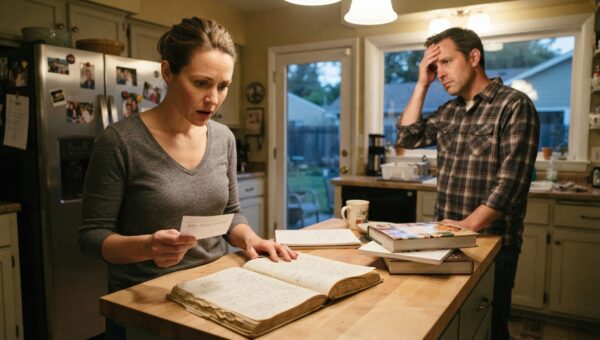
I sat at my kitchen table in Columbus with the tea kettle still whistling on the back burner. In the hallway closet, I had a white wicker basket filled with things I had collected over seven months: six newborn onesies washed in fragrance-free detergent, two flannel swaddles, and a sky-blue sweater I had knitted while watching the evening news. I had taken four days of accrued vacation from my clerk job at the county water department so I could bring casseroles to their house and fold laundry while they slept.
Instead, the house stayed quiet.
Seven months passed. Tyler stopped answering my text messages. When I sent a card for his thirty-first birthday in July with a fifty-dollar grocery gift card inside, the envelope never came back, but I never received a thank-you note either. I saw one photograph of my grandson, Liam, on a mutual family friend’s social media page. He had Tyler’s cowlick and round blue eyes. I saved the photo to my phone, looked at it every night before bed, and spent hours wondering what terrible thing Chloe thought I had done.
I had always thought Chloe and I got along. When Tyler brought her home three years ago, she was polite, soft-spoken, and came from a family in Upper Arlington with a country-club membership and summer trips to Hilton Head. My husband had died of kidney failure when Tyler was seven, leaving me with a thirty-year mortgage on a split-level house and seven thousand dollars in credit card debt. I raised Tyler on a county salary, double shifts, and peanut butter sandwiches. I never had country-club money, but Tyler never missed a dental appointment, had a clean bed, and graduated from Ohio State without a dime of student loans because I worked side jobs doing medical billing until two in the morning.
I assumed Chloe looked down on me. I assumed she thought my small brick house and my polyester work pants were beneath her family. That was the story I told myself to survive the ache in my ribs.
Then, on a Tuesday morning in late October, my desk phone rang at work.
“Carol Miller?” a woman asked.
“Yes, speaking.”
“This is Dr. Sarah Bennett from Oakridge Pediatrics. I have an infant patient here, Liam Miller. We have an acute drug reaction situation. He was prescribed amoxicillin for an ear infection yesterday evening, and his mother brought him into urgent care forty minutes ago with facial swelling and hives. Our records flag a paternal family history of severe beta-lactam anaphylaxis, but the chart is incomplete. Are you Liam’s grandmother?”
My hand clamped around the plastic handset. “Yes. I am Tyler’s mother.”
“Can you tell me about Tyler’s reaction history? Our chart notes state there was a pediatric hospitalization, but we don’t have the hospital name or the exact compound.”
“It was August of 1998,” I said, the memory coming out instantly without having to think. “Tyler was four. He was prescribed amoxicillin-clavulanate for a sinus infection. Within twenty minutes, his lips turned purple and his throat closed. We took him to Riverside Methodist. He spent three days in the pediatric intensive care unit on intravenous epinephrine and steroids. The allergist told us he has a severe cross-reactivity to all penicillin-based antibiotics and first-generation cephalosporins. He cannot have cephalexin either.”
The doctor was typing rapidly on the other end of the line. The keys clicked steadily against the receiver.
“Thank you, Mrs. Miller. That matches the presentation we are seeing right now. We are giving him intramuscular epinephrine and switching to azithromycin. That information is critical.”
“Is Liam going to be okay?” I asked. My throat felt tight. “Is he breathing?”
“His oxygen saturation is stable. We caught it early because his mother brought him in as soon as the rash spread to his neck.” Dr. Bennett stopped typing. Then there was a long, awkward pause on the line. “Mrs. Miller?”
“Yes?”
“That is strange. Your son listed you under a different surname.”
I frowned, holding the receiver closer. “What do you mean?”
“The emergency contact phone number on the intake portal matches your direct line, but the name on the form is Margaret Vance. Not Carol Miller.”
I stared at the computer monitor on my desk. Margaret Vance was Tyler’s father’s older sister. She lived in a high-rise condominium in Denver, worked in corporate finance, and had not seen Tyler since he was twelve years old. She sent a twenty-five-dollar check in a generic card every Christmas until Tyler turned eighteen, and then she stopped completely.
“Why would Tyler write Margaret Vance?” I asked.
“I cannot explain family matters over the phone,” Dr. Bennett said, her tone suddenly cautious and professional. “My only responsibility was getting the allergy history for Liam’s chart. But since you provided the verified medical background, I can send you a secure copy of the intake release form for our records so you have proof of the call.”
Ten minutes later, an encrypted email arrived in my inbox. I entered my birthdate to unlock the document.
It was a standard two-page pediatric emergency intake sheet, dated six months earlier when Liam was four weeks old.
In the section labeled Emergency Contact / Family Medical Proxy, Tyler’s distinct, blocky handwriting filled the blanks:
Contact Name: Margaret Vance
Relationship to Father: Guardian / Mother
Phone Number: My personal cell phone number.
And across the bottom of the page, written in neat, flowing purple ink that did not belong to my son, was a single handwritten note:
“If anything happens, call the woman who raised his father.”
That woman was not me.
PART 2
I stared at that purple ink until the letters blurred into black smudges.
“The woman who raised his father.”
Chloe had written that sentence. I knew her handwriting because she had written our names on the wedding invitations three years ago. It was neat, elegant, and deliberate.
Tyler had not simply told his wife that I was overbearing or unpleasant. He had told her that Margaret Vance raised him.
I leaned back in my desk chair and looked out the window at the gravel employee parking lot. My hands were shaking, not from tears, but from a cold, hard clarity that hit me like a bucket of well water.
Everything from the last three years began to line up differently.
When Tyler got engaged to Chloe, he told me Chloe’s parents were traditional and old-fashioned. He asked me not to bring up his father’s debts or the fact that I had taken out a second mortgage to pay for his roof repair during his sophomore year of college. “Let them think we had it easy, Mom,” he had told me over coffee at a diner near campus. “Chloe’s dad is on three hospital boards. He judges people who struggle.”
I had kept quiet because I loved my son and wanted him to be happy.
Then came the house. Two years ago, Tyler and Chloe found a four-bedroom colonial in Greenfield, a wealthy suburb twenty miles outside the city. The purchase price was four hundred and twenty-five thousand dollars. Tyler came to my house on a Sunday afternoon, sat on my floral sofa, and told me they were short on the down payment.
“Chloe’s parents gave us twenty thousand for new furniture,” he told me, looking down at his sneakers. “If I don’t put down at least ten percent on the mortgage, her father is going to co-sign the loan. I can’t let him do that, Mom. I need to be the man who bought this house. If you can loan me forty-two thousand five hundred dollars from Dad’s old pension payout, I’ll pay you back six hundred dollars a month. Every single month. On the first.”
I gave him forty-two thousand five hundred dollars. It was nearly half of the survivor benefit fund I had preserved for my own retirement, sitting in a modest credit union certificate. I went to the bank on a Monday morning, had a cashier’s check drawn, and handed it to him in an envelope.
He never made a single six-hundred-dollar payment. When I asked him about it four months later, he became defensive, snapped that property taxes had gone up, and said I was suffocating him over money.
Now, sitting in my county office with that pediatric intake sheet on my screen, the real truth showed its teeth.
Tyler had not told Chloe the forty-two thousand five hundred dollars came from his mother who worked forty-hour weeks at the county water authority. He had told Chloe the money came from his wealthy aunt Margaret in Denver, the woman he pretended had taken him in and raised him with elegance and means. He had told Chloe that his biological mother was an unstable, deadbeat woman who neglected him as a child and now harassed him for cash.
That was why Chloe thought I was bad for the baby. Chloe did not hate me because I was working-class. Chloe hated me because Tyler had invented a monster to explain away his own mother, while stealing her life savings to impress his in-laws.
And when the pediatric clinic asked for a family emergency contact who knew Tyler’s medical genetics, Tyler could not use Margaret’s real phone number because Margaret lived in Colorado, had no idea Tyler had a baby, and did not know a single detail about Tyler’s childhood allergies. Tyler needed someone who would answer the phone and save his son’s life if the worst happened, but he could not let Chloe know he was still using me as a safety net.
So he wrote Margaret’s name over my phone number.
I picked up my desk phone and dialed the area code for Denver. I found Margaret Vance’s office line through public business listings. Her assistant patched me through after I said it was family business.
“Carol?” Margaret’s voice sounded crisp, formal, and slightly surprised. “Is everything all right? I haven’t heard from you since Richard’s memorial service.”
“Margaret, I need to ask you one question,” I said. “Has Tyler contacted you in the past two years?”
There was a rustle of papers on the other end. “Tyler? No. He sent an announcement when he got married, and I mailed him a hundred-dollar registry gift card. I haven’t heard a word since. Why?”
“Did you give him forty-two thousand dollars for a house down payment?”
Margaret laughed, a short, dry bark. “Good heavens, no. I’m helping my own daughter through law school. Why on earth would Tyler tell you that?”
“He didn’t tell me,” I said quietly. “He told his wife.”
I thanked Margaret, hung up the phone, and printed two copies of the pediatric intake form. Then I printed my bank statement from two years ago showing the cashier’s check withdrawal for forty-two thousand five hundred dollars payable directly to the title company. Next, I took my purse, walked into my supervisor’s cubicle, and requested the rest of the afternoon off.
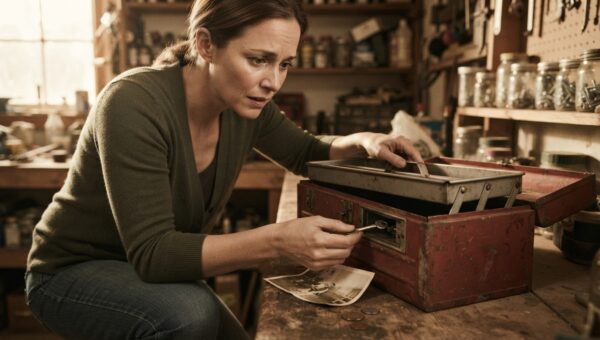
I drove home, went straight to the hall closet, and pulled out the white wicker basket. I took the sky-blue knitted sweater, the six onesies, and the flannel swaddles. Underneath them, in the bottom of the basket, was a brown cardboard accordion file labeled Tyler’s Childhood Records.
Inside that file were Tyler’s immunization cards from the county health clinic, his report cards from first grade through high school with my signature on every grading period, his track ribbons, and the yellowed carbon copy of the emergency room admission from Riverside Methodist Hospital dated August 14, 1998, listing Carol Miller as sole legal guardian.
I put everything into my canvas grocery tote bag, walked out to my ten-year-old Chevrolet, and drove twenty miles north to Greenfield.
PART 3
The neighborhood in Greenfield had wide, curving streets lined with manicured Bradford pear trees and stone mailboxes. Tyler and Chloe’s house had dark gray shutters, a double front door painted glossy black, and two potted boxwood topiaries on the porch.
I parked at the curb behind Chloe’s white SUV.
My heart did not pound. My hands stayed steady on the steering wheel. When you spend thirty years taking orders from county commissioners and stretching a pound of ground beef across three dinners, you do not shake easily. What I felt was a cold, quiet determination. My son had taken my money, erased my name, and turned me into a ghost to feed his own vanity. I was done being quiet.
I walked up the concrete walkway carrying the canvas tote bag and pressed the doorbell.
Footsteps echoed inside. Tyler opened the door wearing gym shorts and an Ohio State sweatshirt. His hair was messy, and he had dark circles under his eyes from a night at the urgent care clinic.
When he saw my face, his jaw dropped open. He stepped onto the porch and pulled the front door halfway shut behind him.
“Mom? What the hell are you doing here?” he whispered, his eyes darting toward the driveway. “I told you never to come to this house. Chloe is inside with Liam. He just got home from the clinic. You need to leave right now.”
“I am not leaving, Tyler,” I said in a normal speaking voice.
“Lower your voice,” he hissed, grabbing my elbow. “Get back in your car. If Chloe sees you, she’s going to call the police. I told you she thinks you’re unstable.”
“Tyler? Who is out there?”
Chloe’s voice came from the entryway. The door swung all the way open.
Chloe was holding Liam against her shoulder in a white fleece sleep sack. The baby’s face was still slightly red around the cheeks, but the swelling had gone down, and he was sleeping soundly with his tiny mouth open against her collarbone.
Chloe looked at me, then looked at Tyler. Her expression hardened into immediate hostility.
“Tyler, get her off our property,” Chloe said, her voice tight and trembling with anger. “What is wrong with you? Our son was in the hospital two hours ago, and you let this woman stand on our porch?”
She looked straight at me. Her eyes were furious. “You have no right to be here. Tyler told me how you treated him. You took off when he was a boy, you blew his father’s insurance money, and you’ve done nothing but ask him for handouts ever since we got engaged. You stay away from my baby.”
Tyler looked at the porch floorboards. He did not look at Chloe, and he did not look at me. His face had gone completely gray.
“Chloe,” I said evenly. “I am the woman who took Dr. Bennett’s phone call two hours ago.”
Chloe paused, frowning. “What are you talking about?”
“Dr. Bennett needed to know what drug caused Tyler’s respiratory collapse when he was four years old,” I said. “Tyler couldn’t tell her because Tyler was four. Margaret Vance couldn’t tell her because Margaret Vance lives in Denver and hasn’t seen Tyler in nineteen years. The doctor called my cell phone because Tyler put my number on the intake sheet.”
“That’s a lie,” Chloe snapped. “We put Margaret on the emergency contact form. Tyler’s aunt raised him after his mother left.”
I reached into my canvas bag, pulled out the two printed sheets of the pediatric intake form, and held them out.
“Look at the phone number on that line, Chloe,” I said. “Read it out loud.”
Chloe did not take the paper at first. She looked at Tyler. “Tyler, what is she talking about?”
Tyler kept his eyes fixed on his sneakers. “Mom, please don’t do this here,” he mumbled. “Let me explain it to her later.”
“Explain what later?” Chloe demanded. She snatched the paper from my hand.
Her eyes scanned the top section, then dropped to the emergency contact box. She saw Tyler’s handwriting: Margaret Vance. Then she looked at the ten-digit phone number.
I pulled my cell phone from my pocket and pressed the speed dial for our home landline, which forwarded directly to my cell. The phone in my hand rang with a loud, clear chirp on the quiet porch.
“That is my number, Chloe,” I said. “It has been my number since 2004. Tyler knows it by heart because he called it every time he needed groceries in college.”
Chloe stared at the paper. Then her gaze dropped to the bottom of the page, where her own purple handwriting stood out against the white paper: If anything happens, call the woman who raised his father.
Her head snapped toward Tyler. “Tyler? Whose phone number is this?”
Tyler swallowed hard. “Chloe, look, my family situation was complicated. My mom was always difficult to deal with, and I didn’t want you to worry about—”
“I raised him, Chloe,” I said, cutting right through his excuses.
I reached back into the tote bag and pulled out the yellowed 1998 hospital record from Riverside Methodist. I held it out so she could see the doctor’s signature, the diagnosis of penicillin-induced anaphylaxis, and my signature at the bottom as sole legal mother and guardian.
Then I pulled out the photo from Tyler’s eighth-grade graduation: me in my beige linen skirt standing next to Tyler, his arm around my neck, laughing behind the middle school gymnasium. I pulled out the photo from his high school varsity track meet where I was pinning his runner number to his jersey.
Finally, I handed her the bank statement from two years ago.
“That is forty-two thousand five hundred dollars,” I told Chloe. “Drawn from my retirement account at the Franklin County Municipal Credit Union. It went directly to First American Title for the down payment on the house you are standing in right now. Tyler promised to repay me six hundred dollars a month. He has not paid six cents. Margaret Vance did not give you that money. I gave you that money.”
Chloe looked down at the bank statement. Then she looked at the photos.
Her breathing changed. The anger in her face did not disappear, but it turned completely away from me and settled square on the man standing beside her.
“You told me your aunt gave you that money from a trust fund,” Chloe whispered. Her voice was deadly quiet. “You told me your mother abandoned you in a trailer park when you were eight.”
Tyler tried to reach for her hand. “Chloe, please, come inside. Let’s talk about this inside.”
Chloe stepped backward into the foyer, out of his reach. She held Liam tighter against her chest.
“Don’t touch me,” she said.
ENDING
Tyler did not follow her into the foyer. He stood on the porch with his hands hanging limply at his sides, looking at the stone driveway as if he wished the earth would open up and swallow him whole.
Chloe looked at him through the doorway. “Take the car,” she said. “Go drive somewhere. I don’t care where you go, but do not come back into this house until I call you.”
“Chloe, listen to me—” Tyler started.
“Take the keys and leave,” she said, her voice dropping into a hard, cold register.
Tyler looked at me for one second. There was no anger in his eyes anymore, only the raw, miserable humiliation of a man whose counterfeit life had been held up to the sunlight. He walked down the porch steps, got into his sedan, backed out of the driveway, and drove down the street without looking back.
The neighborhood was dead quiet. The wind blew a few dry pear leaves across the sidewalk.
Chloe stood in the open doorway holding the baby. Her eyes were red, but she did not cry. She looked down at the papers in her hands, then looked up at me.
“He told me you were dead to him because you stole his college fund,” Chloe said. Her voice shook slightly. “He told my parents that his aunt in Denver paid for everything. My dad gave him a vintage watch at our rehearsal dinner because he thought Tyler was an orphan who pulled himself up from nothing.”
“Tyler had a mother who loved him,” I said. “He just didn’t want you to know she drove a Chevy and worked in a basement office.”
Chloe looked at the baby asleep on her shoulder. Then she stepped aside and opened the black door all the way.
“Come inside, Mrs. Miller,” she said quietly. “Please.”
We sat at her polished granite kitchen island. The house smelled like lavender and expensive candle wax, but the tension between the walls was thicker than grease. I took the sky-blue hand-knitted sweater out of my tote bag and laid it on the counter.
Chloe looked at the tiny wooden buttons I had sewn onto the front. A tear finally escaped her eye and rolled down her cheek, but she wiped it away quickly with the back of her wrist.
“He lied about who he was,” she said. “He lied to my father, he lied to my mother, and he used me to punish you so I would never find out.”
“Tyler has always been ashamed of things that didn’t matter,” I said. “I should have stopped him years ago when he started pretending. That was my mistake. I let him take my silence for permission.”
Liam stirred in her arms, letting out a small, snuffling breath.
Chloe looked down at him, then looked across the island at me. “Do you want to hold your grandson?”
My hands, which had been steady all morning, finally felt a slight tremor.
I stood up, walked around the counter, and took Liam into my arms. He was light, warm, and smelled like baby lotion and clean cotton. His little cheek rested against the rough knit of my sweater. He had Tyler’s exact jawline, the same one I had wiped with a washcloth thirty years ago in our cramped duplex on Maple Street.
I stayed for an hour. Chloe made a pot of black coffee. We did not talk about Tyler’s future or what her parents would say when they found out. We talked about Liam’s ear infections, his feeding schedule, and the fact that amoxicillin was now permanently red-flagged in his state health portal.
Before I left, I laid a legal pad sheet on the counter. On it, I had written a straightforward promissory note for forty-two thousand five hundred dollars, setting the repayment at six hundred dollars a month, direct-deposited into my credit union account on the first of every month, beginning December 1st.
“Give that to Tyler,” I told Chloe. “Tell him that if he misses the first payment, I will take the cashier’s check receipt and the deed transfer directly to your father’s office at the hospital board. Tyler owes that money to my retirement, and he will pay it.”
Chloe took the paper and folded it carefully. “He will pay it,” she said. “I’ll make sure of it.”
When I walked out to my car, the late afternoon sun was low over the suburban roofs, casting long, sharp shadows across the grass. Tyler’s sedan was parked two blocks away by the neighborhood park, sitting empty under the trees with its hazard lights off.
I did not stop to look for him.
I drove back south toward my small brick house, the county water district, and my own quiet living room. For seven months, I had carried the shame of an exile I had never earned.
Now, the blue sweater was folded in Liam’s nursery, my name was on his medical chart where it belonged, and the debt was finally written down in black and white.
I unlocked my front door, hung my coat in the hall closet, and put the kettle on the stove. For the first time in a very long time, the silence in my house didn’t feel like an empty room. It just felt like peace.