PART 1
We buried Daniel on a Thursday morning under a gray November drizzle, and by two o’clock his family had gathered at the local steakhouse for the memorial meal. I sat near the head of the long table, staring at my bowl of chicken vegetable soup, unable to touch my spoon. I was fifty-two years old, and my husband of eighteen years had collapsed from an aortic tear while replacing the belt on our riding mower five days earlier.
The grief was sitting in my throat like gravel. But my mother-in-law, Carol, was not looking at the breadbasket or weeping into a handkerchief.
She stood up from her seat, smoothed the front of her black knit dress, and walked around the side of the table. Without saying a word to me about how Daniel had looked in the parlor, she slid a legal-sized piece of folded paper right beside my water glass.
“Daniel always wanted his retirement to come back to his family, Karen,” Carol said. Her voice carried across the private dining room, cutting through the low murmur of clinking iced tea glasses. “He made that promise long before you two ever bought that split-level out in Miller Creek.”
I looked down at the document. It was a printed 401(k) beneficiary designation form from Reynolds Machine & Tool, where Daniel had worked thirty-one years as a tool-and-die machinist.
Carol’s full name was typed across the primary beneficiary line. Daniel’s signature sat on the line below in dark blue ink.
The date stamped beside his name was June 14, 2005.
We were married in September of 2008. The form was dated three full years before our wedding day at Grace Methodist.
Before I could even process the date, Daniel’s older brother, Mark, slid a three-page typed document in front of my soup bowl. He had his own gold ballpoint pen uncapped and ready in his right hand.
“Look, Karen,” Mark said, leaning over my shoulder with his tie tucked into his shirt. “Nobody wants this getting ugly in county court. Carol has already explained the situation to the aunts and cousins. You are sitting on two hundred and thirty-six thousand dollars that Daniel explicitly promised to Mom for her long-term care. You have your own bookkeeping job at the clinic.
If you sign this agreement right now to surrender half of that account to Mom, we will sign a release and keep peace in this family.”
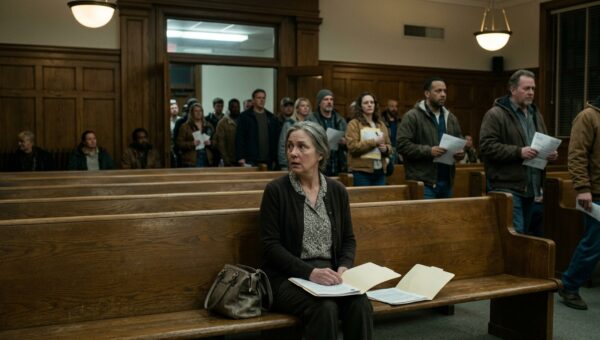
Twenty sets of eyes turned down the length of the white tablecloth. Aunt Clara looked down her nose at me with pinched lips. Cousin Greg stopped chewing his roll. Carol had already spent the last two days working the telephone lines, telling every relative who would listen that I was greedy, that I was trying to keep $236,000 that rightfully belonged to Daniel’s bloodline, and that I had never truly respected their family.
I sat very still. I did not yell. I did not knock over the iced tea.
I looked down at the twenty-year-old form Carol had brought to the restaurant. Then I looked Mark dead in the face.
“Where is my signature, Mark?” I asked.
Carol blinked once, her chin jerking back.
“What does your signature have to do with anything?” Mark scoffed. “Daniel signed it himself in 2005. His signature is right there, certified by human resources.”
“Because Daniel’s plan administrator called me at eight o’clock this morning with the exact same question,” I said, keeping my hands flat against the tablecloth. “And under federal retirement law, an old form means nothing if the wife never signed away her rights.”
PART 2
The table went completely quiet. The only sound was the hum of the steakhouse refrigerator in the service aisle behind us.
Aunt Clara leaned forward, her napkin balled in her fist. “Karen, don’t you talk legal talk at your husband’s homegoing meal. Daniel’s mother carried him into this world. If he wrote her name down, that was his wish.”
“Daniel filled this out when he was twenty-eight and living in his mother’s basement apartment,” I told the room. My voice was raspy from three days of crying, but it did not waver. “He was single. He put his mother down because he did not have a wife or children.”
Carol’s face tightened, two sharp red spots flaring on her cheekbones. She took the twenty-year-old paper off the table, held it against her chest, and pointed a manicured finger at me.
“He never changed it, Karen!” she said, her voice rising so fast that the waitress at the sideboard froze in her tracks. “He worked at Reynolds Machine for eighteen years after he married you. If he wanted you to have every penny of that retirement, he would have filed a new paper. He kept my name on that ledger for twenty years because he knew his brother and I took care of him before you ever showed up!”
“He didn’t need to file a new paper, Carol,” I said.
I reached into my black handbag sitting on the carpet by my feet. I pulled out my phone and a printed email that had arrived at seven-forty-five that morning from the human resources director at Reynolds Machine, a woman named Janice Vance who had known Daniel since their apprenticeship days.
“When Daniel died, the company initiated the standard survivor audit on his qualified ERISA retirement account,” I said. I laid Janice’s printed letter on top of Mark’s unsigned settlement agreement. “Janice pulled Daniel’s physical personnel folder from the vault on Tuesday. She found this 2005 form. And she immediately flagged it as legally void.”
Mark frowned, grabbing the printed email before his mother could touch it. “What does ‘void’ mean? Daniel’s signature is valid. He was of sound mind.”
“Under federal law, the Employee Retirement Income Security Act governs every 401(k) plan in this country,” I said, looking right at Mark. “The moment Daniel and I said our vows on September 20, 2008, I became his automatic, statutory primary beneficiary by law. A married employee cannot name a non-spouse beneficiary, not a mother, not a brother, not an outside trust, unless the legal spouse signs a formal Spousal Waiver of Benefits in the presence of a licensed notary public or a plan representative.”
I looked across at Carol.
“Did Daniel ever bring me a waiver to sign, Carol? Did you ever see my name on a notary stamp surrendering my survivor rights to his pension?”
Carol looked at Mark, waiting for him to contradict me with his gold pen. But Mark was reading Janice’s letter, his eyes tracking down the federal statutory citations Janice had copied into the text. His mouth parted slightly, the arrogant confidence draining right out of his collar.
“This says the company can’t pay the mother without a signed waiver,” Mark muttered under his breath, almost to himself.
“That’s right,” I said. “And there is no waiver, because Daniel never asked me for one. Because Daniel believed I was already listed on the company portal.”
PART 3
“That is a lie!” Carol snapped, slamming her open palm onto the table so hard her soup bowl rattled against the saucer. “Daniel knew what he was doing! You coerced the HR girl! You went down to that plant while my son was lying cold in the ground and you used your clinic connections to rewrite the company records!”
“Sit down, Carol,” my sister-in-law, Susan, muttered from the far end of the table. Susan was married to Daniel’s younger cousin, and she had spent three years caring for her own father through hospice. She knew how benefits worked. “The law is the law. Daniel was married. You can’t just cut a wife out with an old paper from 2005.”
“You stay out of this, Susan!” Carol yelled. She turned back to me, her eyes wet with rage and panic. “You think you’re going to take every dime he made? Two hundred and thirty-six thousand dollars! Mark needs that money to help cover the balloon mortgage on our family farm in Wayne County! Daniel promised his father before he died that he would protect that farm!”
The real truth finally fell onto the tablecloth.
It was never about Daniel’s wishes. It was never about a promise made over a kitchen table twenty years ago.
Mark had taken out an eighty-thousand-dollar second lien against Carol’s farm property three years ago to fund a commercial landscaping venture that had gone bankrupt within fourteen months. Daniel had told me about it last spring. He had come home from Sunday dinner with his hands shaking, telling me that Mark and Carol were begging him to pull money out of our home equity line to save the acreage.
Daniel had said no.
He told them he had a wife, a mortgage, and our own retirement to secure on forty dollars an hour.
“Daniel didn’t leave you that money to save Mark’s debts, Carol,” I said, my chest aching with the fresh memory of my husband sitting on our back steps, feeling the heavy, endless pressure his family put on him every time money got tight. “He worked forty-eight hours a week in a hot machine shop with coolant burning his forearms. He took every Saturday shift they offered so we could pay off our mortgage by the time he turned sixty. He was sixty-two days away from paying off the last balance on our roof.”
I reached across the table, took Mark’s gold pen, and picked up his three-page settlement agreement.
I did not sign my name.
I tore the paper in half, folded the two halves together, and tore them again. The thick white paper made a loud, clean ripping sound that filled the room.
I dropped the pieces into the center of Mark’s bread plate, right on top of his unfinished roll.
“You will not get half,” I told Mark. “You will not get ten percent. And if you or your mother ever call my house again claiming I stole from my husband, I will instruct Janice at Reynolds Machine to forward your settlement contract to the corporate legal team for attempted extortion.”
Mark didn’t say a word. He looked down at the torn papers on his plate, his face gray, his knuckles loose around his napkin.
Aunt Clara dropped her eyes to her soup. Cousin Greg cleared his throat, pushed his chair back slightly, and looked away toward the exit doors. The aunts and uncles who had spent the last two days treating me like an interloper suddenly had nothing to say.
Carol stared at me, her chest heaving under her black knit dress, but her hands were trembling so badly she could barely shove the 2005 form back into her purse.
“You were never one of us, Karen,” Carol whispered, venom dripping from every syllable. “Not from the day you put that ring on his finger.”
“You’re right, Carol,” I said, picking up my purse from the carpet and standing up from the table. “Because in my family, we don’t try to rob a widow over her husband’s memorial meal.”
ENDING
I didn’t stay for the pie or the coffee.
I walked out of the steakhouse into the cool afternoon rain, got into my ten-year-old sedan, and drove the four miles back to the split-level house on Miller Creek.
The house was completely dark when I opened the door. The smell of Daniel’s cedar woodshavings from his shop jacket was still hanging in the laundry room off the kitchen. His leather work boots were sitting on the boot tray by the back door, exactly where he had kicked them off on Saturday morning before heading out to the yard.
I sat down on the floor by his boots, pulled my knees to my chest, and cried until my ribs hurt.
The next morning at nine o’clock, I went down to the administrative offices at Reynolds Machine & Tool.
Janice Vance was waiting for me in the conference room with a warm mug of black coffee and the formal ERISA claims packet. She had the company’s regional legal counsel on speakerphone. Because no valid spousal waiver had ever been executed during our eighteen years of marriage, the plan confirmed that the 2005 pre-marital designation was void by operation of law.
The full balance, $236,412 with accumulated quarterly interest, was approved for a direct spousal rollover into my personal rollover IRA at First National Bank.
Carol and Mark never filed a petition in county probate court.
Their lawyer must have given them the exact same lesson on ERISA preemption that Janice gave me at the dining room table. Three months later, Mark had to put six acres of the Wayne County back pasture up for public auction to satisfy the bank’s note, but Carol kept the farmhouse and her garden.
Neither of them called to ask how I was doing on Thanksgiving, or on Daniel’s birthday in February.
That silence was the cleanest gift they ever gave me.
Last Saturday, the contractor came out to our house and finished the final warranty inspection on our new roof, the one Daniel had saved for dollar by dollar from his Saturday overtime shifts.
I stood on the back lawn in the morning sun, watching the cedar trees sway in the wind along the fence line.
I walked over to the shed, unlocked the padlock, and looked at Daniel’s riding mower sitting under its clean canvas tarp. On the shelf above the workbench was his metal toolbox, with his brass service pin from Reynolds Machine taped right inside the lid.
I reached up, touched the cold metal of his pin, and took a deep, clean breath.
Then I turned off the shed light, locked the door, and walked back inside my home.