PART 1
I am sixty-seven years old, and for the last eleven months, my Friday nights belonged entirely to my daughter, Megan.
Every Friday at four in the afternoon, she would pull into my driveway, leave the engine running, and drop off nine-year-old Toby and six-year-old Clara. She would lean through my kitchen door, kiss my cheek with hurried lips, and say the exact same thing: “Mom, you are an absolute lifesaver.
The firm has us buried under quarterly closing files again. I will be lucky if I get out before midnight.”
I never questioned her. Megan was thirty-eight, working as a senior logistics coordinator for a regional medical supply company. Her husband, Greg, worked in commercial HVAC sales and was frequently traveling county to county. They lived in a nice split-level three miles from me, but with mortgage rates, property taxes, and two growing kids, Megan always talked about how tight things were.
Because I wanted to help, I gave Megan one of my store cards. It was an authorized user card linked directly to my primary credit union debit checking account, specifically intended for the local regional supermarket chain where I do all my shopping. I keep a steady balance in that checking account from my late husband Arthur’s pension and my own modest Social Security. I told Megan, “Use this whenever you need to pick up school snacks, milk, or easy dinners for the kids on your way home.
Just don’t let the kids go hungry when your schedule gets crazy.”
She cried when I gave it to her last November. She hugged me and promised she would only touch it for real emergencies.
I trust my family. I do not sit on a computer every morning picking through my bank ledger line by line. I check my overall balance twice a month to make sure Arthur’s deposit cleared and my utility bills auto-drafted correctly. But two weeks ago, I received an alert on my landline answering machine from the credit union fraud department. A clerk named Brenda said there was an unusual pattern of recurring point-of-sale transactions categorized under hospitality rather than grocery retail.
I sat down at my small oak desk, put on my reading glasses, and logged into the credit union portal.
I did not find grocery charges.
Starting eleven months ago, almost every single Friday between five in the evening and six-thirty, my authorized grocery card had been run at the Pine Crest Motor Lodge, an extended-stay motel out near the industrial bypass by the interstate.
The charges were consistent: ninety-four dollars and fifty cents, week after week. Sometimes there was an extra charge of twelve dollars from the lobby vending machines, or twenty-six dollars from the adjacent roadside taproom.
In total, across forty-one Fridays, Megan had charged slightly over four thousand two hundred dollars to my account.
Not for groceries. Not for fruit cups, sandwich bread, or milk for Toby and Clara. For a budget motel room six miles from my front door.
While I was feeding her children homemade pot roast, helping Toby with his third-grade fractions, and tucking Clara under Arthur’s old wool throw blanket on my living room sofa, Megan was not buried under paperwork at her office. She was checking into a motel room under my name and on my dime.
My hands shook so hard I could barely hold the mouse. My first instinct was pure panic. Was my daughter in some kind of dangerous trouble?
Was she hiding from someone? Was she struggling with an addiction I had somehow missed? Or was she having an affair while Greg was out on sales calls, using her widowed mother as a free daycare service and an unwitting financial accomplice?
I did not call her. I did not send a furious text message. Arthur was a county records clerk for thirty-two years, and if he taught me anything before cancer took him four years ago, it was to never step into a dispute without paper in your hand.
On Thursday morning, I drove down to the main branch of the credit union. I had Brenda print out every single monthly statement going back twelve months. I took a yellow highlighter and marked every charge from Pine Crest Lodge. Then I drove over to the Pine Crest Lodge itself.
The motel was a drab, two-story brick building tucked behind a diesel service station. The young man behind the counter wore a faded polo shirt and looked bored. I laid my card and my driver’s license on the counter. I explained that I was the primary account holder and needed copies of the register receipts for tax and accounting reconciliation on these specific transaction dates. Because my name was the legal primary on the billing card and Megan was merely a secondary authorized user, the clerk pulled up the digital folios without hesitation and printed them out.
Every single check-in was timestamped between 5:15 PM and 5:40 PM on Friday nights.
I took the papers home, put them into a manila folder, and placed the folder inside my sideboard cabinet next to the good china.
I waited for Sunday dinner.
Sunday dinner was a long-standing routine. Megan, Greg, and the kids came over to my house every Sunday at five. I cooked, the kids played in the backyard, and Greg usually helped me carry the heavy trash cans out to the curb.
Yesterday was Sunday.
Dinner was roast chicken, buttered potatoes, and green beans. Greg sat at the far end of the table, quiet as usual, cutting chicken for Clara. Megan sat across from me, scrolling through her phone between bites, complaining about her supervisor and how exhausted she felt.
“Mom,” Megan said, putting her fork down and giving me a tired smile. “Before I forget, can you take the kids again this coming Friday? The regional director is coming in from Chicago, and we have a mandatory audit prep that might run until nine or ten.”
The room was quiet except for the hum of the refrigerator.
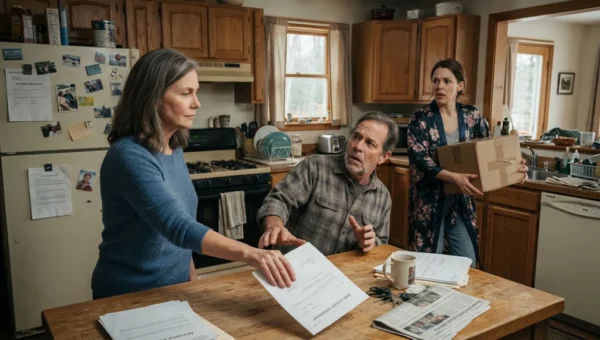
I did not raise my voice. I reached down to the floor beside my chair, picked up the manila folder, opened it, and pulled out the top receipt from Pine Crest Motor Lodge dated October 3rd.
I slid it across the tablecloth until it stopped directly against Megan’s water glass.
Megan looked down. I saw her eyes hit the motel logo, then the amount, then the timestamp. The color drained from her face so completely that her lips turned gray.
She did not speak. She froze, her hand hovering above her napkin.
I opened my mouth to ask her who she was meeting in that room while I wiped her children’s faces and read them bedtime stories.
Before I could get a single word out of my throat, Toby looked up from his mashed potatoes. He looked at the receipt, then looked across the table at Greg, and said in a clear, completely innocent child’s voice:
“Grandma, Dad already knows. He goes there too.”
I turned my head and looked at my son-in-law. Greg did not drop his fork. He did not look surprised. He just looked down at his plate, his jaw clenched tight, refusing to meet my eyes.
I turned back to Megan. Her hands had started to tremble against the table edge, and the first thing that came out of her mouth was:
“Mom, please don’t look at me like that. We had to have somewhere to go.”
PART 2
“Somewhere to go?” I repeated. The air in my dining room felt thin, like someone had sucked all the oxygen out of the space between our chairs. “You had somewhere to go. You have a four-bedroom house three miles down the road. And you have my credit card, which was given to you so Toby and Clara would have food.”
Toby shrank back into his chair, sensing the sudden shift in the room. Clara stopped swinging her legs under the table and reached out to hold her brother’s sleeve.
“Toby, sweetie,” I said, keeping my voice as level as I could manage for the sake of the children. “Take your sister into the living room and turn on the television. Put on that cartoon movie you both like.”
Toby did not argue. He slid off his chair, took Clara by the hand, and led her out. The heavy pocket door between the dining room and living room clicked shut behind them. A moment later, the low, muffled sound of an animated movie filtered through the wood.
I looked directly at Greg. “Your son says you go there too. Are you going to look at me and explain what my grandson is talking about, Greg? Or are you going to let your wife sit there and lie about mandatory office audits?”
Greg rubbed the back of his neck with a calloused hand. He had the exhausted, worn-out posture of a man who had been carrying something heavy for far too long, but there was no shock on his face. Only deep shame.
“I didn’t want her using your card, Evelyn,” Greg said quietly, his voice raspy. “I told her six months ago that if you ever looked at the statement, it would kill you. But she swore she was covering it out of her own side funds and that the grocery account was just a buffer.”
“A buffer?” I pulled the entire stack of statements from the manila folder and dropped them in the center of the table with a hard slap. “Four thousand two hundred dollars, Greg. That is not a buffer. That is four months of Arthur’s pension. That is my property tax payment and my winter heating oil. You two make over one hundred and forty thousand dollars combined. What in God’s name are you doing renting a ninety-four-dollar motel room behind a truck stop every Friday night?”
Megan let out a ragged breath and pressed both palms against her forehead. “We are not cheating on each other, Mom. If that’s what you think, we’re not.”
“Then what are you doing?” I demanded.
“We sleep,” Megan whispered.
I stared at her. “You sleep.”
“We check in at five-thirty, we turn off our phones, we lock the door, and we sleep until eleven o’clock,” Megan said, tears finally spilling over her eyelids and running down her cheeks. “Then we get up, we get in our separate cars, we drive over here, we pick up the kids, and we go home.”
The explanation sounded so absurd, so utterly disconnected from the reality of a four-thousand-dollar theft, that for a second I thought she was mocking me. “You stole four thousand dollars from your widowed mother so you could take a nap?”
“It’s not just a nap, Mom!” Megan’s voice rose, cracking with frustration. “You have no idea what our house is like right now. You have no idea what kind of mess we are in!”
“Megan, don’t,” Greg warned, shaking his head.
“No, Greg, she already has the receipts! What else are we going to tell her?” Megan turned toward me, her face blotchy and red. “Last year, when Greg’s brother lost his contracting business, Greg co-signed a sixty-thousand-dollar commercial equipment loan for him. Without telling me. His brother defaulted in January. The bank came after our personal accounts. They put a lien against our checking, they froze our secondary savings, and Greg’s commission checks have been garnished thirty percent every single month since March.”
I turned to Greg. His face was entirely red now, his eyes fixed on the grain of the dining table.
“Is that true?” I asked him.
“Yes,” Greg said barely above a whisper. “Keith was going to lose his house. He swore the jobs were lined up and he just needed thirty days of bridge financing. The jobs fell through. The lenders attached my wages. We couldn’t make the payments on our credit cards, so the interest skyrocketed to twenty-nine percent. We have collection agencies calling the house forty times a day. Morning, noon, and night. They call our cell phones. They call the landline. They send certified letters. Every time the doorbell rings, Megan has a panic attack thinking it’s a process server.”
“We haven’t slept a full night in eight months, Mom,” Megan sobbed, burying her face in a paper napkin. “Our house feels like a prison. Every room is filled with unpaid bills and envelopes we’re afraid to open. We fight constantly. We scream at each other until the kids cry. By Friday afternoon, my chest is so tight I can’t breathe. I was having panic attacks in the bathroom at work.”
She looked up at me, her eyes pleading for sympathy.
“The first time happened in November,” Megan said. “Greg had been traveling all week, his paycheck came back short because of the garnishment, and our furnace had stopped working. I pulled into the motel parking lot after dropping the kids here because I literally could not drive home without hyperventilating. I just wanted a dark room where no one could call me. I didn’t have enough room on my personal debit card because the account was overdrawn. So I used the grocery card. I intended to transfer the money back that weekend. But then the mortgage payment bounced, and I couldn’t.”
She reached across the table, trying to touch my hand. I pulled my hand back into my lap.
“Then two weeks later, Greg was home,” Megan continued, her voice trembling. “We were screaming at each other in the kitchen while the kids were at school. Greg broke down. He was crying so hard he couldn’t stand up. I told him about the room. I told him we could just go there for five hours on Friday while you had the kids. Just five hours of silence. No phones. No debt collectors. No kids asking why the internet was shut off. Just five hours where we could pretend our lives weren’t completely falling apart.”
I sat in my chair, looking at my daughter and the man she had chosen to marry.
Part of me—the mother part that had spent thirty-eight years bandaging scraped knees and worrying over fevers—felt a momentary ache for the sheer terror they were living under. Debt is a vicious, suffocating animal. I knew what it was like to count pennies; Arthur and I had lean years early in our marriage when the county cut hours and winter heating bills doubled.
But as I looked at the yellow-highlighted receipts spread across my dining table, the ache hardened into a cold, immovable stone.
“You had panic attacks,” I said, my voice dangerously calm. “You had debt collectors calling. And your solution was to let your retired mother pay for your sanctuary.”
“Mom, I was going to pay it back—”
“With what, Megan?” I cut her off. “With what money? You just finished telling me your savings are frozen, your husband’s wages are garnished by thirty percent, and you are drowning in twenty-nine percent credit card debt. You were never going to pay this back. You spent ninety-four dollars every Friday for forty-one weeks because it was easy. Because Grandma was in the kitchen frying chicken and keeping the children safe, and Grandma doesn’t look at her bank statements closely.”
“I didn’t know she was using your card at first, Evelyn,” Greg said, his voice cracking with genuine misery. “When she told me in the spring, I told her it was wrong. But I was so tired. God help me, I was so tired I just let it happen. That’s not an excuse. It’s the truth. I was weak, and I let my wife steal from you because I wanted five hours of quiet.”
“Don’t call it weak, Greg,” I said. “Call it what it is. It’s theft. And worse than that, it’s betrayal.”
I stood up from the table. Both of them looked up at me, terrified of what I was going to do.
“Pack up the kids’ coats,” I told them. “Dinner is over.”
PART 3
Megan stood up quickly, knocking her chair back against the sideboard. “Mom, please. Don’t throw us out like this. Let us talk through this. We can set up a repayment plan. I will give you fifty dollars a week out of my grocery budget—”
“You don’t have a grocery budget, Megan,” I said flatly. “You’ve been using mine. Go into the living room, get Toby and Clara, and take them home.”
Greg stood up too. He reached for Megan’s arm, gently pulling her back. “Megan, stop. She’s right. Just get the kids.”
It took five minutes for them to gather their things. Toby looked at me with wide, worried eyes as he zipped up his jacket. He knew something was terribly wrong, even if he didn’t understand the legal mechanics of it. He had known about the motel because children are not blind; he had probably seen a keycard in Greg’s truck console, or heard them mention the name Pine Crest when they thought he was playing video games with his headphones on.
I bent down and kissed Toby’s forehead. “I love you, Toby. Grandma will see you soon, okay?”
“Did I say something bad at dinner, Grandma?” he whispered, his lower lip quivering.
My heart broke right there in the entryway, but I kept my voice steady. “No, sweetheart. You told the truth. Telling the truth is never bad. You did nothing wrong.”
I kissed Clara, handed her little pink backpack to Greg, and opened the front door.
Megan tried to linger on the porch, her eyes pleading, but Greg took her elbow and guided her down the concrete steps toward their SUV. I locked the front door, turned off the porch light, and stood in the silent foyer for a long time.
I did not sleep that night.
I sat at my kitchen table with Arthur’s old legal pad and a calculator. Four thousand two hundred dollars was not going to put me on the street, but it represented the entirety of my emergency home repair fund—the money meant to replace my water heater and repaint the exterior trim this coming spring. More than the money, the foundation of my relationship with my daughter had cracked down the middle. If she could look me in the eye every Friday afternoon, kiss my cheek, hand me her children, and drive straight to a motel room on my dime while spinning elaborate lies about corporate audits, what else had she lied about?
By Monday morning at eight-thirty, I was sitting in the office of Warren Gable. Warren had been Arthur’s personal attorney and friend for thirty years. He was seventy-one, sharp-eyed, and knew every inch of county property and debt law.
I laid the credit union statements and the Pine Crest folios on his desk. I explained the entire situation, including the garnished wages, Greg’s co-signed equipment loan, and Toby’s comment at the dinner table.
Warren reviewed the paperwork in silence, tapping a gold pen against his blotter.
“Legally, Evelyn, Megan was an authorized user on that card,” Warren said carefully. “You gave her the plastic. That makes criminal fraud charges difficult to pursue unless you want to file a formal police report alleging unauthorized scope of use against your own daughter. But practically speaking, the credit union will not reimburse you because you authorized her on the account. That loss is yours.”
“I don’t want Megan in jail, Warren,” I said, my voice firm. “I don’t want my grandchildren visiting their mother through glass. But I will not be a victim in my own family, and I will not let them drag me down into their financial grave.”
“Then you have to protect yourself immediately,” Warren said. “If Greg’s brother’s creditors have already secured a judgment and garnished his wages, they can eventually move against personal property. If Greg and Megan default entirely, they will likely be forced into Chapter 7 or Chapter 13 bankruptcy within the next twelve months. If you give them money, loan them money, or leave your assets unprotected, you are throwing cash into a burning furnace.”
Warren outlined three non-negotiable steps.
First, I had to revoke Megan’s authorized user status on every account immediately and notify the credit union in writing.
Second, I had to secure my own estate. My will currently left my house and all remaining savings equally to Megan and her brother David, who lived in Oregon. Warren advised me to restructure my estate into an irrevocable trust, ensuring that Megan’s eventual share would be held in a spendthrift trust managed by David, specifically insulated from her creditors and Greg’s legal debts.
Third, Warren told me how to handle the four thousand two hundred dollars.
“Do not accept a fifty-dollar-a-week promise,” Warren said. “She will make three payments and stop when the next utility shut-off notice arrives. If you want that money back, and more importantly, if you want them to understand the gravity of what they did, you require a formal, legally binding promissory note secured against a tangible asset. Or you deduct it directly from any future assistance or inheritance.”
I left Warren’s office and drove straight to the credit union. I had Brenda cancel the secondary card in Megan’s name. I had new account numbers issued for my checking and savings accounts. I changed my online banking credentials and set up daily text alerts for any withdrawal exceeding fifty dollars.
Then I drove to Megan and Greg’s house.
It was eleven in the morning. Both of their cars were in the driveway. Megan had taken a personal day from work; Greg was sitting on the front porch steps in an old gray sweatshirt, staring at the lawn.
When he saw my sedan pull up to the curb, he stood up. He didn’t run inside. He waited at the bottom of the steps.
“Evelyn,” he said, his voice flat and tired.
“Is Megan inside?” I asked, carrying my leather purse and a single manila envelope.
“Yeah. She’s in the kitchen.”
We walked inside together. The house was clean, but the tension was thick enough to taste. On the kitchen counter sat three laundry baskets filled with unfolded clothes, and on the small desk in the corner, a stack of opened envelopes with red collection notices was plainly visible.
Megan was sitting at the table with a mug of black coffee. Her eyes were swollen from crying. When she saw me walk in, she stood up quickly.
“Mom,” she said, her voice shaking. “I’m so sorry. I didn’t sleep at all. I called the credit union this morning to see how much I owed to pay it off, but they told me the card was canceled.”
“I canceled it,” I said, sitting down at the end of the table and placing my envelope in front of me. “Sit down, Megan. Sit down, Greg.”
They both sat.
“I spent two hours with Warren Gable this morning,” I told them. “I know exactly what legal position you are in. I know that Greg’s brother’s default means you are likely heading toward bankruptcy if the garnishment continues. And I know that four thousand two hundred dollars was stolen from my account over forty-one weeks.”
“Mom, please don’t call it stealing—” Megan started, her voice breaking.
“It is stealing, Megan!” I snapped, my voice ringing off the kitchen cabinets. “You took money meant for your children’s food and used it to buy yourself a five-hour escape from your own mistakes! You lied to my face every single Friday for almost a year! You made me complicit in your deceit while I cooked meals for your son and daughter! Do not sugarcoat it with soft words!”
Megan shrank back, tears streaming down her face. Greg reached out and put his hand on her shoulder, but he did not defend her.
“Here is what is going to happen,” I said, opening the envelope and pulling out the documents Warren had drafted for me. “I am not calling the police. I am not filing a theft report. I am doing that for Toby and Clara, not for you.”
Megan let out a shuddering breath of relief, but I held up my hand to stop her.
“Do not thank me yet,” I said. “Because our relationship as it existed is completely over.”
ENDING
The silence in the kitchen was absolute.
“Here are my conditions,” I said, laying the papers out one by one. “First, you will sign this formal promissory note. The balance is four thousand two hundred and twelve dollars and fifty cents. The interest rate is zero percent, but the note requires a mandatory payment of one hundred and fifty dollars on the first of every month, beginning December first.”
“Mom, one hundred and fifty is hard right now—” Megan began.
“Then you will sell something,” I said without an ounce of hesitation. “You will sell that riding mower in your garage that Greg uses twice a month. You will cancel your streaming subscriptions. You will pack your lunch every single day for work. If a payment is missed by more than five business days, Warren Gable will immediately file this note with the county court as an uncontested confession of judgment. That means it becomes a formal legal judgment against this house.”
Greg looked at the document, picked up a pen from the counter, and signed his name on the line marked Co-Borrower.
“Greg!” Megan gasped.
“Shut up, Megan,” Greg said quietly, his voice harder than I had ever heard it. “Sign it. She’s giving us a way out of a criminal charge. Sign the paper.”
Megan looked at her husband, then looked down at the document. Her hand shook so violently that her signature was jagged and broken, but she signed it.
“Second condition,” I continued, sliding the signed note back into my envelope. “I will not watch Toby and Clara on Friday nights. Not this week. Not next week. Not for the foreseeable future.”
Megan gasped as if I had struck her. “Mom, no! Please! The kids love being with you on Fridays! They look forward to it all week! It’s our only time to catch our breath—”
“You lost the right to catch your breath on my time when you turned my house into an alibi for your motel runs,” I said. “If you need a break on Friday nights, you will sit in your living room with the television off and face each other. You will talk to each other. You will figure out how you are going to survive the mess you made. If you need childcare while you work overtime, you can ask Greg’s mother or pay a neighborhood teenager. But my home is no longer your staging ground.”
“Mom, please don’t punish the kids for this,” Megan wept.
“I am not punishing the kids,” I said, looking her squarely in the eye. “I am teaching them, through you, that actions have consequences. Toby knew you were going to that motel, Megan. Think about that. Your nine-year-old son was carrying the burden of your secret in his head while he ate dinner at my table. You put that weight on a child’s shoulders so you wouldn’t have to face your bills.”
She covered her face with her hands and began to sob openly.
“I will still see my grandchildren,” I added, softening my voice just enough to let them know I was not abandoning the children entirely. “I will pick them up from school on Tuesday afternoons, take them to the park or the library, help them with their homework, and bring them back here by six o’clock. But I will not set foot in this house for social visits, and you will not drop them off at my front door on weekends until that promissory note is paid in full.”
Greg took a deep breath, looked at me, and nodded. “Thank you, Evelyn. You’re being fairer than we deserve.”
“I am being fair to myself, Greg,” I answered. “Something Arthur should have taught me to do a long time ago.”
I stood up, zipped my purse, and walked out the front door.
That was six months ago.
Greg followed through. He sold his riding mower, his hunting rifle, and a set of professional diagnostic tools he rarely used, raising enough cash to make the first three payments immediately. Every month since then, an envelope containing a cashier’s check for one hundred and fifty dollars has arrived in my mailbox by the twenty-eighth of the month. I do not cash them into my regular checking account; I deposit them directly into a separate high-yield certificate of deposit that I opened in Toby and Clara’s names for their future college expenses. Megan and Greg do not know that, and I do not intend to tell them.
In February, Greg and Megan officially filed for Chapter 13 bankruptcy protection. The judgment against Greg’s brother’s loan was consolidated into a structured five-year repayment plan. The collection calls finally stopped because federal bankruptcy law prohibits creditors from harassing debtors once an automatic stay is issued.
They are living under a brutally strict court-supervised budget now. There are no vacations, no takeout meals, and no ninety-four-dollar motel rooms. Megan lost fifteen pounds from stress, and she looks older now, her hair showing gray at the temples that she can no longer afford to dye at a salon.
Our relationship is not what it used to be. It may never be.
On Tuesdays, I pick up Toby and Clara from school just as I promised. We go to the local public library, we sit in the children’s section, and we read books together. Toby’s grades have improved, and Clara smiles more than she used to, mostly because the screaming matches in their home have quieted down now that the bankruptcy court has forced their parents to confront their numbers on paper.
When I drop the children off at six o’clock on Tuesday evenings, Megan always comes to the front door. She stands on the threshold, her hands folded in front of her cardigan.
“Thank you, Mom,” she always says, her voice quiet, subdued, and respectful.
“You’re welcome, Megan,” I reply from the porch steps.
She always pauses, looking at me as if she wants to invite me inside for a cup of tea, or ask if she can hug me. But she never does. She knows the line has been drawn, and she knows who drew it.
I walk back to my car, get in, and drive home to my quiet house.
It hurts to see your child struggle, and there are nights when I sit in Arthur’s armchair and wonder if I was too cold, too unyielding, or too harsh. But then I remember the feeling of that slick motel receipt between my fingers, and the innocent sound of my grandson’s voice across the dinner table.
Forgiveness is not the same thing as permission to be used. I loved my daughter enough to raise her, but I respect myself enough to never let her make me a fool again.