The afternoon heat had that dry, heavy stillness that clings to the pavement long after the sun has peaked over the Bakersfield foothills. I was standing in my kitchen wiping down the laminate counters with a damp rag when the delivery van crunched down the gravel drive. It left behind a small brown cardboard box resting against the screen door.
I didn’t think much of it until I picked it up and saw the name. The last name was correct, but the street and house number belonged to a neighborhood clear across town. Fourteen miles away, out near the old canal road where the tracts all look like they were stamped out from the same gray mold.
I almost set it on the porch table for Michael to deal with when he came over for his Thursday night dinner. But Michael was working late at the district warehouse again, the way he always did on Tuesdays and Thursdays, and I figured I had the time to spare. My little sedan started up with its usual rattle, and I tossed the package onto the passenger seat next to my purse. I don’t even know why I bothered. I could have left it at the post office or let the carrier sort it out the next morning.
But I wanted to be helpful. I thought I was being a good neighbor.
The drive took about twenty minutes through the grid of identical stucco houses and dusty lawns. When I pulled up to the address on the label, the driveway held a blue minivan with a faded bumper sticker and a child’s plastic scooter tipped on its side near the grass. I walked up the two concrete steps and rang the bell. Through the frosted glass of the front door, I heard the faint clatter of pots and the muffled sound of a cartoon playing on a television set.
A woman opened the door, wiping her hands on a floral kitchen towel. She had tired eyes and hair pulled back in a loose clip, looking like she was right in the middle of getting dinner together for a couple of hungry kids. She looked at me, then down at the brown box in my hands.
Before I could even open my mouth to explain about the wrong address, my eyes dropped to her left hand resting against the doorframe.
A diamond solitaire caught the afternoon sun slanting through the porch overhang. It wasn’t just any ring. The split band, the six-prong setting, the particular way the small baguettes tapered down the side. It was the exact twin of the $6,200 Zale’s engagement ring sitting on my own ring finger right now. I bought that design with him. Or rather, I was sitting right across the glass counter when he put his card down, telling me how hard it was to find something special after what happened before.
She followed my gaze down to her hand, and a small, easy smile touched her mouth. She didn’t look suspicious. She just looked like a mother dealing with a minor errand. “Oh, Michael must have used the wrong address again,” she said, shaking her head. “He’s always doing that with his online orders.”
I froze. The rag in my purse seemed to weigh a ton. “How do you know Michael?” I asked. My voice sounded thin, like it belonged to someone else standing ten feet behind me.
She let out a short, easy laugh, completely relaxed. “He’s my husband. We’ve been married eleven years.”
The front door seemed to tilt on its hinges. I didn’t drop the box, but my fingers dug into the cardboard until the seams buckled. Slowly, deliberately, I raised my left hand and held it up in the harsh Bakersfield light.
The smile on her face didn’t fade all at once. It just dissolved, piece by piece, until her mouth stayed slightly open and her eyes went completely blank. She looked from my ring to her own, back and forth, as if she were trying to solve a math problem that made no sense at all.
She whispered, “He bought you the same ring?”
I stared at her, my throat tight and dry. “He told me you were dead.”
She didn’t scream. She didn’t yell. She just grabbed the edge of the screen door and gripped the wire mesh until her knuckles turned white. “He told you I died?” Her voice dropped to a flat, dangerous register. “When did he say that happened?”
“Two thousand nineteen,” I said, the words tasting like ash. “Breast cancer. He cried every time he talked about her. I believed every single tear.”
Behind her in the hallway, a little boy’s voice called out from the kitchen, asking when macaroni would be ready. The woman did not turn around. She just stood there in the doorway, staring at me with a terrifying kind of clarity settling over her face. Her name was Sarah. I found that out five minutes later when she invited me inside, pushed the front door shut against the heat, and we sat at a chipped Formica kitchen table while her two children watched cartoons in the next room.
We didn’t yell. We didn’t throw things. We just laid out the timeline. Sarah pulled up bank statements, tax papers, and wedding albums on her phone, while I recited the three years of holidays I spent alone in my apartment while Michael was supposedly visiting his mother in Fresno or working late inventory checks at the regional depot. The lies fit together like tongue and groove. Every missed weekend, every sudden phone call he had to walk outside to take, every carefully curated excuse about why he couldn’t move in with me yet. He had partitioned his life with the precision of an accountant. Two homes, two routines, two sets of anniversaries, funded by the same salary and managed with a cold, staggering indifference to us both.
When I drove back to my house fourteen miles away, my hands were shaking so hard on the steering wheel I could barely keep the car in the lane. I didn’t cry. There was no room for tears yet, just a hard, cold knot in my chest that kept tightening with every mile.
By six o’clock, my phone buzzed on the kitchen counter. It was Sarah. We spoke for less than a minute. The plan was already made.
Michael walked through my front door at precisely 7:15 pm, smelling faintly of the sandalwood soap he always used before coming over. He carried a small white paper bag from the bakery down on Chester Avenue, his usual Thursday night peace offering. He tossed his keys onto the little wooden bowl by the door, took off his jacket, and smiled that warm, familiar smile that used to make me feel like I was the only person in the world who mattered to him.
“Hey, beautiful,” he said, walking over to kiss the top of my head. “Rough day at the yard. Traffic was a nightmare on the bypass.”
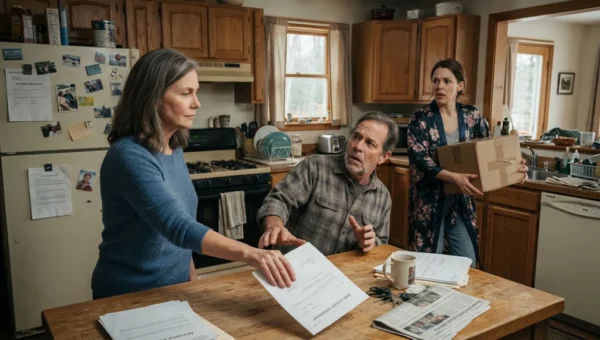
I didn’t move from the kitchen island. I had my arms crossed tight over my chest. On the dark wood surface right between us sat two identical small velvet boxes, opened up, with the two $6,200 Zale’s rings catching the overhead light.
Michael stopped dead in his tracks three feet from the counter. The color didn’t just drain from his face; it felt like the life went out of him all at once. His mouth opened to say something, but no sound came out. He looked at the rings, then up at me, and then toward the hallway where the front door was.
The heavy front door clicked open. Sarah walked into the living room, her car keys dangling from her fingers. She didn’t look angry. She looked calm, exhausted, and entirely finished.
Michael took half a step backward, his back hitting the refrigerator. The performance was gone. The grieving widower, the hardworking provider, the gentle man who cried over old memories. All of it vanished, leaving behind a small, cornered man in a wrinkled shirt who suddenly realized his arithmetic didn’t add up anymore.
“You left the Amazon box at the wrong house, Michael,” Sarah said, her voice steady and quiet in the small kitchen. “Though I suppose you’ve been mixing up your addresses for years.”
He stammered something about logistics, about stress, about how it wasn’t what it looked like, his hands twitching at his sides as he tried to reach out to touch my arm. I stepped back. I didn’t want him anywhere near me. The words he used didn’t even sound like an excuse anymore; they sounded like static noise from a broken radio. Neither of us shouted at him. We didn’t have to. The silence in that room was heavier than any screaming match could ever be.
When he finally realized that neither of us was listening, that every door he had built was locked from the outside, he slumped against the fridge and covered his face with his hands. There were no tears this time. Just a pathetic, hollow silence.
I reached down to my left hand, pulled off the $6,200 Zale’s engagement ring, and laid it quietly on the wood table next to the other one. I unhooked my house key from the ring on my key chain, dropped it right beside the velvet boxes, and picked up my purse. Without looking back at him once, I walked out the front door, down the steps, and into the cool evening air.