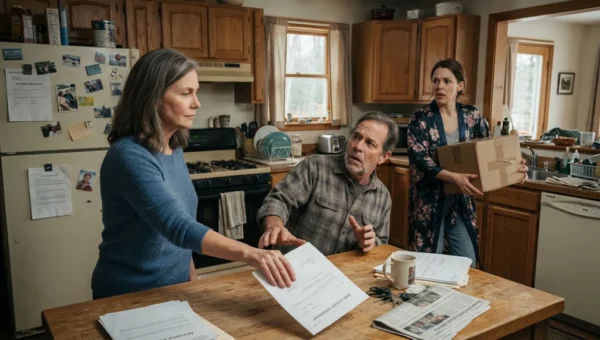
My daughter-in-law brought back three dresses I had sewn for my granddaughter and laid them across my kitchen table like evidence.
“Please stop making these for Sophie,” she said. “She’s embarrassed.”
I touched the yellow one first. I had stitched tiny white daisies along the hem because Sophie had picked that fabric herself two months earlier.
“She told you that?” I asked.
Melissa folded her arms.
“She’s nine. She doesn’t want to hurt your feelings.”
I nodded and put the dresses in a shopping bag.
Three weeks later, Sophie’s school called and asked whether I would come teach her class how to make a French seam.
The teacher said, “Sophie told us her grandmother makes all her favorite dresses.”
That was how I learned my granddaughter was not ashamed of my sewing.
Her mother was.
My name is Joanie. I am sixty-six years old, and I have been making clothes since I was twelve.
My mother taught me on a black Singer machine that had to be kicked underneath before the pedal would catch. I made my prom dress. I made my sister’s maternity tops. I made my son Peter a dinosaur costume so sturdy that three boys wore it before the tail finally fell off.
I never called myself a designer.
I sewed because cloth made sense to me.
If a piece was too short, you knew. If a seam pulled, you could see where. If two things did not fit, you did not blame the fabric and insist it should try harder.
People are more complicated.
Melissa married Peter eleven years ago. She was polite to me from the beginning, which is not the same thing as liking me.
I was careful with her because I did not want to become the mother-in-law who treats every difference like disrespect.
Melissa bought organic soap. I bought whatever was on sale.
She liked white kitchens and clear counters. I had canisters with roosters on them and a bowl by the phone full of buttons nobody had needed since 1998.
She was not wrong to like what she liked.
The trouble started when she decided Sophie should like the same things.
Sophie loved color.
When she was five, she asked me to make a purple skirt with pockets big enough for rocks. When she was six, she wanted pajamas covered in planets. At seven, she asked for a red cape and wore it to the grocery store while Peter pretended not to know us.
Melissa used to smile at that.
Then Sophie transferred to Whitmore Academy.
Whitmore was a private school Peter and Melissa could barely afford. Peter’s company gave partial tuition assistance, and Melissa said the school would open doors.
I did not argue. It had small classes, good teachers, and a library bigger than the one in my town.
But after Sophie started there, things changed.
The first dress Melissa returned was navy with tiny strawberries.
“It’s too childish,” she said.
Sophie had chosen the strawberries.
The next time, Melissa called before a birthday party.
“Could you not send her in anything homemade today?”
I was quiet long enough that she added, “It’s a country club thing. I don’t want her feeling different.”
“She is wearing jeans.”
“Oh. Good.”
I looked at Sophie, who was standing beside me with a patchwork purse she and I had made from my old scraps.
I said, “Do you want to leave the purse here?”
Sophie hugged it against her chest.
“No.”
“Then take it.”
Melissa did not say anything when she picked her up, but the purse did not come back with Sophie that evening.
“What happened to it?” I asked.
“Mom put it somewhere safe.”
That answer bothered me.
I did not push because Sophie was eight and children should not be asked to referee adults.
I started sewing less for her.
Then, in March, she came over for a Saturday while Peter and Melissa attended a work event.
I took her to the fabric store.
“Pick anything,” I said.
She walked past glitter, unicorns, florals and cartoon prints. She stopped at a bolt of yellow cotton with tiny white flowers.
“This one.”
“What do you want it to be?”
“A dress with the buttons down the back.”
“That is a lot of buttons.”
“I can do them.”
“You will do two and ask me to do the rest.”
She grinned. “Probably.”
We made the dress together over three weekends.
Sophie learned how to pin without stabbing me. She learned that you press a seam before you call it finished. She learned the sewing machine did not care if she was impatient.
She wore the dress home the third Sunday.
Melissa looked at it and went still.
“Oh,” she said.
Sophie twirled once.
“Grandma let me do the pockets.”
Melissa smiled at her daughter.
“That’s nice, sweetie.”
Then she looked at me.
“We talked about this.”
“No,” I said. “You told me not to send homemade clothes to one birthday party.”
“You know what I meant.”
I did know.
I wanted her to say it anyway.
“What did you mean?”
Peter was loading Sophie’s overnight bag into the car. He heard the question and came back toward us.
Melissa lowered her voice.
“I mean she is at an age where fitting in matters.”
Sophie looked from one of us to the other.
I said, “Go get the book you left in the den.”
She ran inside.
When the door closed, I asked, “Has someone at school made fun of her clothes?”
Melissa rubbed her temple.
“Not exactly.”
“Then exactly what?”
“There are comments.”
“From children?”
She did not answer.
“From parents?” I asked.
Peter said, “Mom.”
“What?”
“Don’t make this a thing.”
I looked at my son.
That sentence had become popular in their marriage.
I said, “If somebody is making Sophie ashamed of something she likes, it is already a thing.”
Melissa’s face tightened.
“No one is making her ashamed.”
“Then why am I being told to stop?”
Before she could answer, Sophie came back with her book.
The conversation ended.
For two weeks, I heard nothing about the dress.
Then Melissa arrived at my house with a bag.
She took out the yellow dress, the planet skirt, and a blue jumper I had made the previous winter.
“Please stop making these for Sophie,” she said.
I touched the yellow dress.
“She told you she does not want them?”
“She’s embarrassed.”
“Did she use that word?”
Melissa’s jaw tightened.
“You are putting me in a position where I have to betray something my daughter told me.”
That was a clever sentence.
It made asking a follow-up sound cruel.
So I did not.
I put the dresses in the bag.
“All right.”
Melissa looked surprised.
“That’s it?”
“That is what you asked.”
“I don’t want you mad.”
“I am not discussing my feelings about this with you right now.”
She nodded.
Then she said, “Thank you for understanding.”
I did not say that I understood.
For the next three weeks, I sewed nothing for Sophie.
She came over twice and asked whether we could work on something.
“I’m taking a break,” I told her.
“From sewing?”
“From making clothes.”
“Why?”
“I have enough dresses in the world for a while.”
She looked at me carefully.
Children know when an answer has been ironed too flat.
But she did not press.
Then Whitmore Academy called.
The woman introduced herself as Ms. Feldman, Sophie’s fourth-grade teacher.
“We’re doing a unit on family skills and trades,” she said. “Sophie is presenting on sewing. She said you taught her.”
“I did.”
“She brought in a sample of hand finishing that was honestly better than anything I could do.”
I smiled.
“She likes small stitches.”
“She also said you know something called a French seam.”
“I do.”
“Would you be willing to come in for forty-five minutes next Thursday? We’re inviting family members to demonstrate.”
I almost said yes immediately.
Then I remembered the bag on my kitchen table.
“Did Sophie ask you to call me?”
“She put your name first on the form.”
“What did she say about the clothes I make her?”
There was a pause.
Ms. Feldman answered carefully.
“She said you make her favorite dresses.”
I sat down.
“Did she say she is embarrassed by them?”
“No.”
The answer was simple.
I thanked the teacher and told her I needed to check with Sophie’s parents before committing.
Then I called Peter.
He was at work.
“Mom, can this wait?”
“No.”
I told him about the school call.
He was quiet.
“I didn’t know about the form,” he said.
“Your wife told me Sophie was embarrassed.”
“I know.”
“Do you believe that?”
He exhaled.
“I think Melissa was trying to protect her.”
“From what?”
“Some of the moms there can be judgmental.”
“About homemade clothes?”
“About everything.”
“And Sophie?”
“She likes what you make.”
I closed my eyes.
“You knew.”
“Mom.”
“You knew she liked them.”
“I knew she liked some of them.”
“Peter.”
He went quiet.
Finally, he said, “Melissa is worried people will think we can’t afford things.”
There it was.
Not Sophie’s embarrassment.
Hers.
I had spent three weeks believing my granddaughter had outgrown something we loved doing together because two adults found it easier to use a child’s name than admit their own shame.
“Tell Melissa I am going to the school Thursday if Sophie still wants me there.”
“Mom, please don’t embarrass her.”
I almost asked which her he meant.
Instead I said, “I am going to teach a seam.”
Melissa called that evening.
Her voice was controlled.
“Peter told me you spoke.”
“He did.”
“I wish you had come to me.”
“I did. Three weeks ago. You told me Sophie was embarrassed.”
“She is too young to understand social dynamics.”
“That is different from being embarrassed.”
Melissa was silent.
I continued.
“If you do not like the clothes I make, tell me you do not like them. If you do not want her wearing them to certain events, say that. Do not put your opinion in Sophie’s mouth.”
“You’re making me sound shallow.”
“I am telling you what you did.”
“You have no idea what that school is like.”
“Then tell me.”
Her voice cracked slightly.
That was the first sign this was not only snobbery.
She told me about a mother who asked whether Melissa shopped consignment because Sophie wore “so many one-of-a-kind things.” She told me about a fundraiser where another woman complimented a coat and then asked if it was “one of Grandma’s little projects.” She told me she had overheard two parents discussing who could afford the school and who was there on assistance.
“We are there on assistance,” I said.
“I know.”
“Is that shameful?”
“No.”
“Then why are you teaching Sophie to hide anything that might make people guess it?”
Melissa began crying.
“I don’t want her to be the kid they look down on.”
That sentence softened me, but it did not change the facts.
“I understand wanting to protect her,” I said. “But you cannot protect her by teaching her the parts of herself you think rich people might reject.”
Melissa did not answer.
Thursday morning, I carried my portable sewing machine into Whitmore Academy.
Sophie was waiting by the classroom door.
She ran toward me.
“You came!”
“I was invited.”
She hugged me around the waist.
Then she whispered, “Mom said not to bring the yellow dress.”
I looked down at her.
“Did you want to wear it?”
She nodded.
“Why didn’t you?”
“Because she gets nervous about stuff.”
There it was again. A child naming the truth without making anyone a villain.
“I get nervous too,” I said.
“You do?”
“All the time.”
“You don’t look nervous.”
“That is because I am old and talented.”
She laughed.
The class went well.
I showed twenty children how to sew two scraps together so the raw edges disappeared inside the seam. They asked strange, wonderful questions.
“Did people have sewing machines in olden times?”
“Is sixty-six olden times?”
“Can you sew a backpack?”
“Can you sew skin?”
“No,” I said quickly. “Different department.”
Ms. Feldman put three of Sophie’s projects on the front table.
One was a small pouch. One was a crooked pillow. The third was a photograph of Sophie in the yellow dress.
Under the photograph she had written:
MY GRANDMA MADE THIS WITH ME. I DID THE POCKETS AND FOUR BUTTONS.
Four, not two.
I felt tears come before I could stop them.
At the back of the classroom stood Melissa.
I had not known she was coming.
She was holding her purse with both hands.
Our eyes met.
Neither of us looked away.
After the demonstration, the children went to lunch. Sophie ran off with her friends.
One girl pointed at the photograph before leaving.
“That dress is cool.”
Sophie said, “I know.”
Melissa heard her.
We stood alone near the sewing machine.
“I’m sorry,” she said.
I waited.
“I should not have said it was Sophie.”
“No.”
“I thought if I said it was me, you would think I was a snob.”
“I did think that for a while.”
She almost smiled, then did not.
“I was embarrassed,” she said. “Not by you. By feeling like everybody could see we were stretching to be there.”
“That is closer to the truth.”
“I know.”
She touched the photograph.
“I hate that I made this about a dress.”
“It was not about a dress.”
“No.”
We did not hug.
That would have been too easy.
That evening, Peter and Melissa brought Sophie to my house. The three returned dresses were still in the bag by my sewing room.
Melissa picked up the yellow one.
“Sophie,” she said, “do you want this?”
Sophie looked confused.
“Yes.”
“Do you like wearing things Grandma makes?”
“Yes.”
“Do you ever feel embarrassed?”
Sophie thought about it.
“When you say I should change.”
Nobody spoke for a moment.
Melissa sat down.
“I’m sorry.”
Sophie shrugged because nine-year-olds do not always know what to do when adults finally tell the truth.
Then she asked if she could put the dress on.
She wore it to dinner.
The larger repair took longer.
Melissa and I agreed on a simple rule: if she had a concern about something I made for Sophie, she would tell me it was her concern. She would not use Sophie as a shield.
I agreed not to treat every clothing choice like a moral issue. If a school event required a certain dress code, I would respect it. If Sophie wanted store-bought jeans, I would not act wounded.
Peter had his own work to do.
For years, he had been stepping back whenever two women he loved disagreed, then congratulating himself for staying out of it.
I told him staying silent while someone speaks for your child is still a choice.
He did not like hearing that.
He heard it anyway.
In May, Whitmore held a spring arts night.
Sophie wore a blue dress we made together with a simple collar and no daisies.
Melissa bought the fabric.
When one of the mothers complimented it, Melissa said, “My mother-in-law and Sophie made it.”
No apology in her voice. No explanation about cost.
Just the truth.
On the drive home, Sophie asked whether we could make a jacket next.
“A real jacket?” I asked.
“With a lining.”
“That is advanced.”
“I did four buttons.”
“That is true.”
Melissa laughed from the front seat.
I still have the bag the dresses came back in.
I use it for fabric scraps now.
Sometimes the yellow daisies peek out from the top because Sophie outgrew the dress and gave it back to me instead of throwing it away.
I am going to turn it into a pillow for her room.
I asked first.
She said yes.