I was scooping instant coffee into a mug when my sister-in-law called and asked what was inside the blue serving bowl. I could still see it on the dining table from where I stood. I told her nothing was inside. She was quiet for a second, then said, “Then why did Mom make me promise…” and stopped.
I’d accepted the china from my mother-in-law, Darlene, the day before. I didn’t want it.
We lived outside Tucson, in a house where the kitchen table was already crowded with mail and Owen’s old radio. But Darlene had brought the boxes herself, and she kept saying she wanted the dishes used, not left in storage.
I’d tried to turn her down gently. “We don’t have room for a whole set.”
“You have room for a few plates,” she said. “Take them. Please.”
There were dishes for eight, maybe ten. I remember the blue serving bowl because it was heavier than I expected, and because one side had a little raised flower that caught my thumb when I washed it. Darlene said it had belonged to her mother. Then she went quiet and started folding the newspaper she’d used to wrap the plates.
I’d been married to Owen for twenty-seven years. His mother was practical and not much for long talks. I’d always liked that about her.
I’d also learned not to confuse “not much for long talks” with “nothing going on.” Still, I had no reason to think the china had anything to do with family business.
Owen was less concerned than I was. When I said we should ask Darlene why she was giving away the dishes, he shrugged. “She’s downsizing. She doesn’t want the boxes.”
That was true. She’d moved into a smaller apartment a few months earlier. I didn’t want to make a simple thing complicated, so I thanked her and stacked the boxes in our spare room.
The next evening, I decided to use the china for the first time. Owen’s sister, Beth, was coming for dinner, along with Darlene. I rinsed the plates, dried them with the old striped towels I’ve had since the nineties, and set the blue bowl in the center of the table.
I almost put it back in the cabinet. The bowl took up too much space, and we were only having roast chicken, salad, and rolls.
But Darlene had said she wanted the set used, so I left it there.
Beth came in behind Darlene. She took off her jacket, looked toward the table, and stopped moving. It was only a second or two. I remember because Owen was still holding the front door open, waiting for her to come inside.
Then Beth set her purse back on her shoulder.
“I can’t stay,” she said.
I thought she’d forgotten something or had a headache. Darlene didn’t say anything. Owen asked what was wrong, but Beth was already walking out.
She didn’t eat. She didn’t explain. I watched her back out of the driveway while the chicken sat cooling on the counter.
I was embarrassed, which is an ugly thing to admit. I’d cooked dinner and set out the good plates. Part of me was mad at Beth for making it look like I’d done something to her.
Another part wondered if I had. I kept thinking about the way she’d looked at the table, not at me.
Darlene sat down to dinner and talked about the new apartment. Owen tried once more to ask if Beth was all right. His mother cut a roll in half and said, “She gets upset about things.”
That was all she offered. I let it go for the rest of dinner, though I wasn’t enjoying it. The blue bowl sat between us, holding salad nobody wanted seconds of.
At 10:18, Beth called. I was in the kitchen making coffee for the next morning. I don’t know why I remember the time. I guess I looked at the clock because her call felt so late.
“Did Mom leave the blue serving bowl?” she asked.
“Yes,” I said. “It’s on the table.”
“Did you look inside it?”
“I served salad in it.”
She went quiet. Then came that unfinished sentence about the promise. I asked what promise she meant, but she said she couldn’t talk about it over the phone. She sounded mad, but not at me exactly. More like she was trying to keep herself from saying too much.
“Just don’t throw anything out,” she said.
I looked at the bowl. It was empty except for a few strands of lettuce and a bit of dressing near the bottom.
“I won’t,” I said.
After we hung up, I called Owen into the kitchen. He was watching the late news and came in rubbing his eyes.
“Beth thinks there’s something hidden in the bowl,” I said.
He gave me the look people give when they think a family problem is about to become their problem. “She’s upset. Mom’s been dealing with her about the old house for years.”
I asked what he meant. Owen said they’d argued about their mother’s property, but he hadn’t paid much attention. He thought the house had been sold and the money split years ago. He couldn’t say when. He couldn’t say what the agreement was. He’d always treated it like something between Darlene and Beth.
That bothered me more than it should have. Owen was a grown man, and Darlene was his mother. I didn’t expect him to know every detail of her plans, but I didn’t like hearing that a fight had gone on for years while he looked away.
Still, it was late. I told myself I was being pulled into something that wasn’t mine. I cleaned the last bits of salad out of the blue bowl and set it upside down on the towel.
The next morning, I picked it up again.
I’m not a person who takes apart dishes for fun. But I remembered the weight of it. The base didn’t sit flat on the counter. It rocked, just a little, when I pressed one edge.
I turned it over and ran my thumb around the bottom. There was a seam under the glaze, almost hidden by the raised ring that kept the bowl from scratching a table. At first I thought it was a crack. Then I saw one small strip of old tape tucked along the seam.
My hands were damp from washing it. I dried them on my pants and went to get a butter knife.
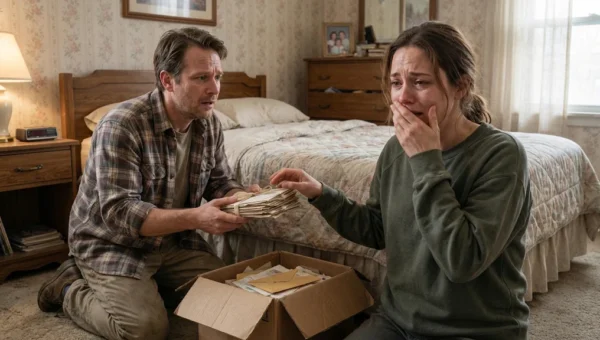
The bottom came loose with a soft click. Inside was a flat, taped-up envelope, yellow at the edges and stiff from age. I didn’t open it right away. I sat at the table with the envelope in front of me and thought about Darlene wrapping each plate in newspaper, folding it carefully, and asking me to use the set.
I called Owen. He was still upstairs.
He came down, saw the envelope, and said, “You found something?”
“I think so.”
I asked him to open it. He said I should do it, since I’d found it. I got annoyed at that. It felt like he wanted the answer without being part of the moment.
So I slit the tape with the butter knife.
There were two documents inside. One was the original deed to a family burial plot. The other was a signed agreement about how Darlene’s family property was to be divided. I read it once, then again, because the names and shares were written in old-fashioned legal language. But the main part was plain enough. The papers were meant to go to Beth if she met a condition Darlene had set.
The condition was tied to the family home. Darlene had promised Beth the papers, and the right to handle the burial plot, if Beth kept the old house in the family and maintained it while Darlene was alive. Beth had sold it after Darlene moved. Darlene saw that as the promise being broken.
Owen stared at the agreement. “I didn’t know this existed.”
I believed him. He had that uncomfortable, trapped look he got when he realized somebody else’s silence had saved him from choosing a side.
The paperwork didn’t explain everything. It didn’t explain why the old house had been sold, or what Darlene had told Beth when she agreed to it. It did show that the promise had been real, and that Darlene had decided the condition was no longer met. It also showed why Beth had walked out when she saw the china. The bowl wasn’t just part of the set. It was where Darlene had hidden the proof.
I called Darlene. I didn’t want to do it by phone, but I didn’t want her to come over and act as if the papers had simply appeared.
“I found the envelope,” I said.
There was a pause. “You opened it?”
“Yes.”
She asked me to bring the papers to her apartment. I told her I wasn’t doing that alone. Then I asked Owen to call Beth and tell her to come over too.
He looked at me like I was making things worse. I probably was, in the short term. But I wasn’t going to sit at my own table with a secret that belonged to all of them.
Darlene arrived first. She took one look at the bowl’s loose bottom and set her purse on the floor. Beth came ten minutes later. She didn’t take off her jacket. Owen stayed by the counter while I laid the deed and agreement on the table.
Darlene reached for the envelope. I put my hand on it.
“Tell us why you gave me the set,” I said.
She looked at me, then at Owen. “I wanted the papers found.”
“You could have called Beth,” I said.
“I did.”
Beth let out a short breath through her nose. “You told me I’d get them if I kept the house.”
“You sold it.”
“I sold it after you said I could. You said you couldn’t keep it up.”
Darlene didn’t answer right away. She smoothed the paper towel beneath her coffee cup, even though it wasn’t wrinkled.
Then she said, “I thought if the papers were in your house, Beth would finally have to face what she’d done.”
I looked at her. “You used my house to do it.”
She didn’t deny that. She said she didn’t know how else to make her children talk about it. She said Beth had avoided her calls and Owen had stayed out of it. She sounded tired, not cruel. That didn’t make what she’d done all right.
Owen stepped away from the counter. “You could’ve told me.”
Darlene said she didn’t want another argument. Beth said, “You made me promise, then changed what the promise meant.” She was crying by then, but she kept her voice low.
That was the part I understood. Beth had believed the papers were meant for her. Darlene believed Beth had broken the deal. Owen had spent years telling himself it wasn’t his business. And I’d been handed a box of china without being told I was holding the next argument.
I said I wouldn’t keep the set. I also wasn’t going to decide who deserved the papers. They needed to go to an estate lawyer who could check the deed and the agreement and put the records where they belonged. Darlene could choose the lawyer with Beth present. Owen could go too.
No one was happy. That was fine. I wasn’t looking for them to thank me.
We put the original documents back in the envelope. Darlene agreed to have a lawyer review them and make sure the burial plot deed was recorded or transferred correctly. The signed agreement would be handled as part of the family property records, not left hidden in a dish cabinet.
Owen and I carried the china boxes to the front hall. On the drive back from the lawyer’s office a few days later, he said he should have asked more questions years ago. I told him I wished he had. We both knew a single talk wouldn’t fix all of that, but he didn’t argue with me.
Beth and Darlene are still careful around each other. Owen and I are careful too, in a different way. We agreed we won’t accept another family gift without asking what comes with it. Maybe that sounds cold. I don’t mean it that way. I mean I’m done being surprised at my own table.
I washed the blue bowl, dried it with the striped towel, and packed it in a cardboard box by the front door, ready to go back where it came from.