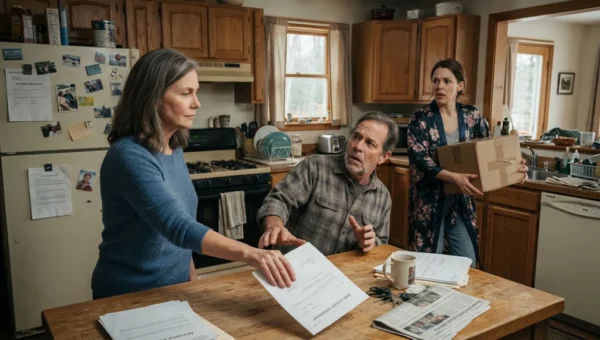
“Maybe we should skip it this year,” Ben said, folding the road map along its old crease. “Mara’s been acting strange.” It was the last normal thing he said before the trip stopped being a trip and turned into the place he’d spent most of his life trying not to see.
I’d heard versions of it before. Every year we drove up to see his sister, and every year Ben found a reason to make the visit shorter.
He said Mara didn’t like company. She said he never stayed long enough to talk. Their calls ended as soon as I came into the room, usually with Ben saying, “I’ve got to go,” before hanging up.
I’d let myself believe it was just how they were. I work at a hospital, and I’m used to families who can sit in the same room and still keep whole subjects between them. I should’ve known better. Still, when Ben said the house had been sold when he was a boy, I didn’t ask why he kept a ring of old brass keys in a box in our closet.
That was the first clue. I put it away.
The second was how fast Ben wanted to cancel. He’d already taken Friday off. The cooler was out. I’d written down the address for the same roadside place we used every year, though he could’ve driven there with his eyes closed. He kept folding and unfolding the map.
“She called twice yesterday,” he said. “She’s not making sense.”
“What did she say?”
“Nothing important.”
I looked at him. “Ben.”
He pressed the crease in the map with his thumb. “I don’t want to do this right now.”
The keys had been in a small wooden box with his old report cards and a baseball glove that smelled like dust. I’d noticed them years earlier. When I asked what they opened, he said, “Nothing now. The house was sold.” He’d said it like the subject was settled, so I treated it that way.
That night, after he went to bed, I found the box and took the keys out. I wasn’t proud of what I did next. I called Mara without telling him.
She answered on the fourth ring. I heard a TV murmuring in the background, then it went quiet.
“Is Ben there?” she asked.
“No. It’s just me.”
A pause. “He say we aren’t coming?”
“He thinks we should skip this year.”
“He always thinks that.”
I nearly said I was sorry. Instead, I asked what was going on. Mara let out a breath through her nose.
“Did he keep the keys to our childhood home?”
I looked down at the brass in my hand. “Yes.”
“Bring them when you come,” she said. “But don’t tell him.”
Her voice wasn’t strange. It was steady, almost careful. That bothered me more than if she’d sounded upset.
“Why?”
“I need you to see it.”
I didn’t sleep much. In the morning, Ben asked if I’d packed his blue sweater. I told him I couldn’t find it. I put the keys in my purse instead. Then I drove north alone, telling myself I’d turn back if the whole thing felt wrong.
The address was still on a folded card in the glove box. Ben had given it to me years ago, when he first took me to meet Mara. Back then, we’d stayed at a motel near town and he’d said the old house was long gone.
We visited his sister at a small rental nearby. I remember thinking the whole arrangement seemed odd, but I didn’t push.
This time I drove to the address. The house was there.
It sat on a quiet street a few miles from the lake, with long grass around the side and an old porch that needed work. I parked and checked the number twice. My hands were on the steering wheel. I could have left. I thought about Ben at home, finding the keys gone, and I kept sitting there for another minute.
Then I saw the light upstairs.
The back door was unlocked.
I called Mara’s name from the kitchen. The house smelled like old paper, dust, and something faintly sweet, like the hand soap my grandmother used to keep by the sink. A row of cups sat upside down on a towel. There was a calendar on the wall, old enough that I couldn’t tell when it had last been changed.
I didn’t touch anything. I did notice what was missing: no moving boxes, no sign that anyone had cleared the place. A child’s coat hung from a hook near the back door. The sleeves had gone stiff.
“Mara?” I called again.
“Up here.”
The stairs creaked under my feet. I kept the keys in my hand. At the top, the hallway was narrow, with family pictures along one wall. The faces were hard to make out through the dust on the glass, but I recognized Ben as a boy. He had a gap between his front teeth.
Mara stood at the far end holding a stack of photographs.
“You came,” she said.
“I did.”
She looked past me, as if checking the stairs. “He didn’t?”
“No.”
Her mouth tightened. “He said he’d come back.”
I didn’t know what to say to that. In one photo, Ben was maybe ten, standing beside a girl with one arm slung around his shoulders. Mara was younger than I’d pictured her. They both looked like kids who expected someone to call them in for dinner.
“What happened here?” I asked.
She lowered the pictures a little. “Our parents were in trouble. Money trouble. Other trouble. They left one night and didn’t come back.”
I had to ask. “And Ben?”
“An aunt took him. She told him the house was sold. She told him I’d gone somewhere else.” Mara touched the edge of the photo with her thumb. “I wouldn’t leave. I thought they’d come back if I kept the place.”
I didn’t correct her. There wasn’t anything to correct.
“Who looked after you?”
“People did, a little. Then they stopped. The house was still here. I was here.” She said it plainly, like she was explaining a work schedule.
For a long time, I thought Ben had just cut ties with his sister. I hadn’t understood that the whole story he told me had been built to keep this house out of his life. Mara had kept calling anyway. Ben had answered, but he’d ended the calls before I heard what she was asking him to do.
“He said it was sold,” I told her.
“I know.”
Her voice went thin on those two words. Then she moved the pictures against her chest, as if she needed to hold them there.
A car door slammed outside.
Mara turned toward the stairs. I knew the sound of Ben’s car. He must have realized the keys were missing, called Mara, and figured out where I’d gone. His steps came up fast, then stopped when he saw us.
For a second, none of us spoke.
Ben looked at the photographs in Mara’s arms. “You kept those?”
“I kept everything,” she said.
He reached for the railing. His face looked older than it had that morning.
“Mara,” he said. “I’m sorry.”
“You said you’d come.”
“I know.”
“You said the house was gone.”
“I know.”
She shook her head. “No, you don’t.”
He rubbed both hands over his face. “Aunt Dottie told me it was sold. She said it was better if I stopped asking. I was a kid. I believed her because I needed to believe it.”
“Why didn’t you come back?” I asked.
Ben looked at me, then at his sister. “I thought if I came back, I’d have to know what happened. I didn’t want to know. I was ashamed I left.”
“You were a child,” I said.
“I still left her here.”
Mara stared at him. “You got to leave.”
That was the part he couldn’t answer. He sat down on the stair, not looking at either of us. I wanted to be angry with him. I was angry. But I also knew he’d made a life by refusing to look at a part of himself he couldn’t fix when he was ten years old. That didn’t make the lie harmless.
I took the keys from my pocket and set them on the hallway table. They made a small, ordinary clink.
Ben looked at them. “I kept those all this time.”
“I know,” I said.
He hadn’t forgotten the house. He’d kept the keys while telling me it was gone. I didn’t know if that was a lie he chose each day, or one he’d said so many times it had become the only version he could live with. Either way, Mara had been left to hold the other version alone.
We didn’t solve it in that hallway. We did make a plan. The next morning, we called a doctor and arranged an evaluation for Mara. She needed more help than either of us could provide by dropping in once a year. She agreed to stay with a cousin nearby while we figured out safe care and what needed fixing at the house.
Ben called a local agent and asked about managing the property, then putting it on the market once Mara had a place to go. He didn’t say he was ready to sell. He said he was ready to stop pretending it had already happened.
On the ride home, he didn’t try to explain the past again. I didn’t tell him everything was fine. I said we’d handle one thing at a time, and he nodded.
Before we left, I opened the upstairs window because the room smelled shut up. The evening air moved the old photos on the sill. Ben and I walked out together toward the car under a darkening sky. The heavy brass keys stayed on the hallway table beside the open window.